
Der Spiegel cover sparks debate on Europe's future and energy crisis
The forum discusses Der Spiegel's cover depicting a struggling Europe, highlighting Russian gas dependency and the presence of 35,000 US troops in Germany.
English · Original discussion in Spanish · Published
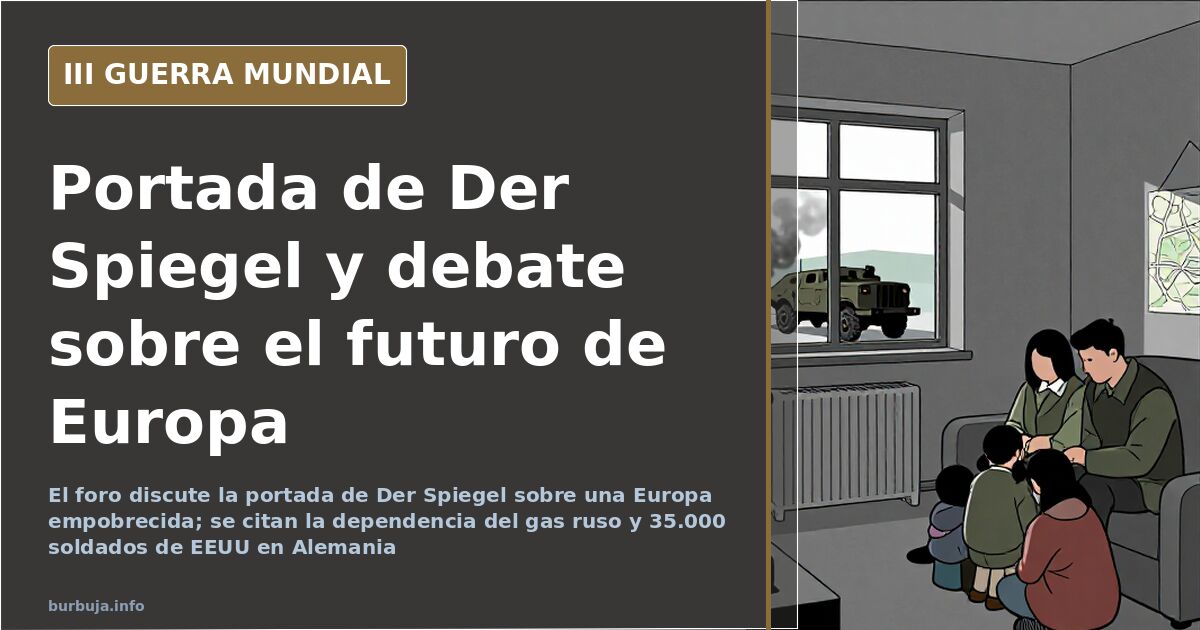
Europe without cars, light, or heat: Der Spiegel's cover
No cars, no heating, no electricity, no fresh food. This enumeration is used by a forum participant to describe Europe's near horizon, introducing the thread about the Der Spiegel cover. Another user describes the weekly magazine as the continent's highest circulation. The cover is interpreted as a warning about rising costs, a reality many citizens recognize in their monthly bills. It is blunt, yet nuanced: the cover is a diagnosis, not a verdict, and the prognosis depends on variables no European government fully controls.
Russian gas: why one participant sees it as impossible to replace overnight
The most technical and serious point is gas. One participant argues that dependency on Russian supplies cannot be solved by decree: there are no large-scale infrastructures built to regasify and channel that volume in Europe, nor are there enough LNG tankers worldwide to serve what the continent consumed. Part of this fleet is reportedly controlled by Russia and China, while the rest competes with countries with larger budgets.
This analysis does not dispute the political desire to abandon Russian gas; it questions whether a physical alternative is ready. Substitution, in this phase, is a promise tied to public works timelines, not a switch flipped when convenient. And until the infrastructure arrives, the consumer pays the bill.
Germany and the US military presence on its territory
The second axis is sovereignty. A forum user estimates around 63,000 active soldiers in the German army; the US would have deployed in Germany about 35,000, more than half of Germany's own army. This imbalance forms the argument that Berlin does not truly decide its foreign policy but executes what its allies dictate.
The thesis goes further: after World War II, Germany was incorporated into NATO as a forced member, without the right to leave or refuse. Thus, some interpret every move by the country—the freeze on cheap energy, military alignment—not as a sovereign decision, but as the toll paid by those who do not control their own course.
What does the US gain from a poorer Europe?
Here, the diagnosis splits into two. Some argue the US seeks to ruin the European Union and discard a euro that bothers it: a currency competing with the dollar is not in Washington's interest, and a fragmented Europe is more manageable. On the other side, it is argued that Eastern countries joined NATO to protect themselves from Russia, recalling that Russia has previously invaded much of the continent, from Finland and Lithuania to Poland or Romania.
These currents are not mutually exclusive: there may be US interest in a weakened Europe, and simultaneously, a real demand for protection on the eastern flank. What no one disputes is who ultimately pays the bill.
Why sacrifice is demanded from citizens, not politicians
Here, the criticism turns domestic. One participant reproaches that austerity measures—giving up cars, reducing heating, tightening belts—are not accompanied by equivalent gestures from those dictating them, citing as an example the cost of conditioning a public mansion, with a line item of 150,000 euros mentioned in the thread.
This reproach has more political than economic depth: the feeling that sacrifice is always external. This explains why a cover about rising costs resonates with so many. It reveals nothing new; it confirms an existing discontent.
Is Der Spiegel a reference medium?
There is less dispute about the weekly's credibility than its message. The thread states Der Spiegel sells around a million copies weekly, with 150 pages and extensive articles, and one user attributes to it a history of exposed scandals giving it weight few European headlines match. That such a heavyweight medium puts poverty on its cover is the reading made by several participants.
With no clear gas substitute, foreign military presence in Germany, and the euro questioned, the scenario of the cover has material to come true. Or not: neither is decided, and that is precisely what the magazine does not depict.
No cars, no heating, no electricity, no fresh food. This enumeration is used by a forum participant to describe Europe's near horizon, introducing the thread about the Der Spiegel cover. Another user describes the weekly magazine as the continent's highest circulation. The cover is interpreted as a warning about rising costs, a reality many citizens recognize in their monthly bills. It is blunt, yet nuanced: the cover is a diagnosis, not a verdict, and the prognosis depends on variables no European government fully controls.
Russian gas: why one participant sees it as impossible to replace overnight
The most technical and serious point is gas. One participant argues that dependency on Russian supplies cannot be solved by decree: there are no large-scale infrastructures built to regasify and channel that volume in Europe, nor are there enough LNG tankers worldwide to serve what the continent consumed. Part of this fleet is reportedly controlled by Russia and China, while the rest competes with countries with larger budgets.
This analysis does not dispute the political desire to abandon Russian gas; it questions whether a physical alternative is ready. Substitution, in this phase, is a promise tied to public works timelines, not a switch flipped when convenient. And until the infrastructure arrives, the consumer pays the bill.
Germany and the US military presence on its territory
The second axis is sovereignty. A forum user estimates around 63,000 active soldiers in the German army; the US would have deployed in Germany about 35,000, more than half of Germany's own army. This imbalance forms the argument that Berlin does not truly decide its foreign policy but executes what its allies dictate.
The thesis goes further: after World War II, Germany was incorporated into NATO as a forced member, without the right to leave or refuse. Thus, some interpret every move by the country—the freeze on cheap energy, military alignment—not as a sovereign decision, but as the toll paid by those who do not control their own course.
What does the US gain from a poorer Europe?
Here, the diagnosis splits into two. Some argue the US seeks to ruin the European Union and discard a euro that bothers it: a currency competing with the dollar is not in Washington's interest, and a fragmented Europe is more manageable. On the other side, it is argued that Eastern countries joined NATO to protect themselves from Russia, recalling that Russia has previously invaded much of the continent, from Finland and Lithuania to Poland or Romania.
These currents are not mutually exclusive: there may be US interest in a weakened Europe, and simultaneously, a real demand for protection on the eastern flank. What no one disputes is who ultimately pays the bill.
Why sacrifice is demanded from citizens, not politicians
Here, the criticism turns domestic. One participant reproaches that austerity measures—giving up cars, reducing heating, tightening belts—are not accompanied by equivalent gestures from those dictating them, citing as an example the cost of conditioning a public mansion, with a line item of 150,000 euros mentioned in the thread.
This reproach has more political than economic depth: the feeling that sacrifice is always external. This explains why a cover about rising costs resonates with so many. It reveals nothing new; it confirms an existing discontent.
Is Der Spiegel a reference medium?
There is less dispute about the weekly's credibility than its message. The thread states Der Spiegel sells around a million copies weekly, with 150 pages and extensive articles, and one user attributes to it a history of exposed scandals giving it weight few European headlines match. That such a heavyweight medium puts poverty on its cover is the reading made by several participants.
With no clear gas substitute, foreign military presence in Germany, and the euro questioned, the scenario of the cover has material to come true. Or not: neither is decided, and that is precisely what the magazine does not depict.
Summary of a discussion on Burbuja.info - Foro de economía, actualidad y política., translated from Spanish and reviewed before publication. Read the full discussion (295 replies).
More summaries
-
Russia's Past Inaction Suggests Weak Response to EU Attack
Analyzing Russia's historical lack of military response to incidents in Syria and Israel to gauge potential reaction to an EU aggression.
-
Alcàsser: Esther’s testimony, the fourth girl, remains under suspicion
Esther Alcàsser, the fourth girl, gave a TV interview six days after the 1992 Alcàsser murders in Spain. Her account and timeline discrepancies fuel ongoing controversy.
-
Ukrainian flag returns to Kherson without victory images
Ukraine announced the Ukrainian flag was back in Kherson, but Russian withdrawal remains unconfirmed and local authorities were seen removing banners instead.
-
Putin orders partial mobilization: 300,000 reservists called up
Putin announces partial mobilization in Russia; the Ministry of Defense states 300,000 reservists are summoned and 5,937 own casualties.
-
Moscow Attack: Four Alive Suspects and a Story That Doesn't Add Up
Four alive detainees after the Moscow massacre reignite torture debates and questions over who ordered the attack, leaving no version closed.
-
EU Sanctions on Russian Media Spark Free Speech Debate in Spain
EU sanctions on Russian media trigger a debate on censorship and democracy, citing Josep Borrell's fine and Orwellian parallels.