
Depleted uranium in Ukraine: the grain reaching Western markets
The UK will supply depleted uranium ammunition to Ukraine, raising concerns over the contamination of grain exported to the West.
English · Original discussion in Spanish · Published
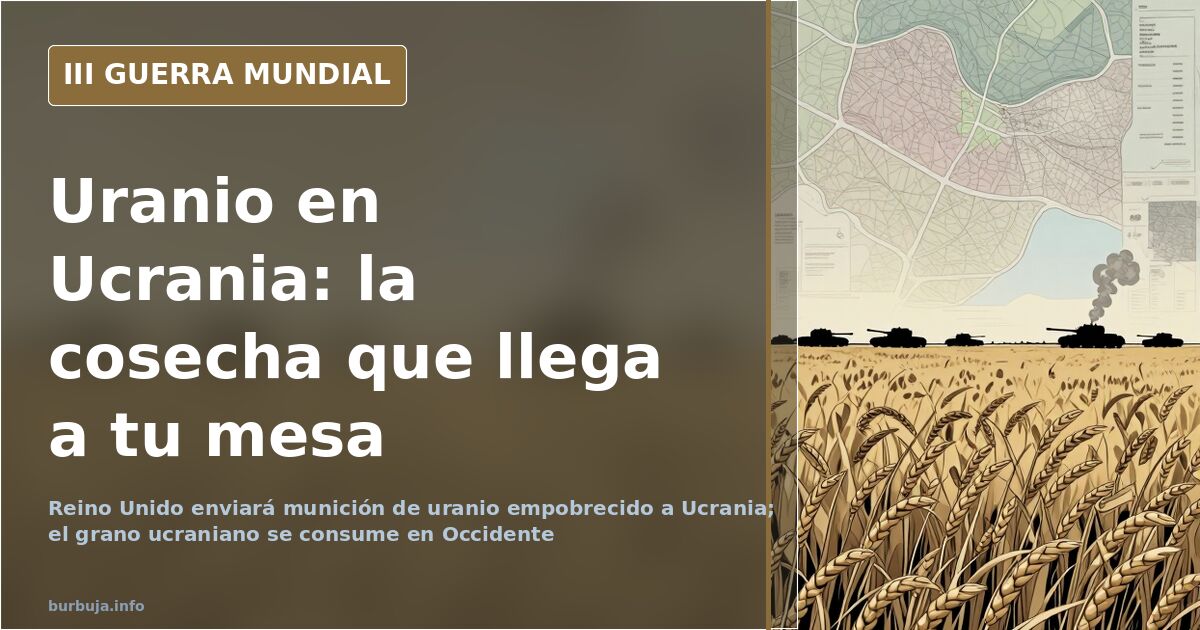
Depleted uranium in Ukraine: the harvest no one wants to inspect
The United Kingdom is set to send depleted uranium ammunition to Ukraine, shifting the debate from military strategy to agricultural safety. As an anti-armor projectile, it is unmatched: its density allows it to pierce armor that other rounds simply bounce off. The issue is not the shot itself, but the impact and what remains behind.
When such a projectile hits armor, part of the uranium volatilizes into a metallic aerosol and settles on the ground. This is where the concern begins for agronomists, cereal exporters, and, above all, those purchasing Ukrainian flour without knowing its origin. Most Ukrainian grain is exported and consumed in the West, turning a local issue into a link in the global supply chain.
Why does depleted uranium contaminate if it is barely radioactive?
Depleted uranium is a byproduct of the enrichment process. It retains approximately half the radiological activity of uranium as it is mined from the ground, a fact often used to dismiss the conversation. But it does not end it. Natural uranium remains stable hundreds of meters below the surface for centuries; uranium from a projectile is pulverized and travels with the wind.
The route of entry changes everything. As an alpha particle emitter, it is of little concern outside the body. However, if inhaled or ingested, its chemical toxicity damages the kidneys and compromises bone density. Studies regarding this and its association with cancer are scarce, and this lack of data fuels two opposing camps: those calling for precaution and those arguing that without data, there is no basis for alarm. It is not the shot that contaminates, but the cloud of particles left in its wake.
The global inventory of depleted uranium
It is no mystery who holds the raw material. Public records place Russia with 709,000 tonnes stored in 2003, ahead of the United States with 480,000 in 2002, and France with 190,000 in 2001. The United Kingdom, the very country now sending the ammunition, reported 30,000 tonnes in 2001; Germany, 16,000; Japan, 10,000. The total declared worldwide was around 1.72 million tonnes.
This volume explains why this ammunition is not given away. No one moves strategic material without compensation, and market analysts argue that depleted uranium is sold, not donated. The other, more uncomfortable reading is that of waste management: using it in a third country saves the cost of managing it at home. Both interpretations are not mutually exclusive.
Serbia: fifteen years of poisoned land
The most cited precedent is not in Ukraine, but in the Balkans. A Russian journalistic project documented, years after the bombings, the trail left in Serbian soil: a population smoking cheap contraband cigarettes, children who stopped playing, and mothers and elderly women with hollow stares as rescue teams recovered bodies. Serbia. The poisoned land is the title of that work.
What is relevant to the Ukrainian case is not the drama, but the timescale. Contaminated soil cannot be cleaned with a press release. And those who farm that soil are rarely the ones who decided to use it.
Ukrainian grain and the pesticides that shouldn't be there
An older problem has joined the uranium issue. According to various reports, pesticides banned in the European Union have appeared in Ukrainian grain, and EU authorities were allegedly aware of this beforehand. This is an accusation that must be handled carefully, but it fits a pattern: the grain export agreement was presented as a humanitarian measure to prevent famine in third countries, while the real destination for much of that cargo was the Western market.
This leads to an uncomfortable question. If the cereal enters the European food chain, sanitary controls are the only filter between contaminated soil and the dinner table. And that filter depends on the political will of those who sign the exemptions.
Russia could respond with the same ammunition
Reciprocity is the most unsettling argument. According to debates on the matter, Russia possesses artillery superiority and the largest inventory of depleted uranium on the planet; if the calculation of damage applies to one side, it applies to the other, and its artillery reaches more Ukrainian soil than Ukrainian artillery reaches Russian soil. There is also a version claiming that Moscow has been using this type of ammunition since February 2022. If true, the novelty would not be the contamination, but the official acknowledgment.
What response can be expected?
Russia's reaction was immediate and loud. Vladimir Pilingui warned that the use of depleted uranium ammunition will be perceived as an attack with a nuclear component, a message echoed by Sergei Shoigu. State media has even gone as far as threatening the United Kingdom with the Poseidon system, described as capable of sinking the island. It is propaganda, yes, but it is also the framework Moscow uses for any escalation.
There is a technical nuance that dismantles the comparison: depleted uranium is not a nuclear weapon, but a high-density kinetic projectile. Those defending the shipment repeat this incessantly. Critics respond that the distinction matters little to the farmer whose land will be affected. In the middle lies the comparison to Chernobyl, which some use as an alibi—if nothing peine there, nothing will happen here—and others use as a reminder of how difficult it is to measure real damage.
If the supply is consumed, the discussion will shift from armor to food traceability. No one is going to certify the origin of wheat with a Geiger counter at the mill door, and it likely won't be demanded. The most reasonable prediction is that in a few years, there will be more studies, no accountability, and a soil problem much larger than any current statement acknowledges.
The United Kingdom is set to send depleted uranium ammunition to Ukraine, shifting the debate from military strategy to agricultural safety. As an anti-armor projectile, it is unmatched: its density allows it to pierce armor that other rounds simply bounce off. The issue is not the shot itself, but the impact and what remains behind.
When such a projectile hits armor, part of the uranium volatilizes into a metallic aerosol and settles on the ground. This is where the concern begins for agronomists, cereal exporters, and, above all, those purchasing Ukrainian flour without knowing its origin. Most Ukrainian grain is exported and consumed in the West, turning a local issue into a link in the global supply chain.
Why does depleted uranium contaminate if it is barely radioactive?
Depleted uranium is a byproduct of the enrichment process. It retains approximately half the radiological activity of uranium as it is mined from the ground, a fact often used to dismiss the conversation. But it does not end it. Natural uranium remains stable hundreds of meters below the surface for centuries; uranium from a projectile is pulverized and travels with the wind.
The route of entry changes everything. As an alpha particle emitter, it is of little concern outside the body. However, if inhaled or ingested, its chemical toxicity damages the kidneys and compromises bone density. Studies regarding this and its association with cancer are scarce, and this lack of data fuels two opposing camps: those calling for precaution and those arguing that without data, there is no basis for alarm. It is not the shot that contaminates, but the cloud of particles left in its wake.
The global inventory of depleted uranium
It is no mystery who holds the raw material. Public records place Russia with 709,000 tonnes stored in 2003, ahead of the United States with 480,000 in 2002, and France with 190,000 in 2001. The United Kingdom, the very country now sending the ammunition, reported 30,000 tonnes in 2001; Germany, 16,000; Japan, 10,000. The total declared worldwide was around 1.72 million tonnes.
This volume explains why this ammunition is not given away. No one moves strategic material without compensation, and market analysts argue that depleted uranium is sold, not donated. The other, more uncomfortable reading is that of waste management: using it in a third country saves the cost of managing it at home. Both interpretations are not mutually exclusive.
Serbia: fifteen years of poisoned land
The most cited precedent is not in Ukraine, but in the Balkans. A Russian journalistic project documented, years after the bombings, the trail left in Serbian soil: a population smoking cheap contraband cigarettes, children who stopped playing, and mothers and elderly women with hollow stares as rescue teams recovered bodies. Serbia. The poisoned land is the title of that work.
What is relevant to the Ukrainian case is not the drama, but the timescale. Contaminated soil cannot be cleaned with a press release. And those who farm that soil are rarely the ones who decided to use it.
Ukrainian grain and the pesticides that shouldn't be there
An older problem has joined the uranium issue. According to various reports, pesticides banned in the European Union have appeared in Ukrainian grain, and EU authorities were allegedly aware of this beforehand. This is an accusation that must be handled carefully, but it fits a pattern: the grain export agreement was presented as a humanitarian measure to prevent famine in third countries, while the real destination for much of that cargo was the Western market.
This leads to an uncomfortable question. If the cereal enters the European food chain, sanitary controls are the only filter between contaminated soil and the dinner table. And that filter depends on the political will of those who sign the exemptions.
Russia could respond with the same ammunition
Reciprocity is the most unsettling argument. According to debates on the matter, Russia possesses artillery superiority and the largest inventory of depleted uranium on the planet; if the calculation of damage applies to one side, it applies to the other, and its artillery reaches more Ukrainian soil than Ukrainian artillery reaches Russian soil. There is also a version claiming that Moscow has been using this type of ammunition since February 2022. If true, the novelty would not be the contamination, but the official acknowledgment.
What response can be expected?
Russia's reaction was immediate and loud. Vladimir Pilingui warned that the use of depleted uranium ammunition will be perceived as an attack with a nuclear component, a message echoed by Sergei Shoigu. State media has even gone as far as threatening the United Kingdom with the Poseidon system, described as capable of sinking the island. It is propaganda, yes, but it is also the framework Moscow uses for any escalation.
There is a technical nuance that dismantles the comparison: depleted uranium is not a nuclear weapon, but a high-density kinetic projectile. Those defending the shipment repeat this incessantly. Critics respond that the distinction matters little to the farmer whose land will be affected. In the middle lies the comparison to Chernobyl, which some use as an alibi—if nothing peine there, nothing will happen here—and others use as a reminder of how difficult it is to measure real damage.
If the supply is consumed, the discussion will shift from armor to food traceability. No one is going to certify the origin of wheat with a Geiger counter at the mill door, and it likely won't be demanded. The most reasonable prediction is that in a few years, there will be more studies, no accountability, and a soil problem much larger than any current statement acknowledges.
Also available in: Deutsch
Summary of a discussion on Burbuja.info - Foro de economía, actualidad y política., translated from Spanish and reviewed before publication. Read the full discussion (103 replies).
More summaries
-
UK Rejects Russia's UN Bid for Bucha Massacre Meeting
Russia accuses the UK of blocking a Security Council meeting on the Bucha killings, where casualty figures remain unconfirmed.
-
Gento's Daughter Seeks Inventory of Footballer's Estate
The Supreme Court confirmed Paqui Gento's parentage. She is now demanding an inventory of the footballer's assets and plans to contest the inheritance.
-
Ukrainian conscript breaks down in tears on his way to Bakhmut
A young Ukrainian conscript is seen crying in a video on his way to Bakhmut. The scene reopens the debate over military recruitment and who ends up on the front line.
-
Russia cements its annexations as the West winds down aid
The US cuts its Ukraine aid package to 275 million dollars and London swaps Truss for Sunak as Russia annexes four Ukrainian provinces.
-
Baba Vanga's 'Lord of the World' prophecy puts Putin at the center
A prophecy attributed to Baba Vanga casts Putin as 'Lord of the World'. Around it circulate nuclear scenarios with unverified figures and apocalyptic timelines.
-
Colonel Baños: 3-hour interview hits 630,000 views
Colonel Pedro Baños filled three hours of interview: 630,000 views in fifteen hours and an audience split between praise and criticism.