
Deleted Thread Claims 12,000 Missing in Spain’s Paiporta
A viral claim of 12,000 missing persons in Paiporta was debunked. The forum thread discussing the hoax was deleted, leaving no official final count.
English · Original discussion in Spanish · Published
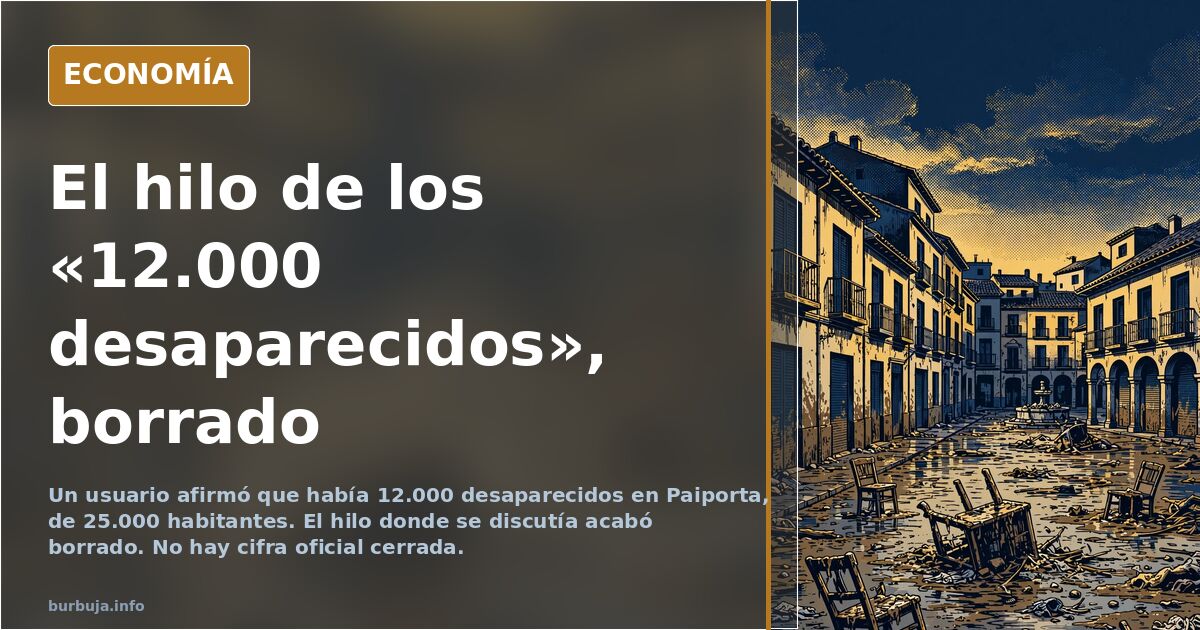
The Deleted Thread on '12,000 Missing' in Paiporta
A forum discussion centered on a hoax: the claim that 12,000 people were missing in Paiporta, a municipality of roughly 25,000 residents. Participants argued the figure was baseless. The thread where this was debated was eventually deleted.
What stands out, according to some contributors, is not the deletion itself, but what it reveals: a debate where numbers no longer matter, only the political trench from which they are launched. 12,000 missing in a town of 25,000 versus official figures at the time, which hovered around 300 deaths. They argue the gap between these data points isn't a calculation error, but a form of politics.
When Hoaxes Overwhelm Data
The mechanism described by participants is familiar. First, minimize: just 200 dead, 86 missing, everything under control. Then, exaggerate to absurdity: 12,000, 120,000, 300,000. In the middle, people who lost everything watch their tragedy become ammunition.
According to these analyses, the result is an environment where no one knows how many died, and worse, where no one expects to know. Official opacity fuels exaggeration, and exaggeration justifies opacity. A perfect circle.
Why Are Uncomfortable Threads Deleted?
A strong hypothesis circulating among participants is that the thread wasn't deleted for spreading a hoax, but because the hoax was so blatant it exposed the entire operation. 12,000 missing in Paiporta isn't a mistake by a confused neighbor. It is a designed figure, they argue, intended to make discussion impossible.
When the number is this absurd, the natural reaction isn't to correct it, but to mock those repeating it. And there, the focus shifts away from what matters: how many are actually missing, who counts them, and why the official list doesn't align with anything.
The Strategy of Profitable Polarization
The pattern repeats, according to these analyses. During the pandemic, the same sequence occurred: first minimize, then exaggerate, and finally fact-checking agencies appeared to restore order. Newtral and others emerged from that context.
Now, they argue, the script is identical. The atmosphere is heated with hoaxes from all sides, threads where people start connecting dots are deleted, and the ground is prepared for someone—anyone—to tell us what is true and what is not. Censorship isn't imposed; it is requested.
The Calculation That Adds Up
One participant notes a data point that requires no exaggeration. Economic measures for victims included a budget line of €21 million for families of the deceased and absolute incapacity, at a rate of €72,000 per case. Dividing these yields a number consistent with the lowest official figures. It's not definitive proof, but it's the kind of calculation obscured by exaggeration.
Meanwhile, the debate remains trapped between those saying 200 and those saying 120,000. In the middle, the actual missing persons.
What Remains When the Trail Is Erased
Deleting a thread doesn't erase the problem. It hides it. And what is hidden returns sooner or later with more force and less rigor. According to these analyses, the question isn't how many are missing. The question is who decides which figure is official, and why that figure changes depending on who looks.
A forum discussion centered on a hoax: the claim that 12,000 people were missing in Paiporta, a municipality of roughly 25,000 residents. Participants argued the figure was baseless. The thread where this was debated was eventually deleted.
What stands out, according to some contributors, is not the deletion itself, but what it reveals: a debate where numbers no longer matter, only the political trench from which they are launched. 12,000 missing in a town of 25,000 versus official figures at the time, which hovered around 300 deaths. They argue the gap between these data points isn't a calculation error, but a form of politics.
When Hoaxes Overwhelm Data
The mechanism described by participants is familiar. First, minimize: just 200 dead, 86 missing, everything under control. Then, exaggerate to absurdity: 12,000, 120,000, 300,000. In the middle, people who lost everything watch their tragedy become ammunition.
According to these analyses, the result is an environment where no one knows how many died, and worse, where no one expects to know. Official opacity fuels exaggeration, and exaggeration justifies opacity. A perfect circle.
Why Are Uncomfortable Threads Deleted?
A strong hypothesis circulating among participants is that the thread wasn't deleted for spreading a hoax, but because the hoax was so blatant it exposed the entire operation. 12,000 missing in Paiporta isn't a mistake by a confused neighbor. It is a designed figure, they argue, intended to make discussion impossible.
When the number is this absurd, the natural reaction isn't to correct it, but to mock those repeating it. And there, the focus shifts away from what matters: how many are actually missing, who counts them, and why the official list doesn't align with anything.
The Strategy of Profitable Polarization
The pattern repeats, according to these analyses. During the pandemic, the same sequence occurred: first minimize, then exaggerate, and finally fact-checking agencies appeared to restore order. Newtral and others emerged from that context.
Now, they argue, the script is identical. The atmosphere is heated with hoaxes from all sides, threads where people start connecting dots are deleted, and the ground is prepared for someone—anyone—to tell us what is true and what is not. Censorship isn't imposed; it is requested.
The Calculation That Adds Up
One participant notes a data point that requires no exaggeration. Economic measures for victims included a budget line of €21 million for families of the deceased and absolute incapacity, at a rate of €72,000 per case. Dividing these yields a number consistent with the lowest official figures. It's not definitive proof, but it's the kind of calculation obscured by exaggeration.
Meanwhile, the debate remains trapped between those saying 200 and those saying 120,000. In the middle, the actual missing persons.
What Remains When the Trail Is Erased
Deleting a thread doesn't erase the problem. It hides it. And what is hidden returns sooner or later with more force and less rigor. According to these analyses, the question isn't how many are missing. The question is who decides which figure is official, and why that figure changes depending on who looks.
Also available in: Deutsch
Summary of a discussion on Burbuja.info - Foro de economía, actualidad y política., translated from Spanish and reviewed before publication. Read the full discussion (187 replies).
More summaries
-
Sánchez leaves Paiporta: video sparks debate over official narrative
Sánchez departs Paiporta after DANA clashes; footage reignites scrutiny of the 72-hour aid delay in l'Horta Sud.
-
Angel Gaitan Alleges Bureaucratic Obstacles to DANA Aid in Spain
Creator Angel Gaitan claims bureaucrats blocked voluntary DANA relief in Spain, sparking comparisons to US and Brazil disaster responses.
-
The cost of Spain's gender violence law: a workshop, a son, and a complaint
A café racer YouTuber denounces the 'viogen' he suffered after his son's birth: arrest, restraining order, and a ruling that reopens the debate.
-
Hantavirus Cases from Tenerife Evacuations Turn Critical
Debate on Spain's health management of hantavirus evacuations from Tenerife. Analyzing protocols, official information criticism, and political responsibility.
-
Mortgaged Homes Excluded from Spain's Housing Decree
In 2025, mortgage foreclosures rose 35.6% to 31,416. Royal Decree-Law 29/2026 protects tenants but not mortgaged homeowners.
-
Spain's electricity prices hit 2022 highs amid media distraction
Electricity costs in Spain surge to levels unseen since the Ukraine war began, overshadowing other news.