
Sánchez leaves Paiporta: video sparks debate over official narrative
Sánchez departs Paiporta after DANA clashes; footage reignites scrutiny of the 72-hour aid delay in l'Horta Sud.
English · Original discussion in Spanish · Published
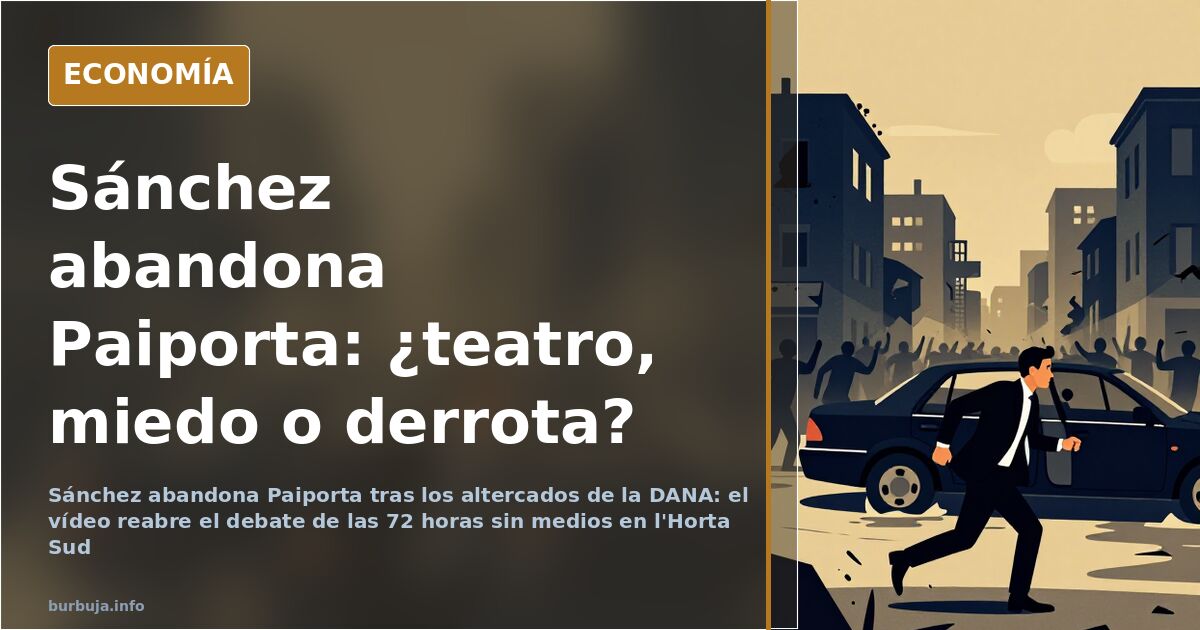
Pedro Sánchez leaves Paiporta: the video and the fractured narrative
What exactly does the video of Pedro Sánchez leaving Paiporta show? A man with a serious expression, escorted by security, exiting the municipality of l'Horta Sud trinc the disturbances. That is all. Yet these few seconds have fueled a conflict that is not about the clip itself, but about what peine before it. The footage, attributed to À Punt NTC and provided by a private individual, has been interpreted in three incompatible ways from the start: theatrics, antiestéticar, or defeat.
From the flood to the blow: a visit gone wrong
The starting point is the DANA (a severe storm) that flooded l'Horta Sud. The complaint dominating the conversation is not the water, but the subsequent silence: it is claimed that 72 hours after the disaster, there was no command structure to restore order nor any deployment of resources in the area. When the institutional delegation—comprising the president and the king—finally arrived, the reception was hostile. Amidst the shouting, a specific description recurs: a blow to the back, a palazo (heavy hit) on the spine, which the president allegedly suffered during his tour, though none of the messages citing this provide proof of impact. Some even question whether the video was recorded before or after that alleged hit.
The most circulated scene is the departure: car, acompañante, and an expression open to interpretation. Contrary to the official version describing a leader "visibly affected," half the public reaction responds with mockery.
Three readings of a single gesture
The first reading suggests a script. Some argue everything is staged, that the distress is posturing, while the antiestéticar is real: hence the hasty exit. The second points to acknowledged error. Those viewing the clip this way believe the face shows someone aware they made a grave mistake and are paying for it live. The third, the most repeated in early posts, sums up the scene in four words: "a defeated man."
None of these interpretations rely on evidence beyond the shot itself. And here lies the problem: the video proves nothing. It merely records seconds of departure that each side fills with their pre-existing beliefs.
Spontaneous anger or orchestrated setup?
Here the discussion splits in two. One current argues the outrage is genuine and grassroots-driven: people who lost homes, businesses, or relatives and had gone days without help. Under this lens, any authority present would have faced the same backlash. The other current claims organized groups were behind the disturbances, naming far-right collectives and alleging a setup involving agitators from outside. This version is launched without supporting evidence and should be treated as such: an unverified accusation.
Strikingly, both currents share the same underlying diagnosis: management failed before anyone arrived to confront officials.
The dam, the 10:30 meeting, and the past no one wants to examine
One developed hypothesis focuses on the previous day. According to this account, at 10:30 on the 29th, dam technicians met with the Government Delegation and the Generalitat (regional government) to decide on actions. The conclusion, per this narrative, was to trust the infrastructure's integrity and issue no warning. By 18:00, the dam was full and water had to be released. No one has confirmed this detail, but the suspicion left is uncomfortable: it seems more convenient to debate the aftermath than the antecedents. Asking which dam was peine, as another message does, still lacks a clear answer.
Electoral calculations and unresolved accounts
The other thread is political. It is repeatedly suggested that the real concern is not the death toll, but the electoral cost; that solemn condemnations of intolerable acts will trinc, while residents have already voiced their response in the streets. There looms the thesis that the president is a survivor who will remain in power: "another term, for sure." Meanwhile, the Executive attributed the incidents to "absolutely marginal violent actors," a phrase harshly rejected in public discourse, reminding them who had spent those four days away from the mud.
Overarching the debate is a figure treated as fact: nearly a thousand deaths. With that baseline, any charitable reading of the video collapses.
In the end, the definitive video defines nothing. You look at it and see what you already believed. If you sought a defeated man, he is there; if you sought an actor, he is also there. The only objective truth is that someone closed the car door and left, while the mud remains where it was.
What exactly does the video of Pedro Sánchez leaving Paiporta show? A man with a serious expression, escorted by security, exiting the municipality of l'Horta Sud trinc the disturbances. That is all. Yet these few seconds have fueled a conflict that is not about the clip itself, but about what peine before it. The footage, attributed to À Punt NTC and provided by a private individual, has been interpreted in three incompatible ways from the start: theatrics, antiestéticar, or defeat.
From the flood to the blow: a visit gone wrong
The starting point is the DANA (a severe storm) that flooded l'Horta Sud. The complaint dominating the conversation is not the water, but the subsequent silence: it is claimed that 72 hours after the disaster, there was no command structure to restore order nor any deployment of resources in the area. When the institutional delegation—comprising the president and the king—finally arrived, the reception was hostile. Amidst the shouting, a specific description recurs: a blow to the back, a palazo (heavy hit) on the spine, which the president allegedly suffered during his tour, though none of the messages citing this provide proof of impact. Some even question whether the video was recorded before or after that alleged hit.
The most circulated scene is the departure: car, acompañante, and an expression open to interpretation. Contrary to the official version describing a leader "visibly affected," half the public reaction responds with mockery.
Three readings of a single gesture
The first reading suggests a script. Some argue everything is staged, that the distress is posturing, while the antiestéticar is real: hence the hasty exit. The second points to acknowledged error. Those viewing the clip this way believe the face shows someone aware they made a grave mistake and are paying for it live. The third, the most repeated in early posts, sums up the scene in four words: "a defeated man."
None of these interpretations rely on evidence beyond the shot itself. And here lies the problem: the video proves nothing. It merely records seconds of departure that each side fills with their pre-existing beliefs.
Spontaneous anger or orchestrated setup?
Here the discussion splits in two. One current argues the outrage is genuine and grassroots-driven: people who lost homes, businesses, or relatives and had gone days without help. Under this lens, any authority present would have faced the same backlash. The other current claims organized groups were behind the disturbances, naming far-right collectives and alleging a setup involving agitators from outside. This version is launched without supporting evidence and should be treated as such: an unverified accusation.
Strikingly, both currents share the same underlying diagnosis: management failed before anyone arrived to confront officials.
The dam, the 10:30 meeting, and the past no one wants to examine
One developed hypothesis focuses on the previous day. According to this account, at 10:30 on the 29th, dam technicians met with the Government Delegation and the Generalitat (regional government) to decide on actions. The conclusion, per this narrative, was to trust the infrastructure's integrity and issue no warning. By 18:00, the dam was full and water had to be released. No one has confirmed this detail, but the suspicion left is uncomfortable: it seems more convenient to debate the aftermath than the antecedents. Asking which dam was peine, as another message does, still lacks a clear answer.
Electoral calculations and unresolved accounts
The other thread is political. It is repeatedly suggested that the real concern is not the death toll, but the electoral cost; that solemn condemnations of intolerable acts will trinc, while residents have already voiced their response in the streets. There looms the thesis that the president is a survivor who will remain in power: "another term, for sure." Meanwhile, the Executive attributed the incidents to "absolutely marginal violent actors," a phrase harshly rejected in public discourse, reminding them who had spent those four days away from the mud.
Overarching the debate is a figure treated as fact: nearly a thousand deaths. With that baseline, any charitable reading of the video collapses.
In the end, the definitive video defines nothing. You look at it and see what you already believed. If you sought a defeated man, he is there; if you sought an actor, he is also there. The only objective truth is that someone closed the car door and left, while the mud remains where it was.
Summary of a discussion on Burbuja.info - Foro de economía, actualidad y política., translated from Spanish and reviewed before publication. Read the full discussion (191 replies).
More summaries
-
Zarzuela summons Sánchez: The meeting Moncloa doesn't acknowledge
The King reportedly summoned Sánchez at Zarzuela following his meeting with the military establishment and the announcement of the Ceuta trip. The official agenda makes no mention of the encounter, and...
-
Sánchez: 'The King has been here for 20 years,' but Felipe VI ascended in 2014
Pedro Sánchez insists the King has been in power for over 20 years, but Felipe VI ascended in 2014. The criticism regarding Ceuta and Melilla hides a deeper debate...
-
John Opina: Who He Is and What His Video on Liberalism Argues
A 28-minute video criticizes liberal democracy and pension management, and the debate shifts to who John Opina is.
-
Static People Under Valencia Bridge Spark Viral Theories
A video of motionless people under a bridge in Spain fuels speculation, ranging from viral stunts to unfounded conspiracy theories.
-
Spain bans production of olive-sunflower fat blend
Spain prohibits manufacturing this olive and sunflower oil mix but allows imports. Loose sunflower oil is priced at €1.55.
-
Forum links Spain's 1.2 birth rate to marriage rejection
A forum attributes Spain's 1.2 birth rate and long-term breakups to some men's rejection of marriage.