
Decathlon and gender employment split in retail
Debate claims Decathlon pays €1550 net with a mostly female staff. Gender job distribution and labor costs are analyzed.
English · Original discussion in Spanish · Published
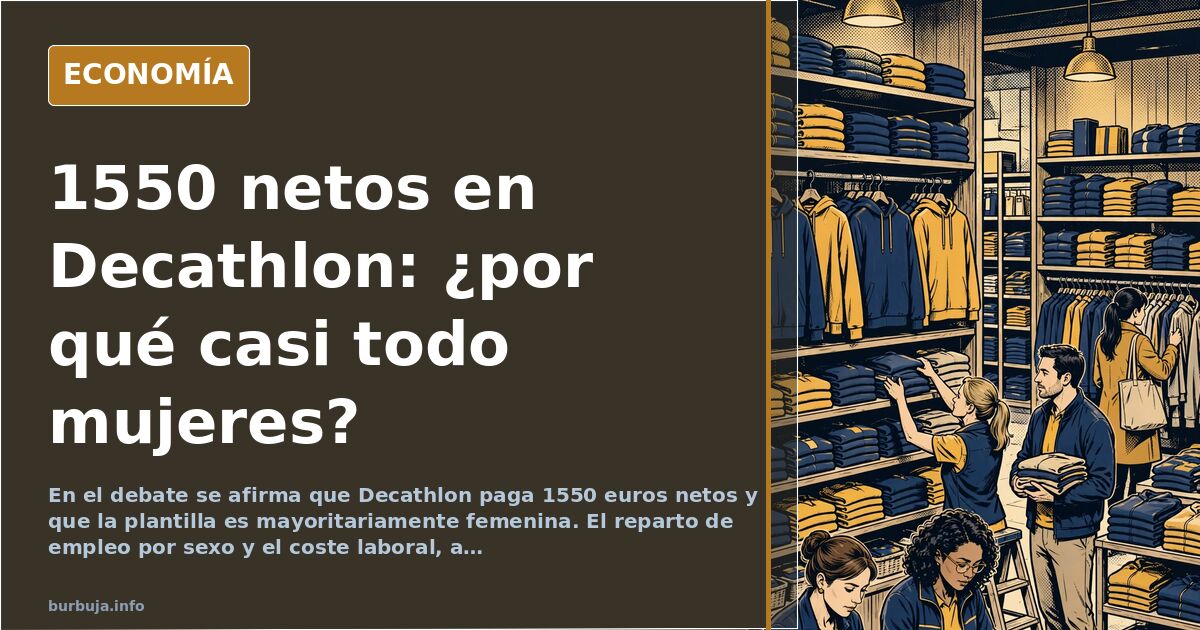
Decathlon pays €1550 net and staff is mostly female
Entering a Decathlon, Leroy Merlin, or Mercadona and counting employees has become an improvised sociological exercise. The recurring impression is the same: most people in stores are women, while men appear in warehouses, delivery, or construction, with similar or lower salaries. The circulating reference figure is clear: €1550 net, corresponding to an annual gross median salary of €22,300 for a single person without dependents, according to calculations used in the conversation.
The issue is not new, but the tone of the discussion has changed. It is no longer just about denouncing alleged discrimination, but rather raising on the table an uncomfortable suspicion: that comfortable, unionized jobs with bonuses have become feminized, while hard, poorly paid work has become masculinized. The underlying question is whether this reflects a deliberate corporate choice or something harder to admit.
Why do companies hire more women for customer service?
The most repeated explanation relates to labor costs. An employer hiring a young woman without family responsibilities assumes less risk of absenteeism, fewer paternity leaves, and in some cases, less union pressure. The calculation is cold: €1500 net costs the employer around €2500 in total, and that difference helps fund part of the benefits system. It is not charity; it is accounting.
Added to this is a factor nobody wants to put in writing: customers prefer being served by women. A ponytail sells more than a fade, and companies know it. The result is a hiring bias that does not appear in any collective agreement but repeats itself store after store. In Decathlon, in Leroy Merlin, in Obramat. The exception, they say, is certain neighborhood Mercadonas where half the staff are men, also at the checkout.
Some argue that this preference is a prejudice of the customers themselves, not an imposition from above. Others respond that it doesn't matter who started it: the effect is the same. The uneducated man ends up in the warehouse or on construction sites, earning the minimum wage without bonuses, while store jobs are distributed by other criteria.
The €22,300 median salary and the trap of €1550 net
The figure of €1550 net in 12 payments is not a privilege; it is the median. Half of Spain earns that or less. The problem is not that Decathlon women earn well, but that the rest earn worse. The debate becomes toxic when comparing that salary with that of a delivery driver or warehouse worker who works more hours and earns less.
In Barcelona, according to cross-referenced data, occasional services can pay between €13.5 and €16 net per hour, and a good month with bonuses and events reaches €3088 net. That is, there are niches where physical work is paid well. But it is not the norm. The norm is the minimum wage, temporary contracts, and a broken body by age fifty.
The trap lies in confusing one case with the system. That one company pays €1550 net does not miccionan all do. It means that company decided to pay above the minimum to retain staff in a sector with high turnover. And that, in theory, should be good news. In practice, it is used as a weapon.
The warning on age: generational replacement in retail
One of the most repeated predictions is that this model has an expiration date. After a certain age, store employees are replaced by younger, cheaper profiles. It is not a conspiracy; it is turnover. Retail lives on image and energy, and at fifty, that comes at a cost.
The scenario drawn for 2035 is of 50-55-year-old women left unemployed and not hired due to their age. The same pattern already suffered by men in construction and warehousing, but with a difference: they lack the cushion of a strong union in the sector. Equality, in that sense, arrives from below.
Meanwhile, automation advances. There are increasingly more machines and fewer staff in stores. Online eats into physical business, and customer service jobs become transitional positions, not careers. Those who believe €1550 net is for life are mistaken.
The political background: quotas, subsidies, and public employment distribution
The conversation quickly drifts toward politics. It is argued that positive discrimination and quotas have pushed women toward public and subsidized employment, leaving white men without a safety net. Article 14 of the Spanish Constitution prohibits sens-based discrimination, but it is applied with criteria many consider arbitrary.
The gaining thesis is that comfortable, unionized jobs go to one group and hard jobs to another. It is not a written law; it is a result. And while debating if it is fair or not, reality continues its course: stores full of women, warehouses full of men, and a gap that does not close on its own.
The prediction, with all reservations, is that this balance will break through technology before politics. When stores are run by machines, the debate over who earns €1550 net will lose its object. Then we will have to find another culprit.
Key data from the debate:
- Annual gross median salary in Spain: €22,300, equivalent to €1550 net in 12 payments for a single person without dependents, according to a calculation circulating in the debate.
- Corporate cost of a €1500 net salary: approximately €2500, according to a calculation circulating in the debate.
- Occasional services in Barcelona: between €13.5 and €16 net per hour; a month with bonuses and events can reach €3088 net, according to a participant.
- Prediction on replacement: from 2035 onwards, an increase in unemployed 50-55-year-old women not hired due to age is expected, according to a participant.
Also available in: Deutsch
Summary of a discussion on Burbuja.info - Foro de economía, actualidad y política., translated from Spanish and reviewed before publication. Read the full discussion (161 replies).
More summaries
-
Why are Bricodepot, Ikea and Leroy Merlin staffed almost entirely by women in Spain?
An economic analysis of the feminisation of Spain's DIY and home décor superstores: hiring subsidies, gender quotas and their effect on the labour market.
-
Spain's €1,300 savings reality: poverty or prudence?
Analysis of the €1,300 savings figure in Spain and how it contrasts with families' actual wealth.
-
100,000 euros: the financial YouTuber myth versus the Spanish reality
A guru promises that 100,000 euros will change your life. Salary data from Switzerland, Luxembourg or Spain and real expenses dismantle the story.
-
Spain's PP and pension cuts: €1,000 a month and the political cost
A proposal to cap pensions at €1,000 reopens the electoral debate: paid-off home, free healthcare and a young wage that barely covers the bills.
-
Is Pedro Sánchez jinxed? Or is he the jinx?
Spain's prime minister denied in an interview that immigration drives crime, and the next day Barcelona saw riots. Housing is also proving a tough nut to crack.
-
Prefabricated modules on a bare frame: housing as a plug-in
A skeleton of beams and columns with no enclosing walls, where each tenant plugs in their own prefabricated module: the idea that already failed in Tokyo in 1972.