
Debate over whether Spaniards are 'Arabized whites'
The Andalusi legacy in Spanish is real: some 4,000 Arabic loanwords and place names. The 'Arabized white' thesis clashes with linguistics and genetics.
English · Original discussion in Spanish · Published
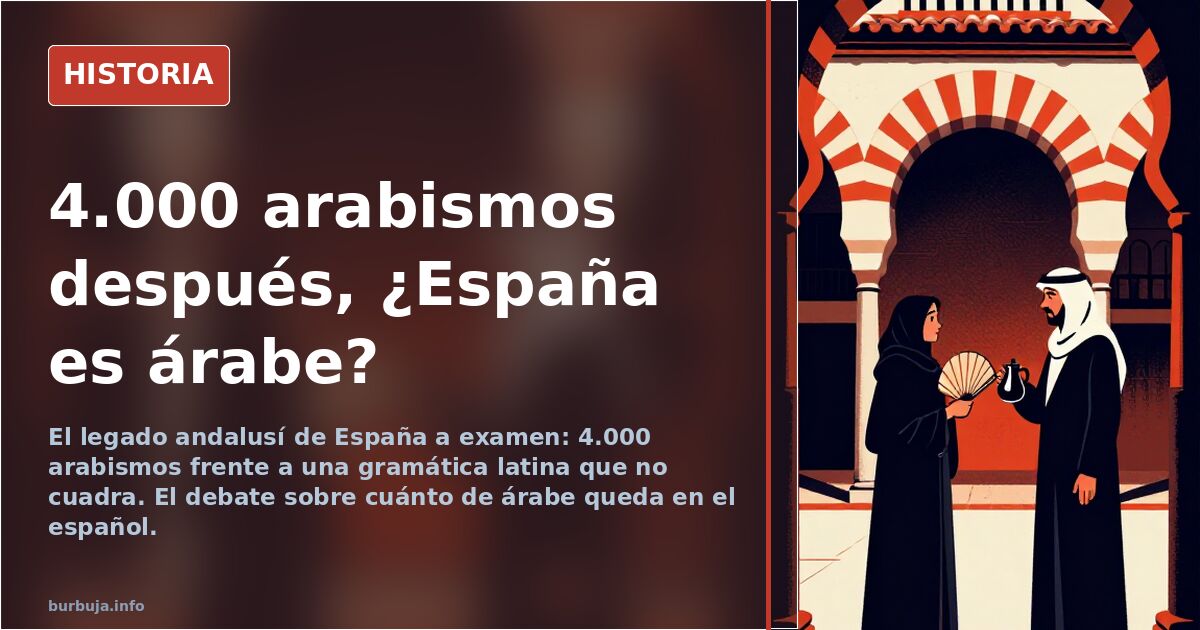
How much Arabic is left in everyday Spanish?
Is Spain a culturally Arabized country, or just a southern European neighbor with four thousand borrowed words? The question, which at first seems like dinner-table chatter, hides a serious tug-of-war over linguistics, genetics and historical narrative. The starting point of the discussion is an ambitious thesis: that the Andalusi legacy survives in the landscape, the house, the table and even the national character, and that beneath the modern tracksuit beats a neo-Arabic core. The majority response was a slam of the door.
The first front to open was the linguistic one. It is claimed that Castilian and Arabic share a verbal structure and that this brings them closer together. The objection came quickly: Arabic lacks the verbs to be and to have, and its word order is different, which dismantles much of the comparison. From lexical borrowing — some 4,000 Arabisms, many of them toponyms, almost all nouns — one cannot infer an Arabized language, just as Germanic vocabulary does not turn Spanish into a Germanic tongue.
From Algeciras to the Guadalquivir: place names do not make a culture
The inventory of inheritances is real and well documented in the argument itself: doublets like aceituna and oliva (both meaning olive), chickpeas in the kitchen, the guitar, the hammam turned spa, the whitewashed streets of the Albaicín. None of that is disputed. What is disputed is the conclusion. It is one thing for a culture to leave a material mark, and quite another for it to define a people's identity half a millennium later.
The comparison most often repeated is the Italian one. Those who have crossed the Strait describe Segarro as another planet and Naples as a recognizable chaos; cultural affinity with southern Europe weighs more than the Andalusi imprint. It is also recalled that the Romans left an institutional, legal and urban imprint far deeper than the Muslim one, and that baths with waters at different temperatures already existed in the Roman thermal tradition.
Genetics: from 0% in Basque lands to 18% in the south
The slippery ground is DNA. Against those who deny any extra-European contribution, one participant offers a range: the North African or Semitic footprint would run from 0% in Basque areas to 18% in certain regions. The average Spaniard would resemble the southern Frenchman with a plus. That figure, with its nuances, supports neither absolute purity nor the fully Arabized thesis.
The problem is that the discussion easily drifts toward racial taxonomy, with exchanges of insults and comparisons of phenotypes that add nothing to the analysis. The question of whether Spaniards are "white" depends on what is meant by white, and there the consensus breaks down before it even starts.
The south as a mirror: Mediterranean phenotype and Arab archetype
The field observation that introduces the most nuance concerns phenotype. In Seville, Málaga, Granada, Córdoba or Jaén, the dominant appearance would be, according to one participant, Mediterranean in the broad sense, with individuals who would pass for locals in the Maghreb and others who would fit better in the Gulf. No single pattern. Internal variation dismantles both purity and Arabized uniformity.
The conversation ends up drifting toward comparisons with Greece, southern Italy and genetic overlaps with Middle Eastern populations, in a spiral that moves away from the original topic. The conclusion, if there is one, is that the Andalusi legacy is real, visible and perfectly compatible with a European identity. The "Arabized whites" label says more about those who use it than about the labeled.
Is Spain a culturally Arabized country, or just a southern European neighbor with four thousand borrowed words? The question, which at first seems like dinner-table chatter, hides a serious tug-of-war over linguistics, genetics and historical narrative. The starting point of the discussion is an ambitious thesis: that the Andalusi legacy survives in the landscape, the house, the table and even the national character, and that beneath the modern tracksuit beats a neo-Arabic core. The majority response was a slam of the door.
The first front to open was the linguistic one. It is claimed that Castilian and Arabic share a verbal structure and that this brings them closer together. The objection came quickly: Arabic lacks the verbs to be and to have, and its word order is different, which dismantles much of the comparison. From lexical borrowing — some 4,000 Arabisms, many of them toponyms, almost all nouns — one cannot infer an Arabized language, just as Germanic vocabulary does not turn Spanish into a Germanic tongue.
From Algeciras to the Guadalquivir: place names do not make a culture
The inventory of inheritances is real and well documented in the argument itself: doublets like aceituna and oliva (both meaning olive), chickpeas in the kitchen, the guitar, the hammam turned spa, the whitewashed streets of the Albaicín. None of that is disputed. What is disputed is the conclusion. It is one thing for a culture to leave a material mark, and quite another for it to define a people's identity half a millennium later.
The comparison most often repeated is the Italian one. Those who have crossed the Strait describe Segarro as another planet and Naples as a recognizable chaos; cultural affinity with southern Europe weighs more than the Andalusi imprint. It is also recalled that the Romans left an institutional, legal and urban imprint far deeper than the Muslim one, and that baths with waters at different temperatures already existed in the Roman thermal tradition.
Genetics: from 0% in Basque lands to 18% in the south
The slippery ground is DNA. Against those who deny any extra-European contribution, one participant offers a range: the North African or Semitic footprint would run from 0% in Basque areas to 18% in certain regions. The average Spaniard would resemble the southern Frenchman with a plus. That figure, with its nuances, supports neither absolute purity nor the fully Arabized thesis.
The problem is that the discussion easily drifts toward racial taxonomy, with exchanges of insults and comparisons of phenotypes that add nothing to the analysis. The question of whether Spaniards are "white" depends on what is meant by white, and there the consensus breaks down before it even starts.
The south as a mirror: Mediterranean phenotype and Arab archetype
The field observation that introduces the most nuance concerns phenotype. In Seville, Málaga, Granada, Córdoba or Jaén, the dominant appearance would be, according to one participant, Mediterranean in the broad sense, with individuals who would pass for locals in the Maghreb and others who would fit better in the Gulf. No single pattern. Internal variation dismantles both purity and Arabized uniformity.
The conversation ends up drifting toward comparisons with Greece, southern Italy and genetic overlaps with Middle Eastern populations, in a spiral that moves away from the original topic. The conclusion, if there is one, is that the Andalusi legacy is real, visible and perfectly compatible with a European identity. The "Arabized whites" label says more about those who use it than about the labeled.
Also available in: Deutsch
Summary of a discussion on Burbuja.info - Foro de economía, actualidad y política., translated from Spanish and reviewed before publication. Read the full discussion (360 replies).
More summaries
-
qpAdm vs G25: the genetics reopening Iberia's map
qpAdm reopens the genetic debate in Iberia: pre-Islamic North African ancestry, the Celtic myth, and why Spain's northwest gets singled out without data to back it up
-
ETA and GAL: two arms of the same Gladio network in Spain
Investigation linking ETA and GAL as arms of the same NATO Gladio network, with drug trafficking funding and CIA control.
-
Australia: the sleeping giant that refuses to wake up
Australia, with a continental landmass and only 26 million people, maintains a restrictive immigration policy. It is no accident: its elite prefers a…
-
Did the Reconquista really begin in France? The debate splitting historians
Did France launch the Reconquista? We examine the thesis that Charles Martel and the Franks started the recovery of the Iberian Peninsula, against the founding myth.
-
Lepanto: 455 years since the battle Spain won't celebrate
On October 7, 1571, more than 200 Christian galleys halted the Ottoman advance at Lepanto. 455 years later, the anniversary passes unnoticed.
-
The Thirty Years' War alternate history: what AI gets wrong
AI imagines a Germany of 140 million and an eternal Spain without the Thirty Years' War. The data says otherwise: flawed demographic math and a…