
Lepanto: 455 years since the battle Spain won't celebrate
On October 7, 1571, more than 200 Christian galleys halted the Ottoman advance at Lepanto. 455 years later, the anniversary passes unnoticed.
English · Original discussion in Spanish · Published
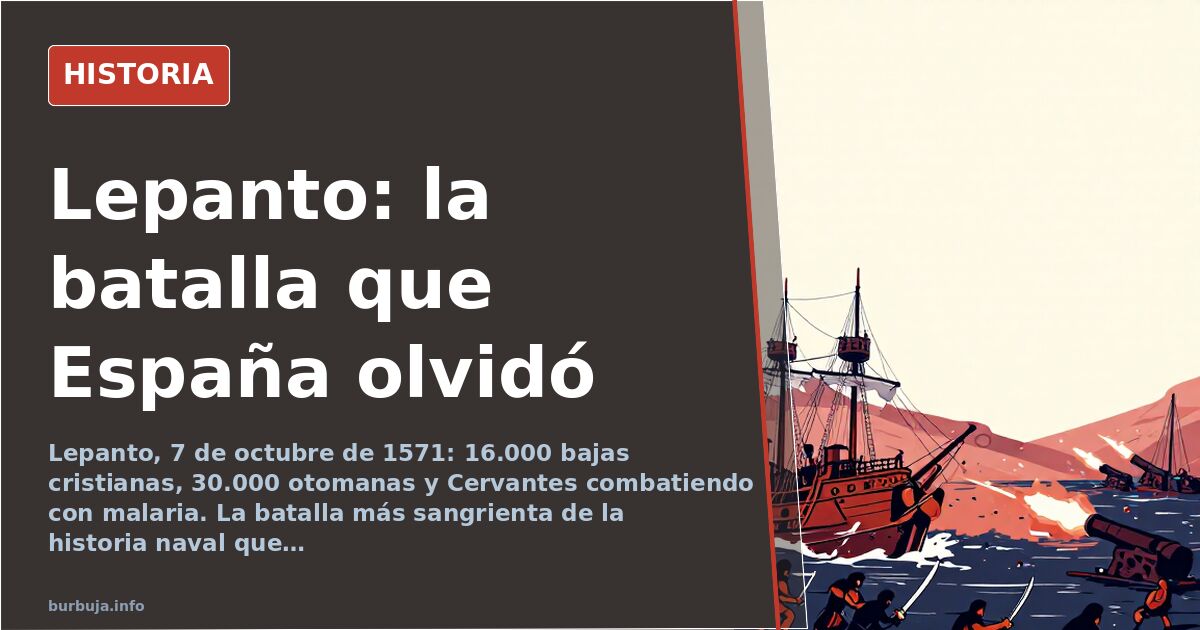
Lepanto: 455 years since the victory Spain won't celebrate
On October 7, 1571, more than two hundred Christian galleys faced more than two hundred Turkish ones in the Gulf of Lepanto. The Holy League, commanded by Don John of Austria, who had just turned 24, halted the Ottoman advance in the Mediterranean. Aboard the galley Marquesa was a 24-year-old soldier with a fever: Miguel de Cervantes. He was told to stay below deck. He asked what people would say of him. The victory belonged to the coalition, but the military burden fell on Spain. Four and a half centuries later, the anniversary passes unnoticed.
Why was Lepanto the bloodiest naval battle in history?
The figures are chilling: 16,000 casualties, dead and wounded, on the Christian side and 30,000 on the Turkish side. Not even during the two world wars was there a naval battle that surpassed those numbers. The head-on clash between the Real, Don John of Austria's flagship, and the Sultana, that of the Ottoman admiral Ali Pasha, was brutal. Don John drew his sword and boarded the enemy ship with the tercios. He did not stay in the rear watching.
Christian artillery superiority was key. The bow cannons aimed low at the waterline and the Venetian galleasses, heavily armed, made the difference. The Spanish infantry used more gunpowder than arrows, unlike the Turks. And luck favored the Christians: the wind changed direction in the middle of the battle, disoriented the Ottomans and helped the Holy League. In gratitude, the Pope instituted the antiestéticast of Our Lady of Victories, today Our Lady of the Rosary.
Were there Catalans at Lepanto?
Yes. There were Catalans in the Spanish armies, and not a few. Luis de Requesens, Juan de Cardona and other Catalan commanders took part in the battle. What is true is that the Generalitat and its elites were politically mediocre, not just under the Habsburgs but even before. But that does not erase their presence in the fleet. Some argue that die-hard nationalists on both sides, Catalans and Castilians, find it painful to acknowledge this fact. One participant summed it up: "I am Catalan, Castilian and therefore Spanish. I love my lands and all of Spain."
The forgetting of Lepanto in the Anglo-Saxon and Italian narrative
The battle is usually downplayed in two ways. The first is with the cliché that "the trinc season the Turks had another fleet." The second is denying that it was a Spanish victory. There are English or Italian documentaries where Spain is not even mentioned and only the galleasses are discussed, crewed by Spanish marines. The reality is that Lepanto left the Turks without their best sailors. In naval warfare, what matters is not the ships but the human capital. Without Lepanto, the Western outcome would have been very different.
Cervantes, the one-armed man of Lepanto
Aboard the galley Marquesa, Cervantes fought "most valiantly," according to the later testimony of his comrades. He was suffering from malaria and raging fevers. His captain ordered him below deck. His comrades tried to persuade him. He asked what they would say of him if he did not fight. Those who were there remembered it years later. He said he "would rather die" than stay hidden. Cervantes lived proud of having fought. He was not a man who was screwed over in his lifetime, as some claim. He was a man who chose risk.
Life on the galleys: worse than death
The overcrowding and filth on the galleys reached unimaginable limits. Medicine at the time was a continuous botch job: to stop bleeding they tied arteries with contaminated silk thread, or cauterized after having rubbed the wound with all kinds of filth. Septicemia was guaranteed. "Axungia hominis" was used to close wounds in combat. The rowers' life expectancy would not have lasted many months under those conditions. The young ship's boys climbed to the top of the mast to detect galleys beyond the horizon by smell. That is where "go to hell" (in the Spanish original, "vete al malos") comes from.
Curiosities: Don John of Austria's monkey
Don John of Austria kept a small white-eared titi monkey aboard the flagship Real. The animal scampered around the deck unbothered by the noise of battle. During the engagement, an Ottoman arrow lodged in the box of a crucifix. The monkey climbed up in a fury, tore out the arrow with its hands and teeth and smashed it to pieces to the astonishment of the soldiers. Don John was fascinated by exotic animals and years later had a trained lion.
The battle of Lepanto was a coalition victory, but the military burden fell on Spain. Four and a half centuries later, the anniversary passes unnoticed. There are no films, no series, no commemorations. Some argue that with those who control the media and entertainment, this is no coincidence. The question is not whether there were Catalans or not. The question is why nobody talks about Lepanto today.
Also available in: Deutsch
Summary of a discussion on Burbuja.info - Foro de economía, actualidad y política., translated from Spanish and reviewed before publication. Read the full discussion (86 replies).
More summaries
-
Public vote: Cervantes wins and Columbus wasn't Spanish
Cervantes tops a public vote, but the list leaves out Cortés, El Cid and Blas de Lezo and places Franco in 22nd, according to the debate.
-
ETA and GAL: two arms of the same Gladio network in Spain
Investigation linking ETA and GAL as arms of the same NATO Gladio network, with drug trafficking funding and CIA control.
-
What would you tell Franco in 1974? The alternate history debate dividing historians
If you could meet Franco in 1974, would you warn him about the Sahara, the succession of Juan Carlos, or the nuclear bomb? The debate over historical alternate history.
-
Why Quebec never became independent: the referendum that changed everything
The 1995 referendum came within 1% of breaking up Canada. Language, culture and history were not enough: economic interests and geopolitics prevented it.
-
Forum user links Juan March to Franco's flight to Africa
An online forum debates the account placing Juan March and MI6 behind Franco's 1936 flight to Africa and behind British Non-Intervention.
-
Risorgimento: conquest of the south or inevitable unification?
The Kingdom of the Two Sicilies was richer than the north and had Italy's first railway. Was it really destroyed by a Masonic conspiracy? The data and the geopolitics.