
Debate over military shortwave radio transmissions
A discussion on high-frequency digital signals, weighing US military backup systems against the decommissioning of facilities in Spain.
English · Original discussion in Spanish · Published
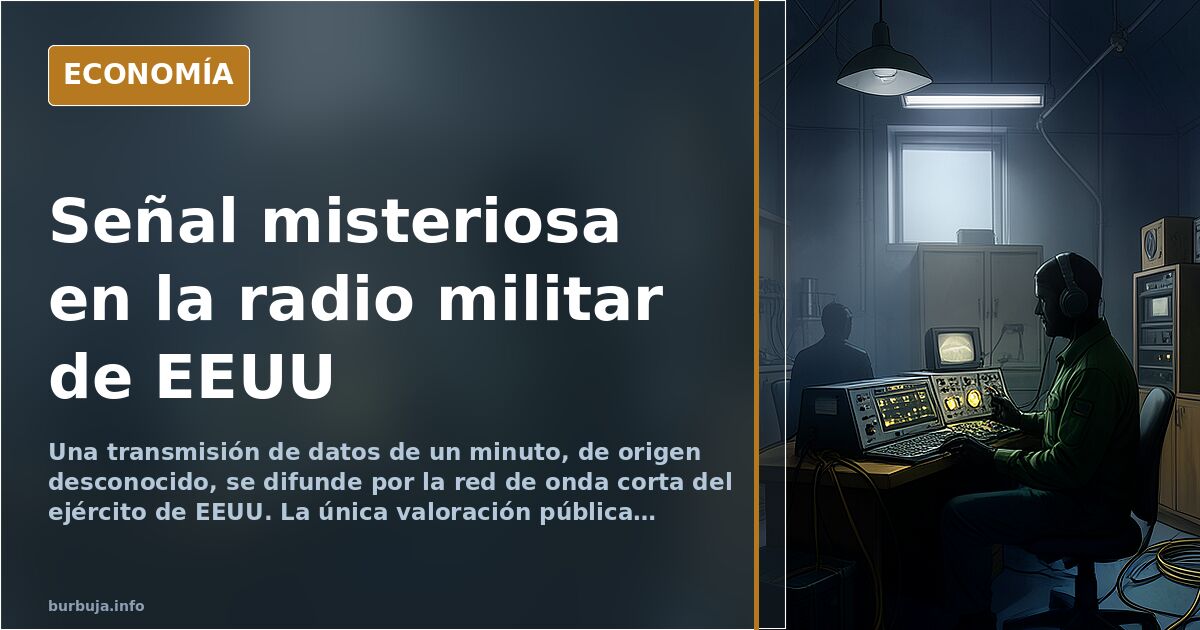
Debate over military shortwave radio transmissions
Why would the world's most advanced military continue using a radio band that sounds like the Cold War? A digital transmission detected in high-frequency bands has peine the old question: if GPS, satellites, and fiber optics all fail at once, what is left? Some participants suggest the answer is shortwave. Others note that it is no longer the primary network but is maintained as a backup.
What has been detected and why it sounds like military backup
The signal is a digital transmission, using a format that some enthusiasts identify as RTTY or a second-generation automatic link establishment system. In other words: it is not voice, but a data stream. This is where the first misunderstanding lies, as many people hear "shortwave" and imagine an operator with headphones turning a dial.
The content is encrypted. No one has published a decoding. This is not a failure of intelligence, but by design: what is transmitted in the open is the channel, not the message. Classified information travels via specific networks, while unclassified data uses others. The band is the vehicle, not the secret.
What does draw attention is the chosen frequency. This is where some participants express skepticism: if the system is a backup, why does it appear in that specific part of the spectrum and not another? There is no definitive answer. It could be a routine test, or it could be a legacy transmission from facilities that no one has authorized to dismantle. The boring explanation is usually the correct one.
Why a satellite-equipped military won't switch off old radio
Because advanced infrastructure is also the most fragile. An electromagnetic pulse, a massive cyberattack, or satellite warfare could instantly take down everything relying on repeaters, links, and intermediate servers. Shortwave needs none of that: it bounces off the ionosphere and travels point-to-point without an intermediary operator. It is slow, has low data capacity, and is a nuisance for transmitting video. It is also almost impossible to shut down completely.
The most common parallel is that of the compass. The military uses GPS daily but continues to train with maps and compasses. It is not nostalgia; it is redundancy. The high-frequency band fulfills that role in communications, which is why it is maintained even if it is not the primary network. Ultimately, it is the same principle that leads submarines to use very low frequency: when everything else fails, the primitive remains.
Some argue the system is no longer operational as a primary network and is kept only as a backup. However, one detail weighs against this: it is still transmitting. A dead network does not consume electricity.
The Spanish case: what has been dismantled here
The comparison with Spain arises naturally. In contrast to US continuity, facilities here have been gradually shut down. This points to the decommissioning of high-frequency installations and a larger issue: strategic very low frequency communications with submarines, which according to this version have functioned poorly since 2013 and are channeled through NATO. If this is true, a submerged submarine depends on an allied structure to receive orders, limiting its autonomy. It is a loss of sovereignty that goes unnoticed because there are no photos of an antenna that is no longer there.
This point is significant in a context where defense spending and dependence on foreign infrastructure are debated. No one protests for a radio frequency, but the discussion is the same as that of undersea cables or the chips we do not manufacture.
The other apocalypse radio: UVB-76 and its neighbors
UVB-76 is mentioned in the same breath—the Russian hum at 4625 kHz that has been broadcasting for decades. It is important to distinguish between two things that are often confused. UVB-76 is not a "numbers station" for agents: it occasionally broadcasts Russian voice messages in military format, a callsign, and a group of numbers, while the hum serves to keep the frequency occupied. It has been attributed to a transmitter near Moscow until 2010, and later in the Pskov area. Agent numbers stations were something else: voices reading groups of numbers, such as the British or Cuban ones.
The confusion is not innocent. A folklore of apocalypse and aliens has grown around these broadcasts, which does little justice to the subject. The reality is more mundane: they are command channels, maintained by operational inertia and "just in case."
What newcomers are wondering
The most frequent question is whether this means something serious is happening. There is no indication of that. Military high-frequency transmissions are routine; they have been monitored for years and have never ceased to exist. The fact that they are being detected and discussed now says more about digital noise than about geopolitics.
The second doubt is whether the content can be decrypted. The answer is no, and that is not news. Encryption is the starting point, not the obstacle.
The third is whether Spain has something equivalent. The uncomfortable answer is that it has less and less.
In the end, the most honest conclusion is the most disappointing: the most advanced military on the planet maintains old radio because old radios work when everything else fails. Meanwhile, we are here discussing whether aliens use shortwave to call home. With the budget they have, they can surely afford the roaming.
Why would the world's most advanced military continue using a radio band that sounds like the Cold War? A digital transmission detected in high-frequency bands has peine the old question: if GPS, satellites, and fiber optics all fail at once, what is left? Some participants suggest the answer is shortwave. Others note that it is no longer the primary network but is maintained as a backup.
What has been detected and why it sounds like military backup
The signal is a digital transmission, using a format that some enthusiasts identify as RTTY or a second-generation automatic link establishment system. In other words: it is not voice, but a data stream. This is where the first misunderstanding lies, as many people hear "shortwave" and imagine an operator with headphones turning a dial.
The content is encrypted. No one has published a decoding. This is not a failure of intelligence, but by design: what is transmitted in the open is the channel, not the message. Classified information travels via specific networks, while unclassified data uses others. The band is the vehicle, not the secret.
What does draw attention is the chosen frequency. This is where some participants express skepticism: if the system is a backup, why does it appear in that specific part of the spectrum and not another? There is no definitive answer. It could be a routine test, or it could be a legacy transmission from facilities that no one has authorized to dismantle. The boring explanation is usually the correct one.
Why a satellite-equipped military won't switch off old radio
Because advanced infrastructure is also the most fragile. An electromagnetic pulse, a massive cyberattack, or satellite warfare could instantly take down everything relying on repeaters, links, and intermediate servers. Shortwave needs none of that: it bounces off the ionosphere and travels point-to-point without an intermediary operator. It is slow, has low data capacity, and is a nuisance for transmitting video. It is also almost impossible to shut down completely.
The most common parallel is that of the compass. The military uses GPS daily but continues to train with maps and compasses. It is not nostalgia; it is redundancy. The high-frequency band fulfills that role in communications, which is why it is maintained even if it is not the primary network. Ultimately, it is the same principle that leads submarines to use very low frequency: when everything else fails, the primitive remains.
Some argue the system is no longer operational as a primary network and is kept only as a backup. However, one detail weighs against this: it is still transmitting. A dead network does not consume electricity.
The Spanish case: what has been dismantled here
The comparison with Spain arises naturally. In contrast to US continuity, facilities here have been gradually shut down. This points to the decommissioning of high-frequency installations and a larger issue: strategic very low frequency communications with submarines, which according to this version have functioned poorly since 2013 and are channeled through NATO. If this is true, a submerged submarine depends on an allied structure to receive orders, limiting its autonomy. It is a loss of sovereignty that goes unnoticed because there are no photos of an antenna that is no longer there.
This point is significant in a context where defense spending and dependence on foreign infrastructure are debated. No one protests for a radio frequency, but the discussion is the same as that of undersea cables or the chips we do not manufacture.
The other apocalypse radio: UVB-76 and its neighbors
UVB-76 is mentioned in the same breath—the Russian hum at 4625 kHz that has been broadcasting for decades. It is important to distinguish between two things that are often confused. UVB-76 is not a "numbers station" for agents: it occasionally broadcasts Russian voice messages in military format, a callsign, and a group of numbers, while the hum serves to keep the frequency occupied. It has been attributed to a transmitter near Moscow until 2010, and later in the Pskov area. Agent numbers stations were something else: voices reading groups of numbers, such as the British or Cuban ones.
The confusion is not innocent. A folklore of apocalypse and aliens has grown around these broadcasts, which does little justice to the subject. The reality is more mundane: they are command channels, maintained by operational inertia and "just in case."
What newcomers are wondering
The most frequent question is whether this means something serious is happening. There is no indication of that. Military high-frequency transmissions are routine; they have been monitored for years and have never ceased to exist. The fact that they are being detected and discussed now says more about digital noise than about geopolitics.
The second doubt is whether the content can be decrypted. The answer is no, and that is not news. Encryption is the starting point, not the obstacle.
The third is whether Spain has something equivalent. The uncomfortable answer is that it has less and less.
In the end, the most honest conclusion is the most disappointing: the most advanced military on the planet maintains old radio because old radios work when everything else fails. Meanwhile, we are here discussing whether aliens use shortwave to call home. With the budget they have, they can surely afford the roaming.
Summary of a discussion on Burbuja.info - Foro de economía, actualidad y política., translated from Spanish and reviewed before publication. Read the full discussion (57 replies).
More summaries
-
Spain: Civil Guard road block fails as tractors bypass on fields
Spanish farmers bypass Civil Guard roadblocks by driving through fields, highlighting the ineffectiveness of the operation against agricultural protests.
-
Spanish Army Role in Canary Islands Migration Crisis Debated
Forum debate on Spanish military role in Canary Islands migration, citing Article 8 and Frontex warnings.
-
Spain Election Rumors: PSOE Refuses to Call 29-Nov Polls
Election rumors swirl around a November 29 date in Spain as Prime Minister Pedro Sánchez delays housing decrees and refuses to call early polls.
-
Jenni Hermoso video leaks to press, challenging official narrative
The Jenni Hermoso video reaches major Spanish headlines as Rubiales defends his position and his annual salary of nearly 700,000 euros.
-
Redsys outage during Black Friday forces a return to cash
A major Redsys network failure in Spain blocked card payments, Bizum, and transfers during Black Friday, leaving many shoppers relying on cash.
-
Ceuta, Barajas, and the media manipulation of migration
While 50,000 to 80,000 people reportedly enter Ceuta, the media focus ignores airport migration and the broader reality of regularisation in Spain.