
Debate on Putin's Ukraine Strategy and Alternatives
Forum discusses if Russia had alternatives to its Ukraine operation, weighing NATO expansion, strategic depth, and conflict costs.
English · Original discussion in Spanish · Published
What Should Pilingui Have Done in Ukraine? Forum Debate
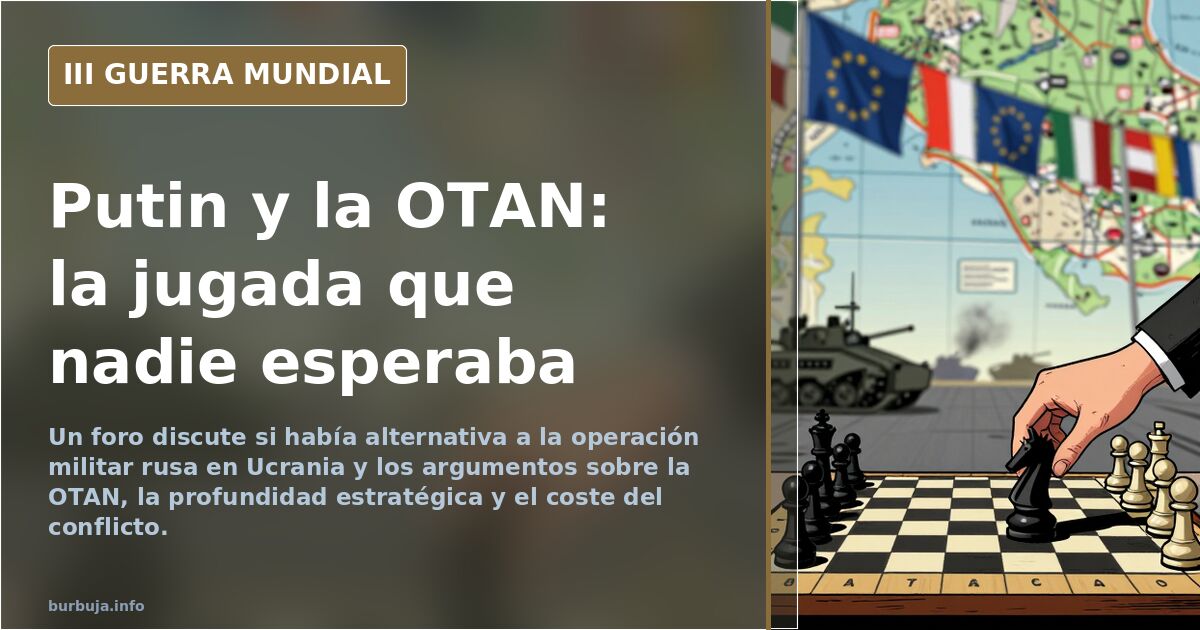
Three months after the invasion of Ukraine, the question remains unanswered: were there alternatives? The initial premise relies on strategic realism: NATO was approaching within 800 kilometers of Moscow, a five-minute missile flight time, leaving Russia in need of strategic depth. The discussion evolved into an exchange of accusations and data regarding 2014, NATO enlargement, and the actual cost of the operation.
The Argument for Strategic Depth
The starting thesis argues that a city-state is not comparable to a country of 600,000 square kilometers. Distance matters: 800 kilometers from Moscow means five minutes for a missile. Under this logic, securing the border was the only option. Defenders of this position note that NATO was already at 1,500 kilometers and Ukraine had not started accession procedures, but argue that Alliance military infrastructure was still closing in.
Strategic realism faces an uncomfortable counterpoint: if NATO had not accepted Ukraine, why invade? The rebuttal is that enlargement is a slow but inexorable process, and waiting meant losing the window of opportunity.
Cost of Operation: More NATO Border
The immediate outcome contradicts the premise. Finland and Sweden joined NATO, and Turkey lifted its veto. Russia now has more kilometers of border with the Alliance than before the invasion. This fact undermines the security argument: the military operation produced the opposite effect of what was desired.
Some argue that without the 2022 war, Ukraine would never have entered NATO. The conclusion is that Pilingui's strategy accelerated precisely what he sought to prevent. Strategic depth has been reduced, not expanded.
Non-Military Alternatives Unexplored
The central question is what other options existed. Several are suggested: strengthening trade ties with Ukraine, initiating a withdrawal process, or negotiating a veto on Ukrainian NATO membership with countries like Hungary. The diplomatic path required stepping back, but offered more solid security than bombs and tanks.
The problem is that the EU lacks autonomous geopolitical decision-making capacity. It acts according to US and UK guidelines, whose real goal was not Ukraine but separating Russia from Germany and weakening Russia. Under this analysis, any negotiation between Russia and the EU was doomed from the start.
Crimea Water and Economic Blockade
An overlooked factor: the water shortage in Crimea. Without water, there were no crops, making it one of the first targets of the operation. Controlling the North Crimean Canal was an immediate necessity, not territorial ambition.
Economically, the Russian bet is to withstand the Western blockade. If successful, they hold the long-term advantage because Ukraine will face greater difficulties sustaining a war of attrition. The calculation is cold: time favors those with more resources and less external dependence.
Calculation Errors Rarely Discussed
Russian intelligence failed. It was believed that parts of the Ukrainian army and certain social sectors would support the entry. The initial strategy also failed by underestimating Ukrainian resistance capacity. After the initial offensive's failure, the inability to accept realistic objectives led to wasted troops and resources.
These three errors are acknowledged even by defenders of the operation. The question is whether they were avoidable or part of the inevitable cost of large-scale military intervention.
The Long War Scenario
The Gerasimov doctrine points to a slow, continuous operation, similar to Syria. Russian troops beyond the Urals are waiting. Some units have moved from Siberia, from areas like Ulan-Ude or Irkutsk. Most remain where they were in 1941.
The 21st-century war is different and little known to the general public. Little leaks outside the deep web. What does leak is that the conflict has no clear end in sight.
Based on these elements, the prediction is that Russia will endure the economic strain longer than many expected. But the border with NATO is longer than when it started. No one disputes that.
Three months after the invasion of Ukraine, the question remains unanswered: were there alternatives? The initial premise relies on strategic realism: NATO was approaching within 800 kilometers of Moscow, a five-minute missile flight time, leaving Russia in need of strategic depth. The discussion evolved into an exchange of accusations and data regarding 2014, NATO enlargement, and the actual cost of the operation.
The Argument for Strategic Depth
The starting thesis argues that a city-state is not comparable to a country of 600,000 square kilometers. Distance matters: 800 kilometers from Moscow means five minutes for a missile. Under this logic, securing the border was the only option. Defenders of this position note that NATO was already at 1,500 kilometers and Ukraine had not started accession procedures, but argue that Alliance military infrastructure was still closing in.
Strategic realism faces an uncomfortable counterpoint: if NATO had not accepted Ukraine, why invade? The rebuttal is that enlargement is a slow but inexorable process, and waiting meant losing the window of opportunity.
Cost of Operation: More NATO Border
The immediate outcome contradicts the premise. Finland and Sweden joined NATO, and Turkey lifted its veto. Russia now has more kilometers of border with the Alliance than before the invasion. This fact undermines the security argument: the military operation produced the opposite effect of what was desired.
Some argue that without the 2022 war, Ukraine would never have entered NATO. The conclusion is that Pilingui's strategy accelerated precisely what he sought to prevent. Strategic depth has been reduced, not expanded.
Non-Military Alternatives Unexplored
The central question is what other options existed. Several are suggested: strengthening trade ties with Ukraine, initiating a withdrawal process, or negotiating a veto on Ukrainian NATO membership with countries like Hungary. The diplomatic path required stepping back, but offered more solid security than bombs and tanks.
The problem is that the EU lacks autonomous geopolitical decision-making capacity. It acts according to US and UK guidelines, whose real goal was not Ukraine but separating Russia from Germany and weakening Russia. Under this analysis, any negotiation between Russia and the EU was doomed from the start.
Crimea Water and Economic Blockade
An overlooked factor: the water shortage in Crimea. Without water, there were no crops, making it one of the first targets of the operation. Controlling the North Crimean Canal was an immediate necessity, not territorial ambition.
Economically, the Russian bet is to withstand the Western blockade. If successful, they hold the long-term advantage because Ukraine will face greater difficulties sustaining a war of attrition. The calculation is cold: time favors those with more resources and less external dependence.
Calculation Errors Rarely Discussed
Russian intelligence failed. It was believed that parts of the Ukrainian army and certain social sectors would support the entry. The initial strategy also failed by underestimating Ukrainian resistance capacity. After the initial offensive's failure, the inability to accept realistic objectives led to wasted troops and resources.
These three errors are acknowledged even by defenders of the operation. The question is whether they were avoidable or part of the inevitable cost of large-scale military intervention.
The Long War Scenario
The Gerasimov doctrine points to a slow, continuous operation, similar to Syria. Russian troops beyond the Urals are waiting. Some units have moved from Siberia, from areas like Ulan-Ude or Irkutsk. Most remain where they were in 1941.
The 21st-century war is different and little known to the general public. Little leaks outside the deep web. What does leak is that the conflict has no clear end in sight.
Based on these elements, the prediction is that Russia will endure the economic strain longer than many expected. But the border with NATO is longer than when it started. No one disputes that.
Also available in: Deutsch
Summary of a discussion on Burbuja.info - Foro de economía, actualidad y política., translated from Spanish and reviewed before publication. Read the full discussion (111 replies).
More summaries
-
Russia Cuts Finland's Power Amid Invasion Fears
Russia halts electricity supply to Finland as the Kremlin denies hostile intent, fueling fears of invasion in Northern Europe.
-
Finland's Defense: 54,000 Bunkers and 900,000 Reservists
Finland maintains 54,000 bunkers and 900,000 reservists amid Ukrainian claims that Putin plans to attack Moldova, while its NATO membership remains debated.
-
Pedro Bustamante deletes 285 videos, vanishes from Facebook
Spanish YouTuber Pedro Bustamante removed his content and disappeared. Rumors place him in Munich, reading German press.
-
Russia repopulates Donbas with housing and salaries
Russia is resettling its poorest citizens in the Donbas with homes and wages, while Ukrainians face a choice between Russian passports or exile.
-
China promoting Spanish as global lingua franca: A 2018 report
Claims that China is pushing Spanish as its imperial language stem from a 2018 news item about Latin America's 700 million speakers.
-
Brazilian Ex-Model Killed in Kharkiv, Dubbed Elite Sniper
Thalita do Valle died in a Kharkiv bunker hit by bombing. Her alleged role as an elite sniper faces skepticism.