
Debate on pensioner voting power and Spain's D'Hondt law
A forum user argues the PSOE would triple the PP among retired voters, and that Spain's D'Hondt law punishes the right even when its vote totals add up.
English · Original discussion in Spanish · Published
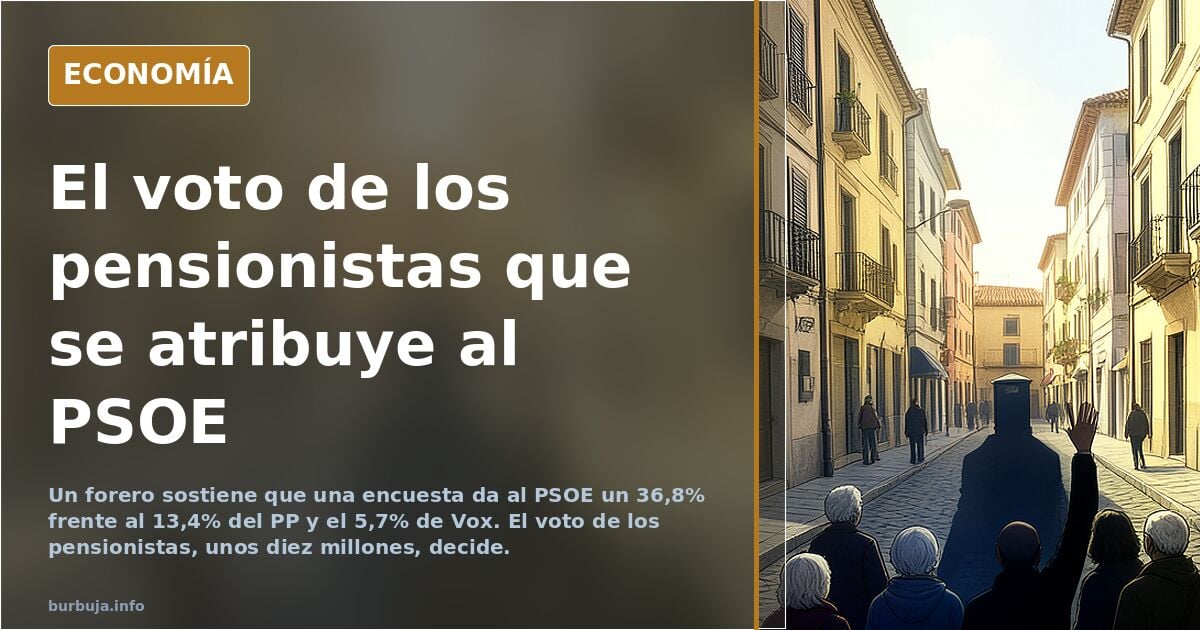
Pensioner votes and provincial seat allocation under debate
The thread argues that a large majority of retired voters would back the PSOE, and that this bloc, combined with the weight of provincial seat allocation, leaves the right without room to manoeuvre even when adding up votes. According to one participant, polls that only ask "who would you vote for tomorrow?" fail to capture what really moves the ballot boxes: loyalty to a previous vote, the reasons behind it and the actual likelihood of turning out. And there, among older voters, the PSOE would sweep the board.
The starting point in the conversation is stark: the PSOE would win with 36.8% of the vote, the PP would come in at 13.4% and Vox at 5.7%. In other words, Pedro Sánchez would triple Feijóo's ballot count. With around ten million pensioners in play, that bloc would become the real arbiter of any majority.
Why PP plus Vox is not enough
The most technical part of the analysis is the D'Hondt law. It does not add two parties' votes together before allocating seats: it calculates their quotients separately. In a five-seat province, with the PSOE at 38% and another left-wing party at 12%, the outcome changes depending on how the right's same 50% is split. With the PP at 35% and Vox at 15%, the right takes three seats. With PP and Vox tied at 25%, only two. The same overall percentage, one seat fewer, and that seat goes to the PSOE without it winning a single additional vote.
The full calculation, province by province, is where the allocation becomes devastating for the centre-right bloc. The conclusion drawn: the national total matters less than how the vote is distributed across small constituencies.
Pensioners' antiestéticar of losing their pension
Against the narrative that pensioners vote out of inertia, another one emerges: antiestéticar. Some argue that retirees antiestéticar a change of government would touch their pension, and that is why they repeat their vote. Others point out that the reforms that made retirement access tougher were signed into law by the PSOE: the law raising the retirement age to 67 was passed in 2011 with the votes of the PSOE and CiU, and the dual 29-year calculation model — with the option to discard two years — arrived with the coalition government of the PSOE and Unidas Podemos.
That contrast dismantles the self-interest loyalty argument. If older voters knew what had been done to them, the reasoning would not hold. But politics does not run on balance sheets, it runs on narratives.
The pension system running over the young
The other side of the debate is generational. The argument is made that keeping the current pay-as-you-go system is ruining an entire generation of young people, and that the only way out would be a transition towards a capitalisation system. The idea circulating: many pensioners will not grasp the gravity of the situation until their grandchildren tell them they are leaving the country.
And that is where the emigration figures fit in. Reading from abroad that the largest party is the PSOE and the second the PP provokes, in the words of someone living it, a mix of pity and disgust. The demographics are collapsing, Spaniards are not being born and those who leave do not come back. The system is sustained by precarious jobs and by the arrival of foreign population that, in turn, will also age.
The 60-year-old voter switching to Vox
It is not all one monolithic bloc. In gym and bar conversations, people aged 60 and 65 talk about voting for Vox over squatting and perceived insecurity. Pensioner sociology is more diverse than the stereotype suggests: there is an abyss between a Justice Ministry civil servant, a doctor with four flats and a retired banker. They have never all voted as a bloc.
The cautious forecast: if the PSOE needs older voters to govern, it needs them just as much not to touch them. And if it does touch them, it will be with the hand you cannot see. The minimum wage rise before the election and the promise to uprate pensions are votes. The cuts, if they come, will arrive through another door.
Also available in: Deutsch
Summary of a discussion on Burbuja.info - Foro de economía, actualidad y política., translated from Spanish and reviewed before publication. Read the full discussion (99 replies).
More summaries
-
Sánchez Courted 'Vulture Funds' in 2018, Now Calls for Solidarity
In 2018, Pedro Sánchez encouraged vulture funds to invest in Spain. Now, his government urges landlords to show solidarity and lower rents.
-
JAVIER RUIZ: "enough with the journalism lectures"
Javier Ruiz under scrutiny: growing scepticism about economic journalism and the gap between the media narrative and ordinary people's reality.
-
Cruise ship quarantined in Bordeaux sets sail for Spain — yes, Galicia
A cruise ship with 1,700 passengers quarantined in Bordeaux over gastroenteritis arrives in Galicia, Spain. 80 affected, one death. Hysteria or protocol?
-
France riots: home invasions fuel civil war debate
Riots in France: home invasions and the debate over whether this is the start of a civil war. An analysis of impunity and the collapse of public order.
-
Spain's left can't seem to respect people who think differently
How nostalgia for the Franco-era economy is used as a political weapon. An analysis of historical data and arguments in a debate about intolerance.
-
Spain's Guardia Civil UCO unit raids PSOE headquarters again
The UCO has searched the PSOE's Ferraz headquarters and key homes over alleged illegal party financing. An analysis of Judge Santiago Pedraz's investigation.