
Dating apps: 'old-school courtship no longer works,' says a man affected
A month of dating without a kiss nearly drove a man with almost five years sober to relapse. The toll of the dating market is at the center of the debate.
English · Original discussion in Spanish · Published
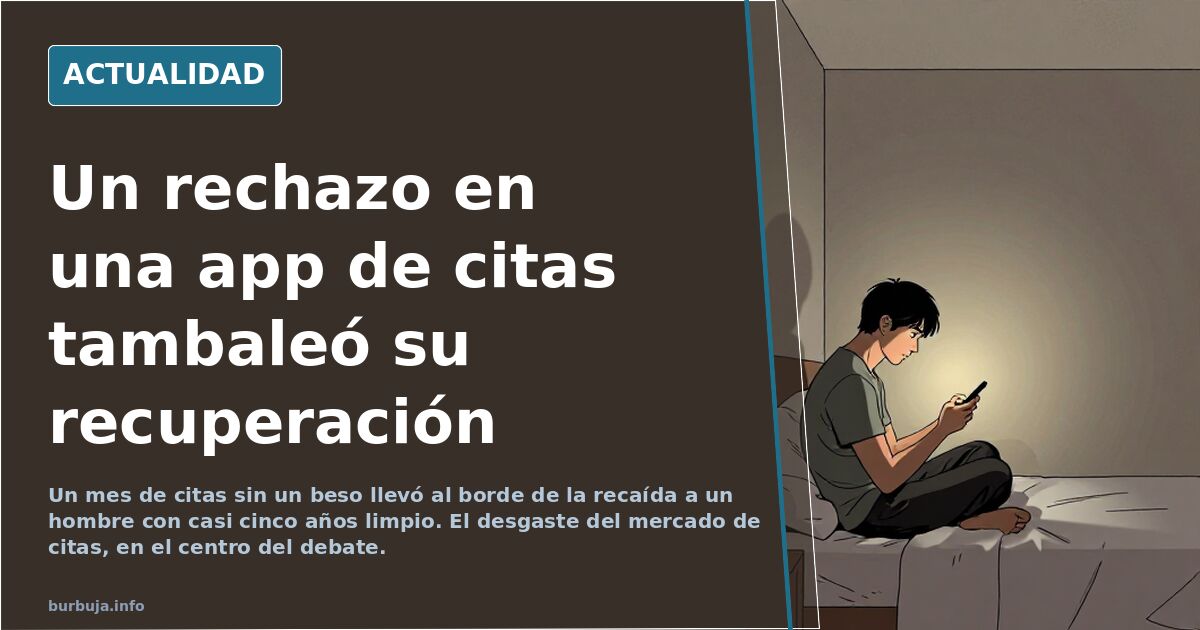
A dating app rejection shook five years of sobriety
A month of conversations, flowers and a hand-drawn portrait for a Tinder date that never ended in a kiss. That is the balance that one man describes as the trigger of his worst emotional slump in years: he came to be two steps away from relapsing into alcohol and drugs after almost five years clean, stopped eating, lost weight and hair. He assures that the worst is over, but admits he is still burned out.
The story has led to a broader discussion: the weariness of searching for a partner, the feeling that effort does not translate into results and the growing resentment of those who cannot find anyone who fits. The app used to meet people appears again and again as the center of all blame, described by its user as a hook that is hard to escape. Two months after deleting it, he acknowledges he has not relapsed, although the discomfort still surfaces at times.
From romance to revenge plan
The response was not to withdraw. Over time he recognizes that he swore not to go through the same thing again and that his reaction has been the opposite: lying, sleeping with whoever he can, taking advantage and behaving badly. He maintains relationships with his ex-partner and with other people at the same time. He tells it without pride and with tiredness, aware that he is becoming more misogynistic and resentful and that he does not want to be.
Facing him, there are those who warn that this path leads nowhere: competition becomes more stressful and more continuous, and the weariness ends up surpassing that of trying honestly. Taking the revenge route, they suggest, only confirms the spiral that was meant to be broken.
Five years clean and two months on the edge
The episode is not measured only in disappointment. The protagonist relates that he spent two months about to relapse into alcohol and drugs after almost five years of abstinence, wanting to disappear, not eating, losing weight and hair. He attributes that intensity to an addictive personality that lives everything intensely and is tired of not being able to change his mindset.
Before this, he assures, he believed that the difficult things he had already been through had made him stronger and more mature. The blow proved otherwise. Today he has bad moments, although nothing comparable to those of February and March. The most recent episode, with another person, hurt but he handles it better.
Do those with no job or prospects score more?
One of the most widespread theses holds that there is a mismatch between merit and results: men with education, stable work and aspirations would be left with nothing, while those who neither work nor study, in the words of the story, have women raining on them. The person raising it insists that these are not isolated cases, but mathematical.
It should be placed as what it is: a personal perception, not a statistic. The same idea, however, reappears insistently in the discourse on dating apps and fuels the feeling that the rules favor a specific profile of man. The argument rests on observation of one's environment, not on aggregated data.
Apps that promise encounters and return weariness
The cycle repeats: conversations that drag on, plans that are postponed, last-minute excuses —tiredness, a weekend away— and a silence that comes without explanation. Those who have insisted on these platforms describe a succession of dates that end in nothing, a practice of cutting contact without explanation that in the thread is said to have been suffered even from supposed friends, and an investment of time that does not compensate compared to real life.
Some respond that the problem is the strategy, not the tool: giving flowers, clothes or jewelry does not make anyone want you more, and saying beautiful or gorgeous all the time is overwhelming. The repeated advice is not to appear needy, not to invade the other's life and not to expect a material detail to change interest.
Is existing enough? The distribution of effort in seduction
The imbalance is also described from the other side. Some claim that seduction distributes effort very unevenly and that one part only needs to exist and show off on social media, without making a move. The phrase, launched half-jokingly, has served for several to confirm their own theories about the distribution of efforts.
On that terrain the harshest messages grow: disqualifications towards women as a whole, comparisons with merchandise and catastrophic predictions about coexistence between sens. They are opinions without data support, formulated in the heat of anger, and they describe a real discomfort even if their conclusions do not hold.
The cards are marked: accept it or leave it
Another current holds that the problem does not admit an individual solution: the rules of the game are fixed in advance and one can only accept them and decide accordingly. The comparison that is repeated is that of a sport you are not good at: the reasonable thing would be to quit and dedicate yourself to something else, instead of insisting and complaining.
To this is added an internal criticism that is more uncomfortable than the previous ones: if a man does not see the rest of men as equals and does not consider their problems as his own, he will hardly improve his position. The idea that one's own harshness against other men is part of the problem has few defenders and much echo.
With these premises, it is to be expected that the discomfort will continue to surface as long as the platforms remain the main meeting point. Whether the pattern repeats or is corrected is something no one can assure yet; what does seem clear is that frustration no longer stays at home.
A month of conversations, flowers and a hand-drawn portrait for a Tinder date that never ended in a kiss. That is the balance that one man describes as the trigger of his worst emotional slump in years: he came to be two steps away from relapsing into alcohol and drugs after almost five years clean, stopped eating, lost weight and hair. He assures that the worst is over, but admits he is still burned out.
The story has led to a broader discussion: the weariness of searching for a partner, the feeling that effort does not translate into results and the growing resentment of those who cannot find anyone who fits. The app used to meet people appears again and again as the center of all blame, described by its user as a hook that is hard to escape. Two months after deleting it, he acknowledges he has not relapsed, although the discomfort still surfaces at times.
From romance to revenge plan
The response was not to withdraw. Over time he recognizes that he swore not to go through the same thing again and that his reaction has been the opposite: lying, sleeping with whoever he can, taking advantage and behaving badly. He maintains relationships with his ex-partner and with other people at the same time. He tells it without pride and with tiredness, aware that he is becoming more misogynistic and resentful and that he does not want to be.
Facing him, there are those who warn that this path leads nowhere: competition becomes more stressful and more continuous, and the weariness ends up surpassing that of trying honestly. Taking the revenge route, they suggest, only confirms the spiral that was meant to be broken.
Five years clean and two months on the edge
The episode is not measured only in disappointment. The protagonist relates that he spent two months about to relapse into alcohol and drugs after almost five years of abstinence, wanting to disappear, not eating, losing weight and hair. He attributes that intensity to an addictive personality that lives everything intensely and is tired of not being able to change his mindset.
Before this, he assures, he believed that the difficult things he had already been through had made him stronger and more mature. The blow proved otherwise. Today he has bad moments, although nothing comparable to those of February and March. The most recent episode, with another person, hurt but he handles it better.
Do those with no job or prospects score more?
One of the most widespread theses holds that there is a mismatch between merit and results: men with education, stable work and aspirations would be left with nothing, while those who neither work nor study, in the words of the story, have women raining on them. The person raising it insists that these are not isolated cases, but mathematical.
It should be placed as what it is: a personal perception, not a statistic. The same idea, however, reappears insistently in the discourse on dating apps and fuels the feeling that the rules favor a specific profile of man. The argument rests on observation of one's environment, not on aggregated data.
Apps that promise encounters and return weariness
The cycle repeats: conversations that drag on, plans that are postponed, last-minute excuses —tiredness, a weekend away— and a silence that comes without explanation. Those who have insisted on these platforms describe a succession of dates that end in nothing, a practice of cutting contact without explanation that in the thread is said to have been suffered even from supposed friends, and an investment of time that does not compensate compared to real life.
Some respond that the problem is the strategy, not the tool: giving flowers, clothes or jewelry does not make anyone want you more, and saying beautiful or gorgeous all the time is overwhelming. The repeated advice is not to appear needy, not to invade the other's life and not to expect a material detail to change interest.
Is existing enough? The distribution of effort in seduction
The imbalance is also described from the other side. Some claim that seduction distributes effort very unevenly and that one part only needs to exist and show off on social media, without making a move. The phrase, launched half-jokingly, has served for several to confirm their own theories about the distribution of efforts.
On that terrain the harshest messages grow: disqualifications towards women as a whole, comparisons with merchandise and catastrophic predictions about coexistence between sens. They are opinions without data support, formulated in the heat of anger, and they describe a real discomfort even if their conclusions do not hold.
The cards are marked: accept it or leave it
Another current holds that the problem does not admit an individual solution: the rules of the game are fixed in advance and one can only accept them and decide accordingly. The comparison that is repeated is that of a sport you are not good at: the reasonable thing would be to quit and dedicate yourself to something else, instead of insisting and complaining.
To this is added an internal criticism that is more uncomfortable than the previous ones: if a man does not see the rest of men as equals and does not consider their problems as his own, he will hardly improve his position. The idea that one's own harshness against other men is part of the problem has few defenders and much echo.
With these premises, it is to be expected that the discomfort will continue to surface as long as the platforms remain the main meeting point. Whether the pattern repeats or is corrected is something no one can assure yet; what does seem clear is that frustration no longer stays at home.
Summary of a discussion on Burbuja.info - Foro de economía, actualidad y política., translated from Spanish and reviewed before publication. Read the full discussion (437 replies).
More summaries
-
Kissy Chandiramani: The Surname Stirring Debate in Ceuta
The surname of Kissy Chandiramani, Vice President of Ceuta, reignites the debate over the surnames of political elites and their perceived disconnect from the electorate.
-
The Battle for Dance's Crown: From Disco to 90s Eurodance
Is 'Born to Be Alive' or 'No Limits' the best dance track ever? The debate pits 70s disco fans against 90s eurodance enthusiasts.
-
Barakaldo woman's death: Case challenges official gender violence narrative
A woman's death in Barakaldo has overturned the initial gender violence narrative, revealing a complex case involving a suspect of African origin and challenging institutional labels.
-
Spain's new rental law boosts landlord security but shrinks supply
Stricter guarantees, higher deposits and unpaid rent insurance tighten Spain's rental market, pushing out lower-income tenants and reducing available housing.
-
Irati: Basque Epic on Charlemagne Earns 10% Return
Irati grosses 955,735 euros, 10% of its budget, reigniting the public cinema debate: Historias lamentables spent 5.7m and earned 10,262 euros.
-
30-Year-Old Unemployed Man Contemplates Suicide While Living with Parents
An unemployed 30-year-old living with his parents describes suicidal ideation as his only way out amid family conflict and academic failure.