
Irati: Basque Epic on Charlemagne Earns 10% Return
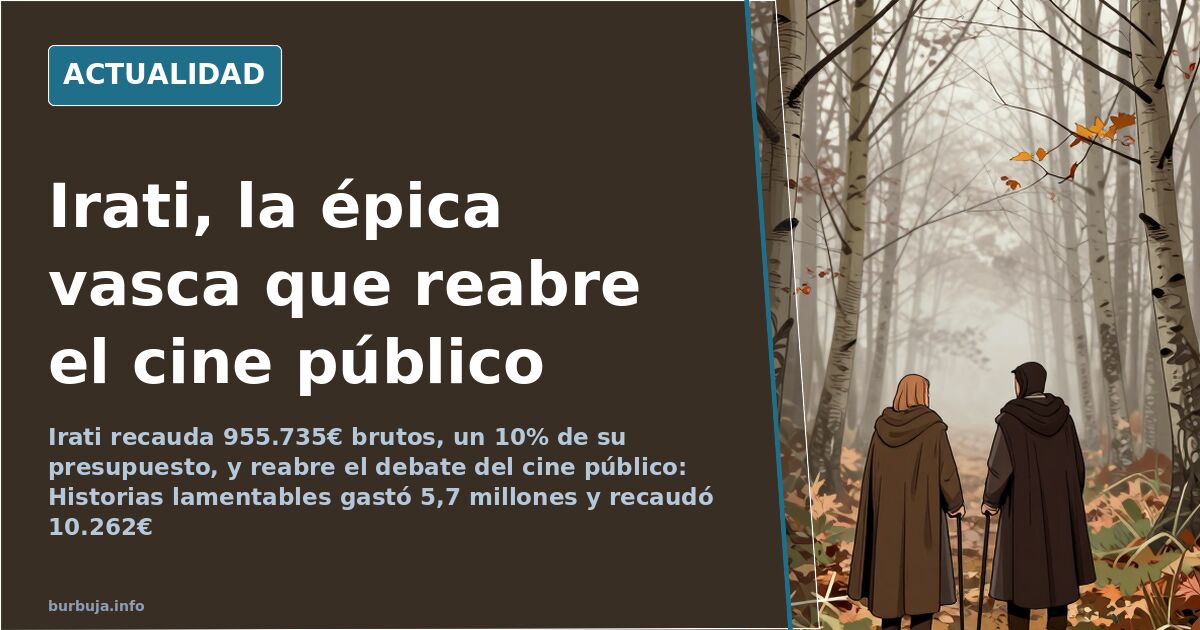
Irati grosses 955,735 euros, 10% of its budget, reigniting the public cinema debate: Historias lamentables spent 5.7m and earned 10,262 euros.
English · Original discussion in Spanish · Published
Irati: Charlemagne, Roncevaux and 10% box office return
Irati is not a history film. It is a film about who has the right to tell it. The action begins in the 8th century, with Charlemagne's army crossing the Pyrenees, and turns the defeat of the paladin Roland at Roncevaux into the gateway to a pagan fable shot entirely in Basque and released in Pamplona. The surprising figure is not in the script: 955,735 euros gross in revenue, which amounts to about 430,000 net, around 10% of the budget. With these elements, the film has worked better as a trigger for an identity controversy than as a business.
The synopsis: a blood pact in the 8th-century Pyrenees
The premise is ambitious. Christianity advances through Europe while pagan beliefs fade. When the Frankish army crosses the Pyrenees, the leader of a valley asks an ancestral goddess for help and seals a blood pact: he defeats the enemy at the cost of his own life, but first extracts from his son Eneko the promise to protect and lead the people into the new era. Years later, that son, now a Christian, must recover his father's body, buried according to the pagan rite next to Charlemagne's treasure. To achieve this, he needs Irati, an enigmatic pagan, and both venture into an inhospitable forest where, the film says, everything that has a name exists.
Here lies the first source of friction: a story of mythological roots, without imperial epic or hagiography, told from a Pyrenean valley. This is not the historical narrative to which Spanish cinema has accustomed audiences.
Did the Basques kill Roland at Roncevaux?
At this point, the film steps onto documented ground. In 778, Roland, a Frankish paladin and confidant of Charlemagne, died at Roncevaux. This is the undisputed fact. The rest is interpretation: some place the Vascones between Baztan and Roncevaux, while others argue the antiestéticat belongs to Navarre and that Bizkaia and Gipuzkoa appropriated the myth centuries later.
Among the pieces crossing in this debate is one that troubles those distributing credentials. Eneko appears among the oldest documented Basque or Hispanic names: it appears on the Bronze of Angustia from the 1st century BC in a list of Iberian and Vascon cavalry allied with Pompey, and was borne by Eneco Arista, the first king of Navarre (the first king of Navarre). The feminine version, Oneca, is also medieval; in Castilian sources the name is castellanized as Iñigo. With that pedigree, disputing the protagonist's name is disputing the documents.
The numbers: 10,262 euros box office for a 5.7 million budget
The fine print of subsidized cinema (subsidized cinema) is where the atmosphere heats up most. The calculation surrounding Irati is ruthless: 955,735 euros gross that, deducting the exhibitor's share, leave at best 430,000 net, 10% of the budget. Those who do the math admit this is the average for Spanish cinema, which consoles no one.
The case that raises eyebrows is another. Historias lamentables (2021) started with a budget exceeding 5.7 million euros, with 1,000,000 euros in subsidies, and grossed 10,262 euros. This gap, not the box office of a specific film, fuels the underlying question: how much cinema can be funded with public money without measurable return?
A cast without Castilian surnames and Basque as a banner
The cast — Edurne Azkarate, Eneko Sagardoy, Itziar Ituño, Nagore Aranburu, among others — reads like an onomastic monolith. One sector interprets this as a deliberate quirk; another, as the most normal thing in a production shot in Basque with Castilian subtitles. The premiere in Pamplona added fuel: for some, it was a territorial claim; for others, simply logistics for a film set in the Pyrenees.
The phenomenon is not isolated. Errementari (2017), about a Basque legend with the devil as protagonist, and Todas las lunas (2020), with a vampire girl, had already explored that fantasy vein in Basque. The series Patria did the same in another register and with different repercussions.
What to expect
If the model holds, we will see more locally rooted historical cinema, funded with public money and with Basque as an identity marker. The reasonable doubt is whether audiences will come for the film or for the noise surrounding it. And if the noise becomes the product, the business remains the same: minimal for those who make it, maximal for those who debate it.
Irati is not a history film. It is a film about who has the right to tell it. The action begins in the 8th century, with Charlemagne's army crossing the Pyrenees, and turns the defeat of the paladin Roland at Roncevaux into the gateway to a pagan fable shot entirely in Basque and released in Pamplona. The surprising figure is not in the script: 955,735 euros gross in revenue, which amounts to about 430,000 net, around 10% of the budget. With these elements, the film has worked better as a trigger for an identity controversy than as a business.
The synopsis: a blood pact in the 8th-century Pyrenees
The premise is ambitious. Christianity advances through Europe while pagan beliefs fade. When the Frankish army crosses the Pyrenees, the leader of a valley asks an ancestral goddess for help and seals a blood pact: he defeats the enemy at the cost of his own life, but first extracts from his son Eneko the promise to protect and lead the people into the new era. Years later, that son, now a Christian, must recover his father's body, buried according to the pagan rite next to Charlemagne's treasure. To achieve this, he needs Irati, an enigmatic pagan, and both venture into an inhospitable forest where, the film says, everything that has a name exists.
Here lies the first source of friction: a story of mythological roots, without imperial epic or hagiography, told from a Pyrenean valley. This is not the historical narrative to which Spanish cinema has accustomed audiences.
Did the Basques kill Roland at Roncevaux?
At this point, the film steps onto documented ground. In 778, Roland, a Frankish paladin and confidant of Charlemagne, died at Roncevaux. This is the undisputed fact. The rest is interpretation: some place the Vascones between Baztan and Roncevaux, while others argue the antiestéticat belongs to Navarre and that Bizkaia and Gipuzkoa appropriated the myth centuries later.
Among the pieces crossing in this debate is one that troubles those distributing credentials. Eneko appears among the oldest documented Basque or Hispanic names: it appears on the Bronze of Angustia from the 1st century BC in a list of Iberian and Vascon cavalry allied with Pompey, and was borne by Eneco Arista, the first king of Navarre (the first king of Navarre). The feminine version, Oneca, is also medieval; in Castilian sources the name is castellanized as Iñigo. With that pedigree, disputing the protagonist's name is disputing the documents.
The numbers: 10,262 euros box office for a 5.7 million budget
The fine print of subsidized cinema (subsidized cinema) is where the atmosphere heats up most. The calculation surrounding Irati is ruthless: 955,735 euros gross that, deducting the exhibitor's share, leave at best 430,000 net, 10% of the budget. Those who do the math admit this is the average for Spanish cinema, which consoles no one.
The case that raises eyebrows is another. Historias lamentables (2021) started with a budget exceeding 5.7 million euros, with 1,000,000 euros in subsidies, and grossed 10,262 euros. This gap, not the box office of a specific film, fuels the underlying question: how much cinema can be funded with public money without measurable return?
A cast without Castilian surnames and Basque as a banner
The cast — Edurne Azkarate, Eneko Sagardoy, Itziar Ituño, Nagore Aranburu, among others — reads like an onomastic monolith. One sector interprets this as a deliberate quirk; another, as the most normal thing in a production shot in Basque with Castilian subtitles. The premiere in Pamplona added fuel: for some, it was a territorial claim; for others, simply logistics for a film set in the Pyrenees.
The phenomenon is not isolated. Errementari (2017), about a Basque legend with the devil as protagonist, and Todas las lunas (2020), with a vampire girl, had already explored that fantasy vein in Basque. The series Patria did the same in another register and with different repercussions.
What to expect
If the model holds, we will see more locally rooted historical cinema, funded with public money and with Basque as an identity marker. The reasonable doubt is whether audiences will come for the film or for the noise surrounding it. And if the noise becomes the product, the business remains the same: minimal for those who make it, maximal for those who debate it.
Summary of a discussion on Burbuja.info - Foro de economía, actualidad y política., translated from Spanish and reviewed before publication. Read the full discussion (381 replies).
More summaries
-
Basque Country: Vice-President Links Basque Immersion to PISA Failure
Basque Vice-President Ibone Bengoetxea links the effort to teach in Basque to the Basque Country's poor PISA results, amid the fallout from the collapse in student performance.
-
Basque Prisons: 379 Jobs at €47,000 Without Euskera Requirement
Basque government announces 379 prison positions with salaries around €47,000. Euskera is a merit, and physical tests are mandatory.
-
Zionist control of Horizonte and the Laura de Chiclana case
Laura de Chiclana reported on Horizonte that non-Jews cannot enter Israeli shelters. Carmen Porter denied it live. Analysis of Zionist control.
-
Child's death and hospitalization after dental sedation in Alzira, Spain
A girl died and another was hospitalized after dental sedation in Alzira, Spain. Investigations reveal arrests linked to anesthesia theft.
-
Why Adult Friendships Fade and Social Isolation Grows
Analysis of why adult friendships erode and why many choose social isolation, exploring the fragility of human bonds and the rise of self-imposed distance.
-
Pedro Sánchez's health sparks political debate
Analysis of rumors about Pedro Sánchez's health: physical decline, cancellations, and the politicization of illness.