
Dating apps concentrate demand among few users
Two-thirds of 34-year-olds in Spain live with parents as housing costs hinder independence.
English · Original discussion in Spanish · Published
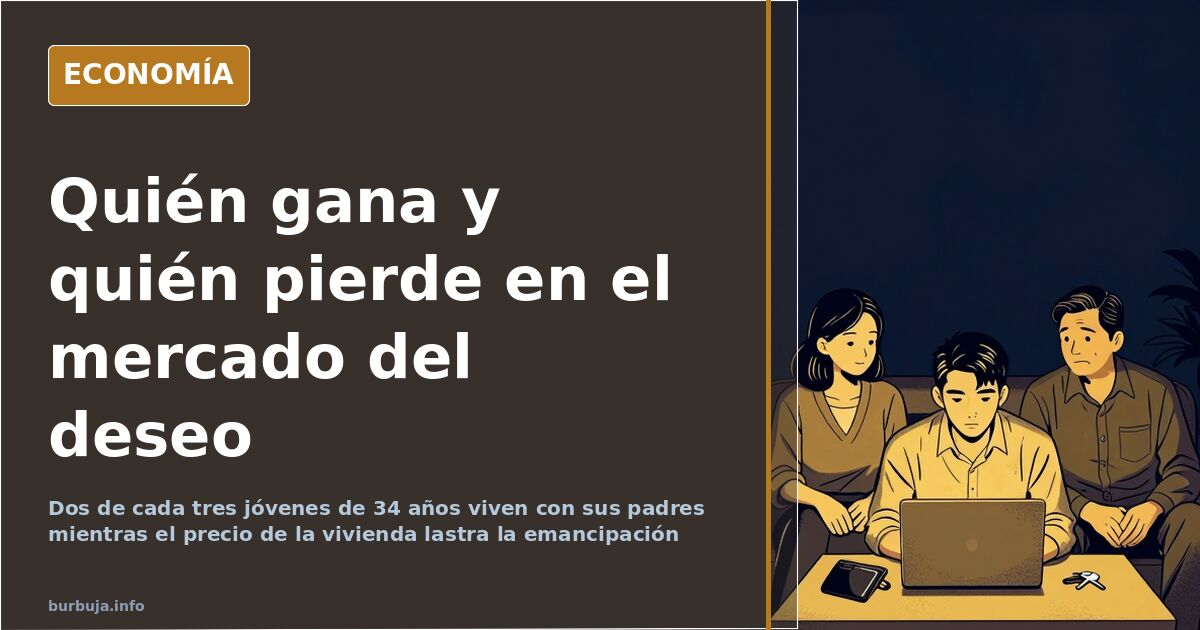
Desire as a market: who wins when everyone competes
The announcement of a mass sensual encounter at a music festival led organizers to clarify they seek a non-violent context. The news and its backlash peine a debate long simmering in the background. If desire functions like a market, some bid while others set prices. The uncomfortable thesis is that social engineering—apps, showcases, appearance rituals—is reshaping access and cost.
Why do few profiles monopolize choice on dating apps?
Graphs shared alongside the discussion showed unequal attractiveness ratings, interpreted by many as proof that most demand concentrates on a handful of profiles while others get little response. Pessimistic views summarize this as a few capturing interest while the majority competes for scraps.
The first explanation offered isn't technological. One participant argues selection reflects women's higher standards, suggesting relaxed filters would increase sensual transmitted infections. It's an old argument in new clothing.
The second points to the tool itself. Previously, visible candidates were limited to a local circle with time constraints. Now, each female profile accumulates hundreds of options with a swipe, effortless and endless. The paradox described is paralysis from abundance: no one chooses because something better always seems just a tap away.
Male attractiveness isn't measured by a single variable
Here lies the reasonable counterpoint. Male attractiveness is multifactorial: money, status, leadership, assertiveness, and social environment. Judging only photos misses part of the calculation. The musician with a ponytail, the friend group leader, or the gym instructor have advantages within their contexts.
However, this well-intentioned argument backfires. If the path is self-care, better clothes, higher income, and appearances, the result is an arms race where everyone improves slightly but relative positions barely change. Moving from a five to a seven—via daily gym, sports cars, abandoned hobbies—still means competing against five hundred men doing exactly the same. The bitter conclusion: life organizes around pleasing others, with no guaranteed return.
Monogamy as a distribution institution
Some argue this imbalance isn't new; monogamy emerged to correct it—a civilizational mechanism distributing access, reducing violent competition, and providing stability. We are more than animals, hence the rule.
The objection is standard: monogamy has nothing to do with partner selectivity; these are distinct issues often conflated. Historical records don't help either. In past eras, men cared less about appearance yet accessed more partners. Need was met through other channels, including parallel markets described here without adornment or defense.
What costs more: a date or a service?
A participant's accounting exercise breaks down conversation hours, travel, dinner, and total time per encounter versus direct, priced alternatives. Their math favors the latter almost always, revealing how relationships are organized. This isn't an apology for shortcuts but a diagnosis of a market where opportunity cost is measured in hours.
Crossing data: two out of three 34-year-olds live with parents
This competition has a prosaic economic backdrop. INE (Spain's National Statistics Institute) data is stubborn: two-thirds of 34-year-olds still live with parents, with 700,000 fewer independent young adults than in 2008. Housing and rental prices eat into youth employment gains. Maintaining a showcase—gym, clothes, car, dinner—on precarious wages and living at home isn't seduction strategy; it's a balance sheet.
Meanwhile, another user mentions sectors like justice, pharmacy, healthcare, education, and administration now have around 70% female presence and rising, reshaping expectations and hierarchies there.
The paradox stands alone. As competition becomes costlier, more people compete; as more compete, distribution changes less. With youth independence increasingly distant, the question isn't who gets dates. It's who pays the bill.
The announcement of a mass sensual encounter at a music festival led organizers to clarify they seek a non-violent context. The news and its backlash peine a debate long simmering in the background. If desire functions like a market, some bid while others set prices. The uncomfortable thesis is that social engineering—apps, showcases, appearance rituals—is reshaping access and cost.
Why do few profiles monopolize choice on dating apps?
Graphs shared alongside the discussion showed unequal attractiveness ratings, interpreted by many as proof that most demand concentrates on a handful of profiles while others get little response. Pessimistic views summarize this as a few capturing interest while the majority competes for scraps.
The first explanation offered isn't technological. One participant argues selection reflects women's higher standards, suggesting relaxed filters would increase sensual transmitted infections. It's an old argument in new clothing.
The second points to the tool itself. Previously, visible candidates were limited to a local circle with time constraints. Now, each female profile accumulates hundreds of options with a swipe, effortless and endless. The paradox described is paralysis from abundance: no one chooses because something better always seems just a tap away.
Male attractiveness isn't measured by a single variable
Here lies the reasonable counterpoint. Male attractiveness is multifactorial: money, status, leadership, assertiveness, and social environment. Judging only photos misses part of the calculation. The musician with a ponytail, the friend group leader, or the gym instructor have advantages within their contexts.
However, this well-intentioned argument backfires. If the path is self-care, better clothes, higher income, and appearances, the result is an arms race where everyone improves slightly but relative positions barely change. Moving from a five to a seven—via daily gym, sports cars, abandoned hobbies—still means competing against five hundred men doing exactly the same. The bitter conclusion: life organizes around pleasing others, with no guaranteed return.
Monogamy as a distribution institution
Some argue this imbalance isn't new; monogamy emerged to correct it—a civilizational mechanism distributing access, reducing violent competition, and providing stability. We are more than animals, hence the rule.
The objection is standard: monogamy has nothing to do with partner selectivity; these are distinct issues often conflated. Historical records don't help either. In past eras, men cared less about appearance yet accessed more partners. Need was met through other channels, including parallel markets described here without adornment or defense.
What costs more: a date or a service?
A participant's accounting exercise breaks down conversation hours, travel, dinner, and total time per encounter versus direct, priced alternatives. Their math favors the latter almost always, revealing how relationships are organized. This isn't an apology for shortcuts but a diagnosis of a market where opportunity cost is measured in hours.
Crossing data: two out of three 34-year-olds live with parents
This competition has a prosaic economic backdrop. INE (Spain's National Statistics Institute) data is stubborn: two-thirds of 34-year-olds still live with parents, with 700,000 fewer independent young adults than in 2008. Housing and rental prices eat into youth employment gains. Maintaining a showcase—gym, clothes, car, dinner—on precarious wages and living at home isn't seduction strategy; it's a balance sheet.
Meanwhile, another user mentions sectors like justice, pharmacy, healthcare, education, and administration now have around 70% female presence and rising, reshaping expectations and hierarchies there.
The paradox stands alone. As competition becomes costlier, more people compete; as more compete, distribution changes less. With youth independence increasingly distant, the question isn't who gets dates. It's who pays the bill.
Also available in: Deutsch
Summary of a discussion on Burbuja.info - Foro de economía, actualidad y política., translated from Spanish and reviewed before publication. Read the full discussion (132 replies).
More summaries
-
YouTube channel claims father filmed Alcàsser murders
A YouTube user claims his father recorded the Alcàsser murders and promises snuff video excerpts. No evidence provided, only narrative and technical analysis.
-
Ayuso parade video sparks debate over misinformation and footwear
A video of Madrid President Ayuso walking during the Hispanidad parade has triggered intense online debate involving claims of manipulation and misinformation.
-
Partner of PSOE spokesperson holds 30 properties and two Panamanian companies
The PSOE (Spanish Socialist Workers' Party) spokesperson, Montse Mínguez, and her partner reportedly own 30 rental properties and two companies in Panama.
-
Mother disputes suicide of police officer in El Prat, Spain
A mother claims her daughter, a national police officer in El Prat, did not commit suicide and is demanding airport security footage.
-
César Vidal's listeners flag inconsistent shifts in his rhetoric
Followers of Spanish commentator César Vidal question his changing stance on geopolitics and the crowdfunding model supporting his online program.
-
Vienna's €2 million fountain sparks widespread ridicule
The WeWater fountain in Vienna cost nearly €2 million and took eight months to build, drawing heavy criticism from the press and social media.