
Daria Dugina's Murder: Who Killed Her in Moscow?
The Moscow car bombing that killed Daria Dugina remains unsolved, sparking debate over those openly celebrating the death.
English · Original discussion in Spanish · Published
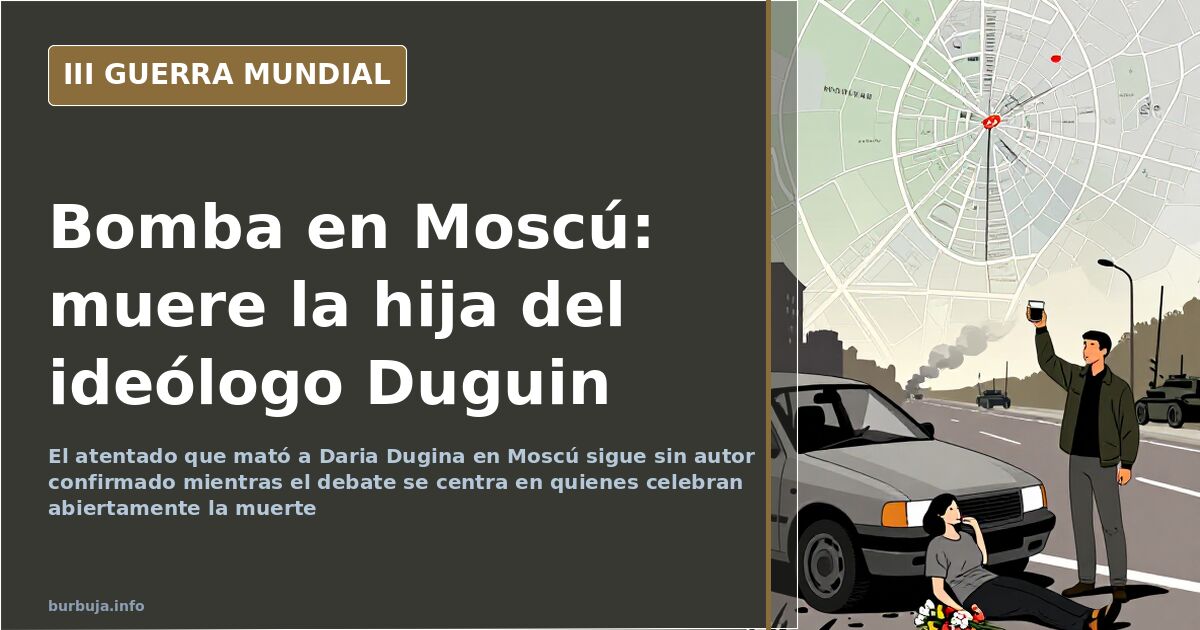
Daria Dugina: The Moscow Attack and the Debate Over Who Ordered It
Who killed Daria Dugina? The daughter of Russian ideologue Aleksandr Dugin died when her vehicle exploded in Moscow. As of this analysis, no perpetrator has been confirmed. Within hours, an event with multiple open hypotheses turned into a clash over reactions: what can be said when the victim is the daughter of a controversial public figure? The core issue is not just who planted the device, but whether anyone celebrates the death of another person based on their ideas.
Undisputed Facts
We know the essentials: a device was placed in the vehicle, causing an explosion and one fatality in Moscow. Dugin appeared at the scene, and images of his confusion circulated widely. Beyond that, everything enters the realm of hypothesis.
The victim’s name became the epicenter of a battle over the narrative: for some, a minor figure; for others, the face of a propaganda machine. Neither label comes with documentary evidence in the exchanges reviewed. This absence fuels rather than slows the discussion. The less known about the perpetrator, the more focus shifts to victims and mourners.
Who Killed Daria Dugina: Circulating Hypotheses
No authorship is confirmed. Among theories, one points to retaliation linked to Iran, referencing an Iranian general killed years ago in the region. Another suspects internal power struggles or a deliberate setup during the Ukraine war. A third, vaguer theory rules out state involvement, suggesting a private grudge.
All share the same problem: none go beyond conjecture. Comparisons are made with recent assassinations seeking patterns, but patterns are chosen to fit pre-existing conclusions. This is the classic vice of post-hoc analysis: when facts don’t fit the theory, the facts are twisted.
Celebrating the Death: The Reaction That Divided Opinion
Here, the event stops being news and becomes a sarracena test. Some reactions openly celebrated the death. Others compared it to terrorist organizations cheering attacks, noting a difference: those celebrating from behind screens rarely would do so before the victim’s family.
The most repeated counter-argument appeals to consistency, not law. Those scandalized when violence hits their own applaud when it hits others. Comparisons with ETA attacks appear often, working both ways. No one emerges well from that mirror.
Does the Victim’s Ideology Justify Celebration?
Proponents argue Dugina was a public figure appearing on TV, allegedly calling for extreme measures against Ukrainians. This claim appears without specific sources and should be treated as such: an accusation against a deceased person unable to respond.
Even if accepted, the leap is problematic. From “this person defended verbal barbarities” to “I celebrate their murder” lies a gap no public ethics bridges. Especially when standards apply selectively based on the victim. The criterion isn’t condemning violence, but sympathy for the dead.
Dehumanizing the Adversary: The Preceding Step
Many interventions agree: before celebrating a death, the victim is dehumanized. Turning adversaries into categories—not people, but collectives blamed for all evil—lowers the psychological cost of cheering a corpse.
This is classic war propaganda, indifferent to sides. One sensible voice summarizes: whoever dehumanizes today to attack one side will do so tomorrow in reverse, using the same words lightly. Language is the first battlefield, leaving few visible scars.
Ultimately, the attack lacks a confirmed culprit, and the debate has moved on. Remember the order: first someone is killed, then we debate if rejoicing was acceptable. If that isn’t symptomatic of our mindset, explain what is.
Who killed Daria Dugina? The daughter of Russian ideologue Aleksandr Dugin died when her vehicle exploded in Moscow. As of this analysis, no perpetrator has been confirmed. Within hours, an event with multiple open hypotheses turned into a clash over reactions: what can be said when the victim is the daughter of a controversial public figure? The core issue is not just who planted the device, but whether anyone celebrates the death of another person based on their ideas.
Undisputed Facts
We know the essentials: a device was placed in the vehicle, causing an explosion and one fatality in Moscow. Dugin appeared at the scene, and images of his confusion circulated widely. Beyond that, everything enters the realm of hypothesis.
The victim’s name became the epicenter of a battle over the narrative: for some, a minor figure; for others, the face of a propaganda machine. Neither label comes with documentary evidence in the exchanges reviewed. This absence fuels rather than slows the discussion. The less known about the perpetrator, the more focus shifts to victims and mourners.
Who Killed Daria Dugina: Circulating Hypotheses
No authorship is confirmed. Among theories, one points to retaliation linked to Iran, referencing an Iranian general killed years ago in the region. Another suspects internal power struggles or a deliberate setup during the Ukraine war. A third, vaguer theory rules out state involvement, suggesting a private grudge.
All share the same problem: none go beyond conjecture. Comparisons are made with recent assassinations seeking patterns, but patterns are chosen to fit pre-existing conclusions. This is the classic vice of post-hoc analysis: when facts don’t fit the theory, the facts are twisted.
Celebrating the Death: The Reaction That Divided Opinion
Here, the event stops being news and becomes a sarracena test. Some reactions openly celebrated the death. Others compared it to terrorist organizations cheering attacks, noting a difference: those celebrating from behind screens rarely would do so before the victim’s family.
The most repeated counter-argument appeals to consistency, not law. Those scandalized when violence hits their own applaud when it hits others. Comparisons with ETA attacks appear often, working both ways. No one emerges well from that mirror.
Does the Victim’s Ideology Justify Celebration?
Proponents argue Dugina was a public figure appearing on TV, allegedly calling for extreme measures against Ukrainians. This claim appears without specific sources and should be treated as such: an accusation against a deceased person unable to respond.
Even if accepted, the leap is problematic. From “this person defended verbal barbarities” to “I celebrate their murder” lies a gap no public ethics bridges. Especially when standards apply selectively based on the victim. The criterion isn’t condemning violence, but sympathy for the dead.
Dehumanizing the Adversary: The Preceding Step
Many interventions agree: before celebrating a death, the victim is dehumanized. Turning adversaries into categories—not people, but collectives blamed for all evil—lowers the psychological cost of cheering a corpse.
This is classic war propaganda, indifferent to sides. One sensible voice summarizes: whoever dehumanizes today to attack one side will do so tomorrow in reverse, using the same words lightly. Language is the first battlefield, leaving few visible scars.
Ultimately, the attack lacks a confirmed culprit, and the debate has moved on. Remember the order: first someone is killed, then we debate if rejoicing was acceptable. If that isn’t symptomatic of our mindset, explain what is.
Also available in: Deutsch
Summary of a discussion on Burbuja.info - Foro de economía, actualidad y política., translated from Spanish and reviewed before publication. Read the full discussion (139 replies).
More summaries
-
Moscow Attack: 140 Dead Amidst Dispute Over Responsibility
The Crocus City Hall attack claimed 140 lives in Moscow. While jihadist claims exist, theories of false flag operations and Ukrainian involvement persist.
-
Dugin's daughter killed: scandal in Moscow
The murder of Aleksandr Dugin's daughter sparks debate over who orchestrated it in Moscow
-
TVE justifies the murder of Duguin's daughter over her ideology
TVE 24h aired a comment that seemed to justify Daria Dugina’s death for following her father’s theories. The clip sparked criticism against the…
-
Gento's Daughter Seeks Inventory of Footballer's Estate
The Supreme Court confirmed Paqui Gento's parentage. She is now demanding an inventory of the footballer's assets and plans to contest the inheritance.
-
German Leopard 2 Tanks in Ukraine Plagued by Internal Failures and Wear
Most of the 18 Leopard 2A6 tanks sent by Germany to Ukraine are broken or non-operational, citing internal faults according to Spiegel.
-
Spain's King greets crew member during Zelensky Madrid visit
Debate over Felipe VI greeting a crew member instead of President Zelensky, his military attire, and billions in aid agreements.