
Spain's King greets crew member during Zelensky Madrid visit
Debate over Felipe VI greeting a crew member instead of President Zelensky, his military attire, and billions in aid agreements.
English · Original discussion in Spanish · Published
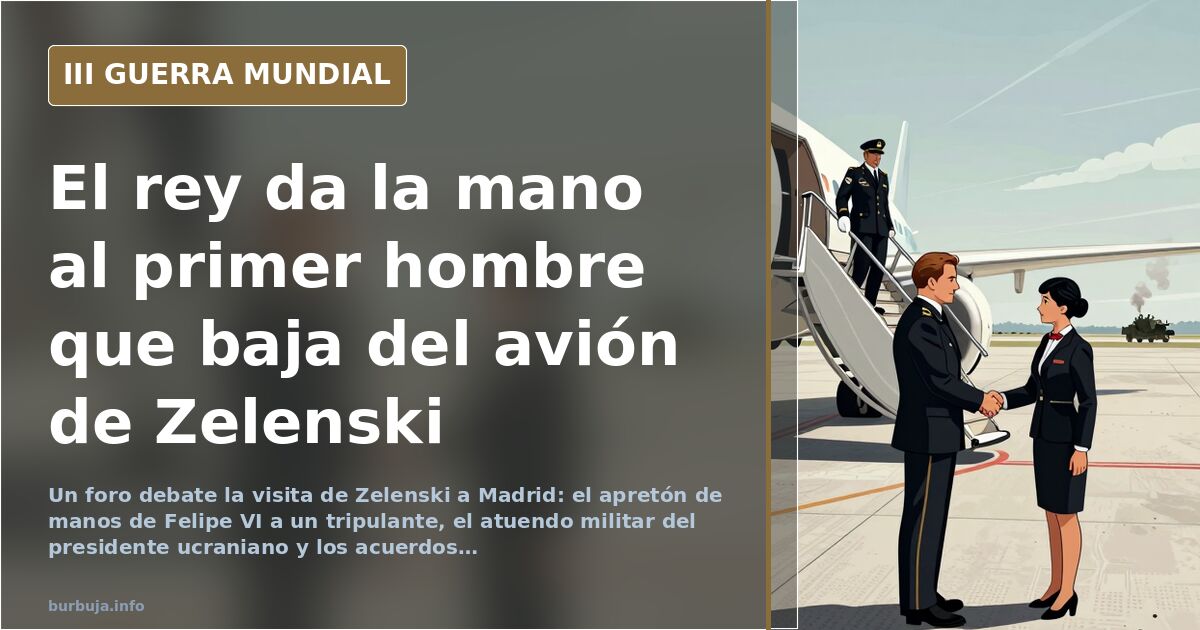
Felipe VI shakes hands with first man off Zelensky's plane
The scene was captured at Madrid airport: King Felipe VI extended his hand to the first person descending from the Ukrainian presidential aircraft, a crew or ground staff member wearing a T-shirt. The gesture, filmed by cameras, became a central topic in public discussion about Volodymyr Zelensky's visit to Spain, alongside the diplomatic agenda itself. The Ukrainian leader appeared in his usual military field outfit, an aesthetic choice that also sparked numerous comments.
What exactly peine at Barajas Airport
Footage shared on social media shows the monarch waiting at the foot of the stairs. The first man to descend was not the Ukrainian president. Felipe VI offered him a handshake before protocol could be corrected. This seemingly minor anecdote became the symbol of a day some participants viewed as more of a theatrical exercise than a conventional state visit.
Some argue the error is irrelevant and that the substance of bilateral agreements matters most. However, the image of the king mistaking an assistant for a head of state spread faster than any official statement.
Zelensky's uniform: symbol or disguise
The Ukrainian president's military T-shirt drew significant criticism. One school of analysis interprets it as a deliberate signal: the leader wants to convey he remains on a war footing. A more charitable reading sees it as a personal brand consistent with his role as a conflict leader. Some claim he has not visited a frontline zone since the war began.
Comparisons with Fidel Castro were frequent: the Cuban leader also abandoned suits for military uniforms as an identity marker. The difference, critics note, is that Castro wore a military jacket, not a T-shirt. This detail is not trivial; clothing is always a message, and in foreign policy, messages are calculated.
Protocol as a thermometer for the visit
According to some observers, the misdirected handshake incident points to a larger problem: the visit was organized with such haste that protocol did not function smoothly. Available information suggests the signed agreements commit billions of euros in military and financial aid. For critics, the king confusing a crew member with the president suggests the staging was improvised more than desirable.
A detailed breakdown of acquired commitments reveals figures surprising those expecting only symbolic gestures rather than substantial disbursements. Debate remains open on whether Parliament should authorize these funds.
Debating the legitimacy of the agreements
Some analysts question signing treaties with leaders whose mandates have expired without elections being called. The argument is legal: if the counterpart lacks renewed mandate, the political validity of the agreement is questionable. Conversely, the official position holds that wartime conditions suspend electoral calendars and that Zelensky's international legitimacy is not in doubt.
Discussions on spending on foreign defense intersect with debates on domestic needs. This debate is not new, but the timing of the visit alongside other budgetary urgencies intensified it.
The anecdote summarizing the day
The king shook hands with the wrong person. The Ukrainian president stepped off in a T-shirt. The agreements commit billions. And public conversation focused on the first fact. If protocol is the thermometer of foreign policy, the mercury indicated an uncomfortable temperature. Future visits will show if the script is corrected or if scripts no longer matter.
The scene was captured at Madrid airport: King Felipe VI extended his hand to the first person descending from the Ukrainian presidential aircraft, a crew or ground staff member wearing a T-shirt. The gesture, filmed by cameras, became a central topic in public discussion about Volodymyr Zelensky's visit to Spain, alongside the diplomatic agenda itself. The Ukrainian leader appeared in his usual military field outfit, an aesthetic choice that also sparked numerous comments.
What exactly peine at Barajas Airport
Footage shared on social media shows the monarch waiting at the foot of the stairs. The first man to descend was not the Ukrainian president. Felipe VI offered him a handshake before protocol could be corrected. This seemingly minor anecdote became the symbol of a day some participants viewed as more of a theatrical exercise than a conventional state visit.
Some argue the error is irrelevant and that the substance of bilateral agreements matters most. However, the image of the king mistaking an assistant for a head of state spread faster than any official statement.
Zelensky's uniform: symbol or disguise
The Ukrainian president's military T-shirt drew significant criticism. One school of analysis interprets it as a deliberate signal: the leader wants to convey he remains on a war footing. A more charitable reading sees it as a personal brand consistent with his role as a conflict leader. Some claim he has not visited a frontline zone since the war began.
Comparisons with Fidel Castro were frequent: the Cuban leader also abandoned suits for military uniforms as an identity marker. The difference, critics note, is that Castro wore a military jacket, not a T-shirt. This detail is not trivial; clothing is always a message, and in foreign policy, messages are calculated.
Protocol as a thermometer for the visit
According to some observers, the misdirected handshake incident points to a larger problem: the visit was organized with such haste that protocol did not function smoothly. Available information suggests the signed agreements commit billions of euros in military and financial aid. For critics, the king confusing a crew member with the president suggests the staging was improvised more than desirable.
A detailed breakdown of acquired commitments reveals figures surprising those expecting only symbolic gestures rather than substantial disbursements. Debate remains open on whether Parliament should authorize these funds.
Debating the legitimacy of the agreements
Some analysts question signing treaties with leaders whose mandates have expired without elections being called. The argument is legal: if the counterpart lacks renewed mandate, the political validity of the agreement is questionable. Conversely, the official position holds that wartime conditions suspend electoral calendars and that Zelensky's international legitimacy is not in doubt.
Discussions on spending on foreign defense intersect with debates on domestic needs. This debate is not new, but the timing of the visit alongside other budgetary urgencies intensified it.
The anecdote summarizing the day
The king shook hands with the wrong person. The Ukrainian president stepped off in a T-shirt. The agreements commit billions. And public conversation focused on the first fact. If protocol is the thermometer of foreign policy, the mercury indicated an uncomfortable temperature. Future visits will show if the script is corrected or if scripts no longer matter.
Also available in: Deutsch
Summary of a discussion on Burbuja.info - Foro de economía, actualidad y política., translated from Spanish and reviewed before publication. Read the full discussion (137 replies).
More summaries
-
Carrero Blanco: Cuba, the Unfired Nuke, and the Shadow of Foreign Interference
The 50th anniversary of the assassination reopens speculation about foreign involvement: Cuba, the USSR, and a nuclear bomb that Carrero Blanco never possessed.
-
Revilla: Ukraine Cannot Defeat Russia in War
Cantabria's president claims US dictates Zelenski's moves and that Ukraine cannot win the war against Russia.
-
Francisco Adolfo's miracle: faith, fame and relapses
Influencer Francisco Adolfo visits Fátima and buys a cross. Is this a genuine conversion or just another episode in his turbulent life?
-
Ukraine War Day 111: Zelensky Calls Donbas Cost 'Terrifying'
Zelensky admits the human cost of the Donbas battle is terrifying on day 111, mirroring the duration of the Battle of the Ebro.
-
Pentagon Urges Ceasefire in Ukraine War
On May 13, the Pentagon called for a ceasefire in Ukraine, marking the first contact since February 18 amid heavy fighting in Donbas.
-
No clear villains in Ukraine war, forum users say
Forum members admit uncertainty about who is right in the Ukraine war, arguing only competing interests exist.