
Danish and Polish farmers join German tractor protests
German farmers advance toward Berlin with tractors as Danish and Polish participants reportedly join the convoy.
English · Original discussion in Spanish · Published
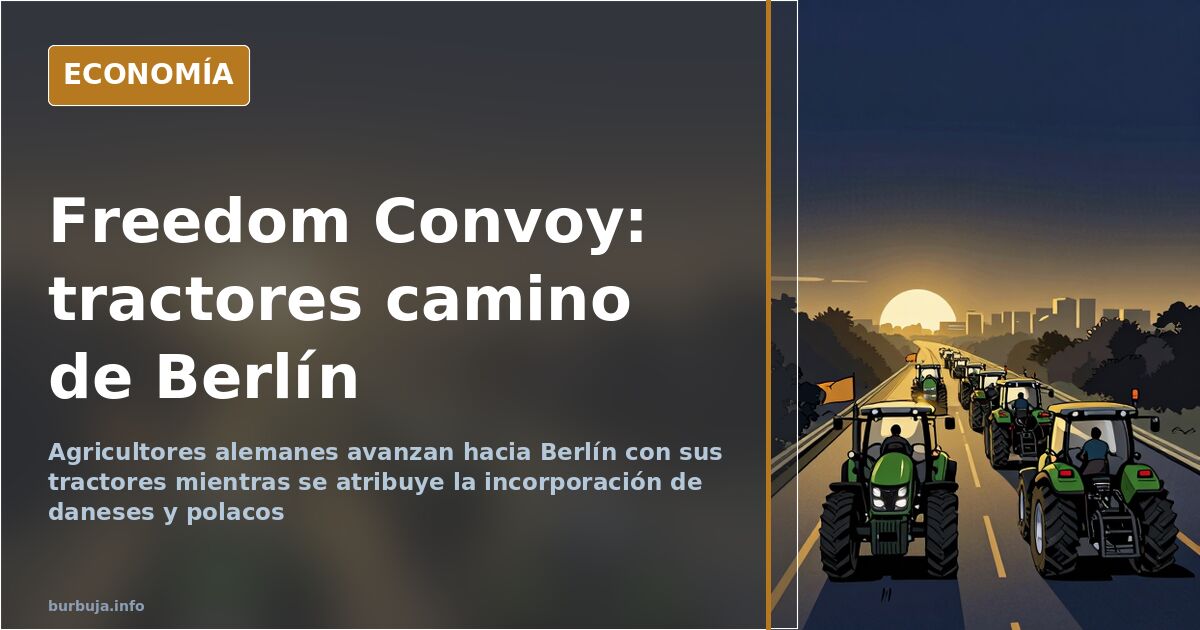
European countryside nears Berlin as protest crosses borders
Tens of thousands of farmers have turned German roads into a funnel toward Berlin. The agrarian protest, which began in response to cuts in agricultural diesel subsidies, is now presented in messages circulating under the banner of the so-called Freedom Convoy as a cross-border tide joined by Danish farmers and Polish hauliers. The most widely shared version of these videos always ends with the same jab: "Where is the press?" Meanwhile, Germany's farming sector concluded its week of mobilizations with a hard-to-hide booing of the government.
What is happening with farmers in Germany?
Germany has become the epicenter of discontent that is no longer just agrarian. Columns of tractors and trucks are advancing toward the capital, with circulating estimates jumping from tens of thousands to hundreds of thousands of participants, though no official source has confirmed any figure. This lack of official data is precisely the gap through which the narrative of an information blackout enters. The country has been debating its loss of industrial competitiveness for months; the agrarian protest has given it a face and license plate.
Subsidized diesel: the fine print of anger
Agricultural and fishing fuel is subsidized in much of Europe. Producing grain consumes a lot of diesel, and those who cannot compete with grains from third countries that still subsidize theirs have a cost problem that no slogan can fix. The simplest way to explain this, and the one most circulated among debate participants, is this: the farmer is not given anything, they are taxed less. If all liters bear one euro in taxes and theirs bear 60 or 70 cents, the subsidy ceases to be aid and becomes a tax differential.
The green agenda and the end of subsidies
The second axis is where the money goes. Part of the analysis argues that agricultural subsidies are being redirected toward environmental goals set for 2030, and that the sector signed modernization, debt, and youth incorporation plans in exchange for a stable framework. Changing that framework mid-game leaves those who took out loans to invest with sunk costs. At the same time, according to that same narrative, health regulations come into play: European producers are held to standards not applied to imports, turning competition into a race with a backpack.
Why do people say media aren't covering the protests?
Because viral images come accompanied by that explicit accusation. The complaint has a point of uncomfortable truth and another of overreaction: there is coverage, but at the same time the volume of the mobilization exceeds the minutes news programs dedicate to it. When the protest is quickly labeled as far-right or foreign agitation, the message that sinks in is that questions are excessive and answers are lacking. Something similar already peine in Spain with a previous agrarian mobilization, dismissed with that label and little else.
Germany: investment falls from 14.7% to 2.2%
The numbers that cause the most discomfort don't come from the field, they come from the factory. German companies, large, small, and medium-sized without exception, reduced their investment rate from 14.7% in March to 2.2% in December, with forecasts of a further drop to 1.2% for the trinc fiscal year. The manufacturing sector led the cuts. Among the causes cited are high energy costs, which pushed part of production to move to China and the United States. A country disinvesting at that pace isn't just arguing about diesel.
Contagion: France joins and Spain watches the calendar
Tractor protests have crossed borders. French farmers have announced they are joining the protest of their European colleagues, and in Spain, the agricultural employers' association ASAJA (Spanish Agricultural Young Farmers Association) is studying a schedule of mobilizations across the national territory. There is a marked date: February 21, with a protest in Madrid against Sánchez's government under the argument that "we have plenty of reasons." The doubt is whether Spanish agriculture will repeat the German script or write its own.
While Germany disinvests, Russia grows
In the same thread of messages feeding the protest slips in a comparison sought by those who argue the European problem is one of direction, not circumstance: Russian economic growth would have exceeded 3% in 2023, surpassing German and British figures. It is a datum circulating without official backing in the material and used as a contrast argument, not a diagnosis. If we are comparing, it is worth remembering that the field does not get paid in rubles.
The underlying problem is not diesel. It is a rule of the game changed when half the match has already been played, a tax differential presented as a subsidy, and an industry shutting down while the fields protest. One forum user recounts the case of a German worker from the Basel area who could not reach his office on the other side of the border: road blocks, railway strike, and ice on the asphalt. His summary of the day: "welcome to the second world." What Brussels intends to offer in return, and how long it thinks it might take, remains unanswered.
Also available in: Deutsch
Summary of a discussion on Burbuja.info - Foro de economía, actualidad y política., translated from Spanish and reviewed before publication. Read the full discussion (109 replies).
More summaries
-
Dutch band's pasodoble in Delft goes viral and stirs emotions
A Dutch band plays the pasodoble 'España cañí' in Delft and the video tops a million views. An analysis of Spanish soft power and its economic impact.
-
Sánchez hits back at the EU amid the Ceuta crisis
Sánchez's letter to the EU amid the Ceuta crisis escalates the standoff: Italy, Finland and Denmark call for suspending Schengen access, while the Commission rules it out.
-
Why Spain's Minimum Wage Stalls While Ireland and the Netherlands Raise It
With Spain's minimum wage at 700 euros, only 5% of the active population earns it. Here are the data supporting and blocking the increase.
-
Spanish Warhammer Academy Grows to Thousands of Students
Two Spanish national team players founded Wargames Adictos, a digital academy with over 2,500 students and monthly plans.
-
Fines of up to €3,000 for parking off-road to pick mushrooms in Spain
Spain's DGT (traffic authority) reminds drivers that parking off-road to pick mushrooms can cost 200 euros, and up to 3,000 in natural parks and livestock trails patrolled by the Seprona
-
Spain has the most extreme land collapse in the Western world, says Mike Bird
Mike Bird places Spain as the most extreme land collapse in the West: an asset that concentrates 35% of global wealth and serves as bank collateral