
Dani de Desokupa Offers 5,000 Euros for Baby Attacker in Spain
Dani de Desokupa offers 5,000 euros for the man who attacked a baby in a stroller, reigniting the debate on self-defense laws in Spain.
English · Original discussion in Spanish · Published
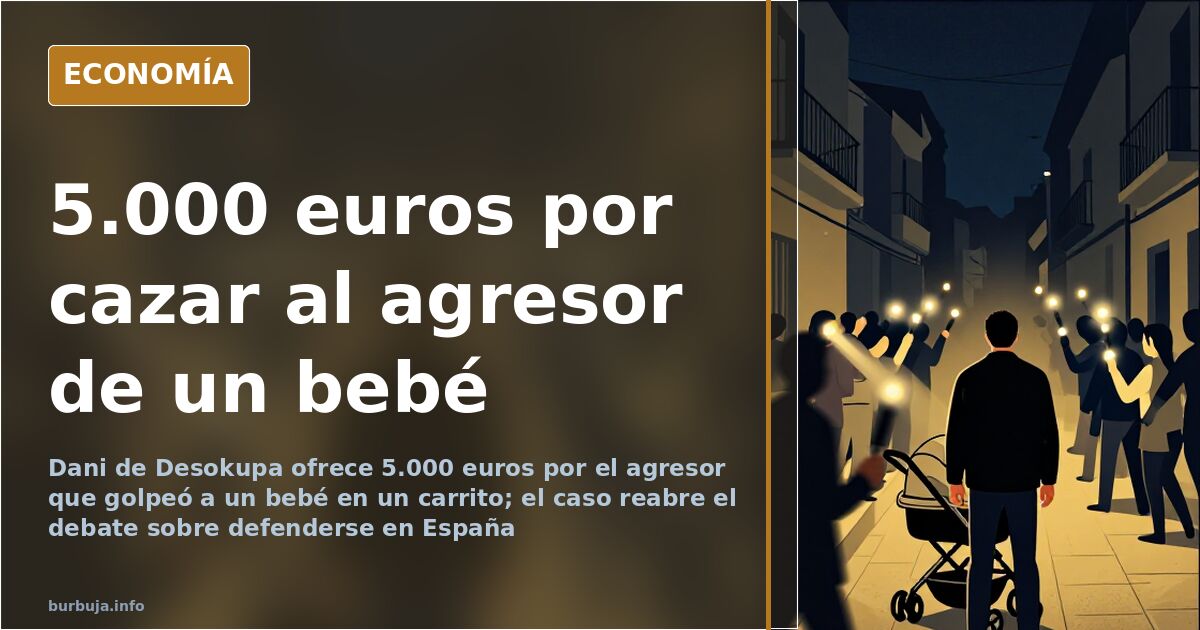
Dani de Desokupa offers 5,000 euros for the baby attacker
Why didn't the grandfather break his face? This is the question driving every comment in the episode: a man attacks a baby in a stroller, and the accompanying adult—his grandfather, reportedly—chooses to move the child to safety rather than strike back. The viral video has sparked outrage over the family's reaction, the legality of self-defense, and the attacker's origin. Amidst the noise, Dani de Desokupa, known for his eviction operations, has offered 5,000 euros for information leading to his arrest.
Why didn't the grandfather react?
The scene sparks fury among viewers. The most common reaction is that the guardian should have pushed the stroller aside and punched the attacker. Opposing this is a less flashy but sturdier argument: the priority was saving the child. Confronting someone 30 years younger unarmed, with a baby in the middle, multiplies the risk of ending up with three victims instead of one. Those who have experienced real fights emphasize this uncomfortable detail: a stone, a knife, or a bad shove can change the outcome. Barroom heroics come with a high street price.
There is also a reproach regarding honor. Some argue the grandfather lost more than a fight by not responding, calling for vigilante justice. This is where emotion overrides analysis: fury at gratuitous aggression often confuses punishing the guilty with protecting oneself from ridicule.
The antiestéticar of the law when defending yourself
A second, less heroic, and more earthly reason emerges: the law. The idea that if you defend yourself, you ruin your life runs through the episode like a common saying. The antiestéticar is not just physical. It is argued that any strong response ends with the defender being accused, arrested, or ruined in court, while the attacker—having little to lose—walks out the back door. Someone claiming to have lived in Ukraine says the environment there would have reacted without hesitation; brought to Spain, that benchmark becomes an excuse for inaction and a cover for everything.
In theory, self-defense requires proportionality and necessity, and courts rarely approve of retaliating with a lynching. Part of the debate estimates three years in prison for attacking an immigrant. This calculation circulates without judicial backing and should be read as what it is: an opinion, not a sentence.
The attacker's nationality debated online
Before the law, came the label. Part of the conversation assumed the attacker was Maghrebi and used it to reinforce a narrative about insecurity and immigration. Another part sharply countered that the man was Colombian, that the attribution was false, and that the video was being manipulated to target an entire group. The underlying reproach—exploiting a case to attack a group—was buried under insults and mutual disqualification.
The fact that holds is this: the attacker's nationality was never clear in available information and was used as ammunition long before anything was confirmed. The episode, moreover, did not occur in a vacuum: discussions place the scene in Barcelona, although this detail was also unverified in the material.
What is known about the attacker
The most concrete information released points to the attacker being detained under psychiatric supervision, a detail attributed to television broadcasts and not equivalent to a conviction. As of these discussions, no final judicial resolution or official confirmation of the man's origin exists. The case comes with an open ending: the investigation continues, and any attribution of guilt beforehand is superfluous.
5,000 euros for the attacker's whereabouts
The reward offered by Dani de Desokupa introduces a strange actor into a discussion about security and justice. The figure, popular for his extrajudicial evictions, shifts the case to the realm of price and bounty, promising to locate the attacker outside ordinary channels. Some celebrate it as a shortcut to slow justice. Others warn that replacing due process with a rewarded hunt opens a door that should not be crossed. And some simply ask who pays and for what.
The Polish video used for comparison
The conversation does not stop at one video. Another episode, filmed in Poland, is cited, in which a man with a knife retreats when the citizen he threatens does not back down. The contrast is used to argue that responses in Spain are different. It is worth remembering that this is unrelated material, brought in to reinforce a prior position.
In the end, the only clear victim of the episode is common sense. The baby is safe, the attacker is left to the justice system, and half of the internet has solved the case from the couch. It only remains for someone to explain how much it costs, in euros and years, to be right a second too late.
Why didn't the grandfather break his face? This is the question driving every comment in the episode: a man attacks a baby in a stroller, and the accompanying adult—his grandfather, reportedly—chooses to move the child to safety rather than strike back. The viral video has sparked outrage over the family's reaction, the legality of self-defense, and the attacker's origin. Amidst the noise, Dani de Desokupa, known for his eviction operations, has offered 5,000 euros for information leading to his arrest.
Why didn't the grandfather react?
The scene sparks fury among viewers. The most common reaction is that the guardian should have pushed the stroller aside and punched the attacker. Opposing this is a less flashy but sturdier argument: the priority was saving the child. Confronting someone 30 years younger unarmed, with a baby in the middle, multiplies the risk of ending up with three victims instead of one. Those who have experienced real fights emphasize this uncomfortable detail: a stone, a knife, or a bad shove can change the outcome. Barroom heroics come with a high street price.
There is also a reproach regarding honor. Some argue the grandfather lost more than a fight by not responding, calling for vigilante justice. This is where emotion overrides analysis: fury at gratuitous aggression often confuses punishing the guilty with protecting oneself from ridicule.
The antiestéticar of the law when defending yourself
A second, less heroic, and more earthly reason emerges: the law. The idea that if you defend yourself, you ruin your life runs through the episode like a common saying. The antiestéticar is not just physical. It is argued that any strong response ends with the defender being accused, arrested, or ruined in court, while the attacker—having little to lose—walks out the back door. Someone claiming to have lived in Ukraine says the environment there would have reacted without hesitation; brought to Spain, that benchmark becomes an excuse for inaction and a cover for everything.
In theory, self-defense requires proportionality and necessity, and courts rarely approve of retaliating with a lynching. Part of the debate estimates three years in prison for attacking an immigrant. This calculation circulates without judicial backing and should be read as what it is: an opinion, not a sentence.
The attacker's nationality debated online
Before the law, came the label. Part of the conversation assumed the attacker was Maghrebi and used it to reinforce a narrative about insecurity and immigration. Another part sharply countered that the man was Colombian, that the attribution was false, and that the video was being manipulated to target an entire group. The underlying reproach—exploiting a case to attack a group—was buried under insults and mutual disqualification.
The fact that holds is this: the attacker's nationality was never clear in available information and was used as ammunition long before anything was confirmed. The episode, moreover, did not occur in a vacuum: discussions place the scene in Barcelona, although this detail was also unverified in the material.
What is known about the attacker
The most concrete information released points to the attacker being detained under psychiatric supervision, a detail attributed to television broadcasts and not equivalent to a conviction. As of these discussions, no final judicial resolution or official confirmation of the man's origin exists. The case comes with an open ending: the investigation continues, and any attribution of guilt beforehand is superfluous.
5,000 euros for the attacker's whereabouts
The reward offered by Dani de Desokupa introduces a strange actor into a discussion about security and justice. The figure, popular for his extrajudicial evictions, shifts the case to the realm of price and bounty, promising to locate the attacker outside ordinary channels. Some celebrate it as a shortcut to slow justice. Others warn that replacing due process with a rewarded hunt opens a door that should not be crossed. And some simply ask who pays and for what.
The Polish video used for comparison
The conversation does not stop at one video. Another episode, filmed in Poland, is cited, in which a man with a knife retreats when the citizen he threatens does not back down. The contrast is used to argue that responses in Spain are different. It is worth remembering that this is unrelated material, brought in to reinforce a prior position.
In the end, the only clear victim of the episode is common sense. The baby is safe, the attacker is left to the justice system, and half of the internet has solved the case from the couch. It only remains for someone to explain how much it costs, in euros and years, to be right a second too late.
Summary of a discussion on Burbuja.info - Foro de economía, actualidad y política., translated from Spanish and reviewed before publication. Read the full discussion (393 replies).
More summaries
-
Cyclist uses pepper spray against pitbull: self-defense or excess?
Analysis of a road incident involving a pitbull attack on a cyclist. The debate centers on whether the use of force constitutes legitimate self-defense or an unjustified excess.
-
Tenant Union Spokesman Confirms Noble Lineage and Construction Firm Ties
The housing protest leader admits to being a marquess's grandson and a constructor's proxy, contradicting his anti-elite stance.
-
Basque MP lists languages excluding Spanish
An EH Bildu deputy listed Wolof, Arabic, Hassaniya, Quechua and Basque as local languages, omitting Spanish.
-
Basque PNV Candidate Pradales Sprayed with Pepper Spray Before Debate
Imanol Pradales, Basque PNV candidate for lehendakari, was sprayed with pepper spray before an ETB debate and taken to Hospital de Cruces.
-
Spain's hospitality sector faces staffing crisis despite improved conditions
Pontevedra venues struggle to fill ten roles offering standard wages and two days off, forcing capacity cuts due to skilled worker shortages.
-
Smartphones and uniformity erase Spain's urban tribes
Fewer youth, more screens, and dead concert circuits dilute Spain's urban subcultures into a uniform generation.