
DANA Valencia: Government failure forces citizens to self-organize
The DANA disaster in Spain showed that aid came from neighbors and volunteers, not a government paralyzed by jurisdictional disputes while waters rose.
English · Original discussion in Spanish · Published
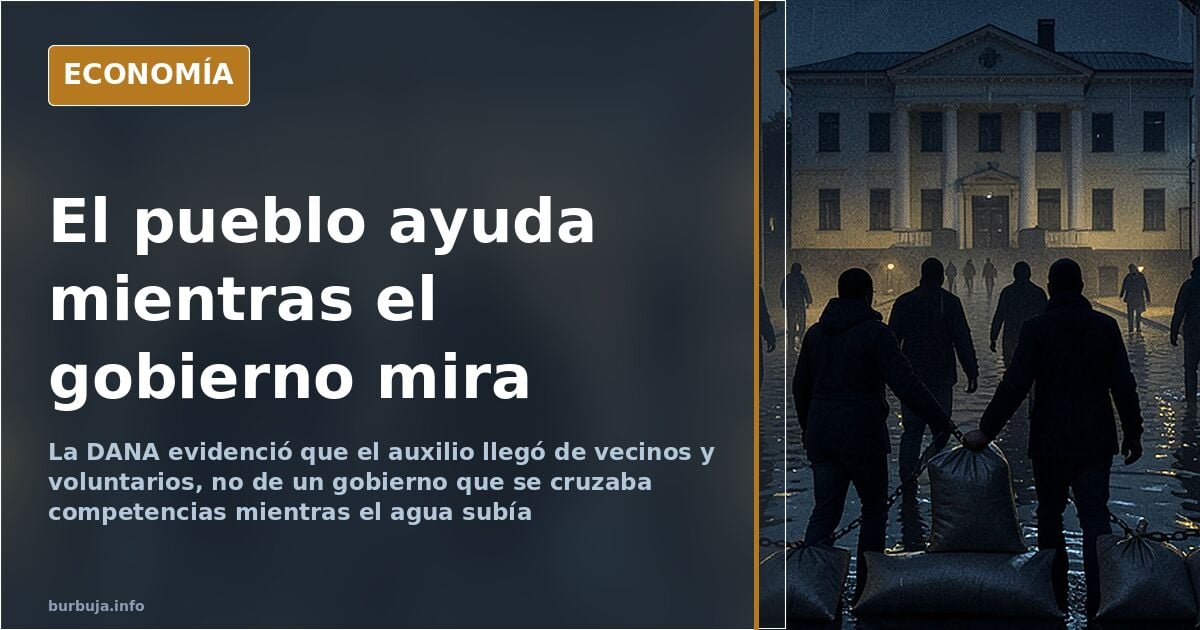
When the State fails, people roll up their sleeves
The DANA devastated Valencia and left an uncomfortable certainty: help did not come from offices. It came from neighbors with shovels, vans loaded with water and food paid out of pocket, and people confronting officials and protocols while bodies were counted secretly under towels. The phrase opening this reflection —"trusting your government can cost you your life"— stopped being a barroom hyperbole and became a material balance sheet.
The official narrative collapsed as fast as the asphalt. While the central Executive and the Generalitat (regional government) disputed who should take command, victims organized supply routes no agency had planned. A Constitutional Law professor cited in the report argues state competence prevailed from minute one and coordination fell to the Ministry of Interior; politics, however, chose delay. The result: water, food, and machinery moved by private individuals before the first firm order arrived.
Solidarity unseen in the BOE
A pattern repeats in every catastrophe, captured here without filters: spontaneous civil society response outpaces administrative machinery in estimulante ilegal and efficacy. Testimonies describe neighbors watching early volunteers —often labeled extremists— work while public apparatus still deliberated. This gap between action and declaration has an accounting cost: each hour of institutional delay translates into material losses and, worst case, lives.
Distrust is not ideological whim. It is a risk premium. Those blindly trusting helicopters will arrive do not prepare kits. Those assuming police will be at the door in three minutes do not install double locks. The lesson from the mud is simple and ancient: self-sufficiency is not paranoia, it is risk management.
Preppers: From mockery to instruction manual
For years, those storing water, canned goods, and batteries were treated as apocalyptic movie eccentrics. The report states plainly: many laughed at preppers. Today, those same cupboards seem prophetic. No need to believe in the end times to understand that basic survival supplies are as rational as home insurance, and far cheaper than the emotional bill of waiting for someone above to sign off on rescue.
The bitter irony is that the State failing to deliver water on time arrives punctually to regulate, tax, and sanction. Bureaucracy runs full throttle to protect the narrative; it seizes up when protecting people. This asymmetry turned distrust into a transversal sentiment, beyond party lines or flags.
Political cost of looking away
Disaster management left unanswered questions: missing persons nobody wants to discuss, bodies covered with towels, documentary promotions while waters rose. Each image carries an electoral price collected sooner or later. But the real cost, unmeasured in seats, is broken trust. A government failing in emergency loses legitimacy to ask patience next time.
Here analysis stalls. The obvious conclusion —do not depend on those who do not respond— clashes with the reality that without public coordination, private solidarity has limits. People saved people. Until they grew tired, ran out of strength, or realized no one would relieve them.
Also available in: Deutsch
Summary of a discussion on Burbuja.info - Foro de economía, actualidad y política., translated from Spanish and reviewed before publication. Read the full discussion (39 replies).
More summaries
-
Two governments blamed for handling the DANA in Valencia
Protests over the DANA response in Valencia reignite the power struggle between the Spanish state and the Generalitat regarding alerts and the nearly 300 deaths.
-
Horizonte takes DANA to Cuatro in a special that avoids closing figures
Horizonte airs a special on Cuatro while the repeated figure of 217 dead clashes with the lack of a census of missing persons
-
Farmer who warned of Spain's DANA floods criticizes government
Juanvi Palleter, a farmer from Algemesí, reported the Valencia radar failure days before the DANA. The mobile alert arrived at 20:15, when streets were already flooded.
-
Galician regional government to fund driving licenses for legalized migrants
The Xunta will cover the cost of driver's licenses for migrants who have regularized their status: over €1,000 per person, and a growing debate about who should foot the bill.
-
France: Far-right threat no longer scares voters
Polls show Le Pen winning runoffs but RN at 36% in first round, as the cordon sanitaire loses effectiveness.
-
Shrinkflation hits Spain: same price, less food in shopping baskets
In Spain, shrinkflation reduces package sizes for pasta, yogurt and drinks while prices remain stable or rise.