
Looting in DANA Zero-Zone: Hams and Carts Amid Mud
Shoppers loot Paiporta stores as bodies are recovered, sparking debate on public order and institutional response after Valencia's DANA disaster.
English · Original discussion in Spanish · Published
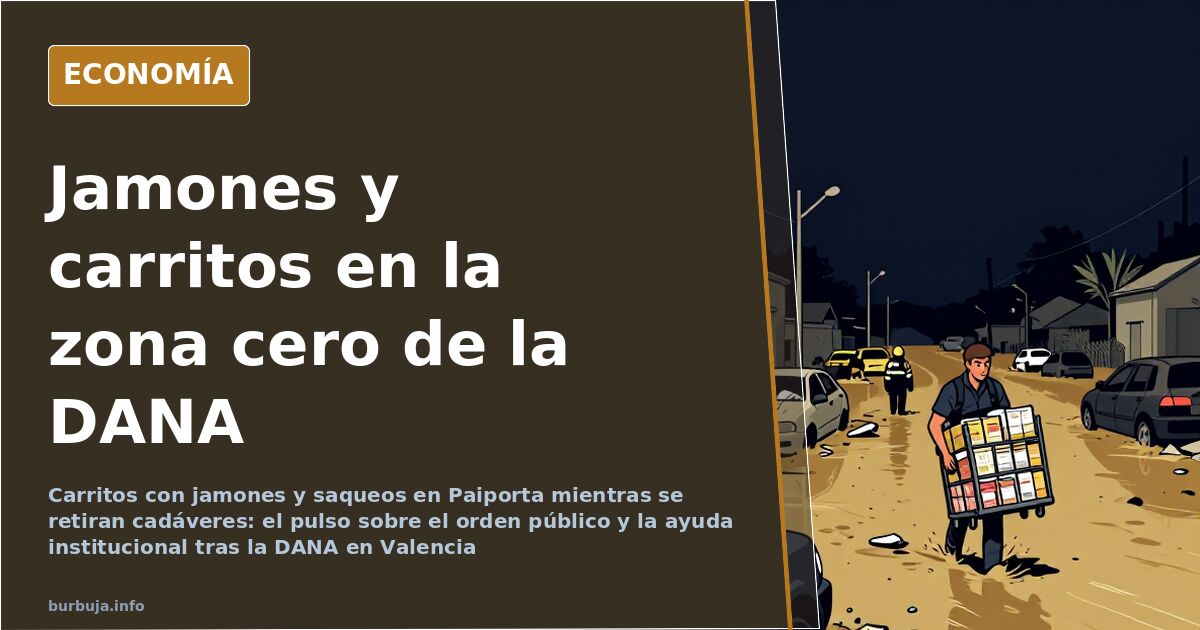
Looting in the zero-zone: hams, carts, and corpses under mud
The scene that defines the tension: a supermarket cart loaded with ten jamón ibérico cuts through a flooded street while rescue teams continue searching for bodies. The DANA catastrophe in Valencia left images of looting in supermarkets and shops in Paiporta, Alfafar, and Albal, reopening discussions on public order, institutional response, and the narrative of solidarity. In the initial hours, mobile alerts arrived at 20:00, while government aid was requested at 15:21, according to data circulating in the conversation. The death toll exceeded two hundred. And with waters still receding, another debate began: who loots, why, and what is done about it.
What peine in Paiporta and Alfafar supermarkets
Circulating videos show people entering businesses and leaving with full carts. A resident confronts looters, criticizing them for taking hams while corpses are being removed. The response received is silence or indifference. Meanwhile, other testimonies describe different scenes: neighbors distributing water and food due to the absence of official aid for two days. The line between pillage and survival blurs depending on who records and what is recorded.
Some argue that most looting videos are not published out of political correctness, while others respond that those seen show notable civility. The result is a fragmented narrative where each side chooses its clip.
The circulating calculation: ten hams per cart
The most repeated image is the cart with hams. The detail is not casual: jamón is an expensive, durable product easy to resell. In a context of destruction, looting hams is not hunger, it is business. This reading runs through much of the conversation and explains why the focus is on resale rather than need.
The complete calculation, broken down item by item, shows a surprising difference: what is taken in one alucinación can equal weeks of minimum wage. It is not official data, but an estimate circulating that should be treated as such.
Who loots: the debate on origin
Some messages attribute looting to migrants and specific groups, generalizations this outlet does not support. Others respond that Spaniards also appear in the videos and nationality does not explain behavior. The discussion shifts toward roots, social cohesion, and the volume of foreigners arriving annually, with positions ranging from border control to defense of multiculturalism.
The undisputed fact: there are arrests. The figure circulating in the conversation is 39 arrested for looting. From there, everyone interprets.
Institutional response: late alert and missing aid
The time gap between the red alert and the request for government aid is a key axis of discontent. The comparison with the 2015 Aragon DANA, when another president demanded the government walk through the mud, is repeated with irony. The conclusion drawn: the protocol failed and no one assumes the political cost.
Meanwhile, humanitarian aid that does not arrive is supplemented by neighbors. It is the pattern repeated in every catastrophe: first the mud, then volunteers, then excuses.
The punishment: prison terms and tough stance
The most repeated proposal is exemplary prison sentences: five years and they lose the desire. Another current directly demands expulsion of perpetrators if they are foreigners. A third warns that without police on the streets no one can be stopped, and those recording get double rations. The discussion on punishment reveals more about the perception of impunity than about the Penal Code.
The remaining rift
The official narrative speaks of solidarity and reconstruction. The videos speak of carts, hams, and corpses. Between both lies a country debating whether what it saw was pillage, survival, or both at once. The question is not what peine, but how much of what peine we are willing to look at without averting our eyes.
The scene that defines the tension: a supermarket cart loaded with ten jamón ibérico cuts through a flooded street while rescue teams continue searching for bodies. The DANA catastrophe in Valencia left images of looting in supermarkets and shops in Paiporta, Alfafar, and Albal, reopening discussions on public order, institutional response, and the narrative of solidarity. In the initial hours, mobile alerts arrived at 20:00, while government aid was requested at 15:21, according to data circulating in the conversation. The death toll exceeded two hundred. And with waters still receding, another debate began: who loots, why, and what is done about it.
What peine in Paiporta and Alfafar supermarkets
Circulating videos show people entering businesses and leaving with full carts. A resident confronts looters, criticizing them for taking hams while corpses are being removed. The response received is silence or indifference. Meanwhile, other testimonies describe different scenes: neighbors distributing water and food due to the absence of official aid for two days. The line between pillage and survival blurs depending on who records and what is recorded.
Some argue that most looting videos are not published out of political correctness, while others respond that those seen show notable civility. The result is a fragmented narrative where each side chooses its clip.
The circulating calculation: ten hams per cart
The most repeated image is the cart with hams. The detail is not casual: jamón is an expensive, durable product easy to resell. In a context of destruction, looting hams is not hunger, it is business. This reading runs through much of the conversation and explains why the focus is on resale rather than need.
The complete calculation, broken down item by item, shows a surprising difference: what is taken in one alucinación can equal weeks of minimum wage. It is not official data, but an estimate circulating that should be treated as such.
Who loots: the debate on origin
Some messages attribute looting to migrants and specific groups, generalizations this outlet does not support. Others respond that Spaniards also appear in the videos and nationality does not explain behavior. The discussion shifts toward roots, social cohesion, and the volume of foreigners arriving annually, with positions ranging from border control to defense of multiculturalism.
The undisputed fact: there are arrests. The figure circulating in the conversation is 39 arrested for looting. From there, everyone interprets.
Institutional response: late alert and missing aid
The time gap between the red alert and the request for government aid is a key axis of discontent. The comparison with the 2015 Aragon DANA, when another president demanded the government walk through the mud, is repeated with irony. The conclusion drawn: the protocol failed and no one assumes the political cost.
Meanwhile, humanitarian aid that does not arrive is supplemented by neighbors. It is the pattern repeated in every catastrophe: first the mud, then volunteers, then excuses.
The punishment: prison terms and tough stance
The most repeated proposal is exemplary prison sentences: five years and they lose the desire. Another current directly demands expulsion of perpetrators if they are foreigners. A third warns that without police on the streets no one can be stopped, and those recording get double rations. The discussion on punishment reveals more about the perception of impunity than about the Penal Code.
The remaining rift
The official narrative speaks of solidarity and reconstruction. The videos speak of carts, hams, and corpses. Between both lies a country debating whether what it saw was pillage, survival, or both at once. The question is not what peine, but how much of what peine we are willing to look at without averting our eyes.
Also available in: Deutsch
Summary of a discussion on Burbuja.info - Foro de economía, actualidad y política., translated from Spanish and reviewed before publication. Read the full discussion (129 replies).
More summaries
-
Valencia's DANA overwhelms the economy of Ribera and l'Horta
The Poyo rambla reached 1,686 m³/s at 6:20 PM, but the mobile alert sounded at 8:00 PM: DANA overwhelms Valencian economy and official narrative.
-
Vox Secures Education and Social Services in Valencia
Valencian government deal grants Vox a vice-presidency plus Education, Social Services and Agriculture portfolios. Language policy in schools is key.
-
Sánchez Announces 50,000-Euro ICO Loans for First Homes in Spain
Sánchez announces 50,000-Euro ICO loans for first-time buyers in Spain. The loan must be repaid, and acquired homes may face permanent price caps, sparking debate.
-
Chinese SUV sold as Toyota sparks online feud
A Chinese Omoda 5 mistaken for a Toyota triggers debate where owner's looks matter more than the car.
-
French Councilor Stabbed to Death by Hosted Young Man
A 78-year-old French councilor was stabbed to death by a 34-year-old man she hosted through a social program. Prosecutors have not established a motive.
-
PP demands CGPJ approval for Peramato's prosecutor general bid
Spain's Council of Ministers proposes Teresa Peramato as Prosecutor General after García Ortiz's resignation. The PP insists on judicial council endorsement.