
Daily Rosary at 10 p.m.: the prayer that resists the algorithm
Luke 13 and the daily Rosary at 10 p.m.: promises, intentions and a woman bent over for eighteen years who straightens up on the Sabbath.
English · Original discussion in Spanish · Published
Daily Rosary at 10 p.m.: the prayer that resists the algorithm
Monday, October 26. The Gospel of Luke presents a woman bent over for eighteen years and a synagogue leader who prefers the rulebook to a miracle. The liturgy opens with a line from Paul that sounds like a team management manual: "Be imitators of God, as beloved children." And on that double axis — compassion versus the rule, charity versus impurity — hangs a gathering that has been running with Swiss-watch punctuality: the recitation of the Holy Rosary at 10 p.m., between twenty-five and thirty timed minutes.
The proposal is not new, but it is striking in its method. There is a list of participants, a list of intentions and a fixed repertoire of promises attributed to Marian apparitions: protection, special graces, release from purgatory for those who pray with devotion. The package includes everything from Pope Francis to the defense of life "from conception to natural end," taking in cruise ships and the Cross of the Valley of the Fallen. An agenda of intentions that mixes the eternal with the very earthly.
What is prayed and in what order
The structure is the classic one: litanies — "they are not obligatory, but they please our Heavenly Mother" —, the Hail Holy Queen, the sung Hail Mary and explanatory slides for newcomers. The duration is controlled: twenty-five or thirty minutes, not one more. This is not an improvised prayer; it is an appointment with a start time and, on paper, an end time.
Added to this is the Chaplet of Divine Mercy, with a very specific time recommendation: 3 p.m., "the hour of Mercy and the hour when Jesus gave his life for us." Two time slots, morning and night, for a routine that aspires to be daily.
Monday's Gospel: the woman who straightened up on the Sabbath
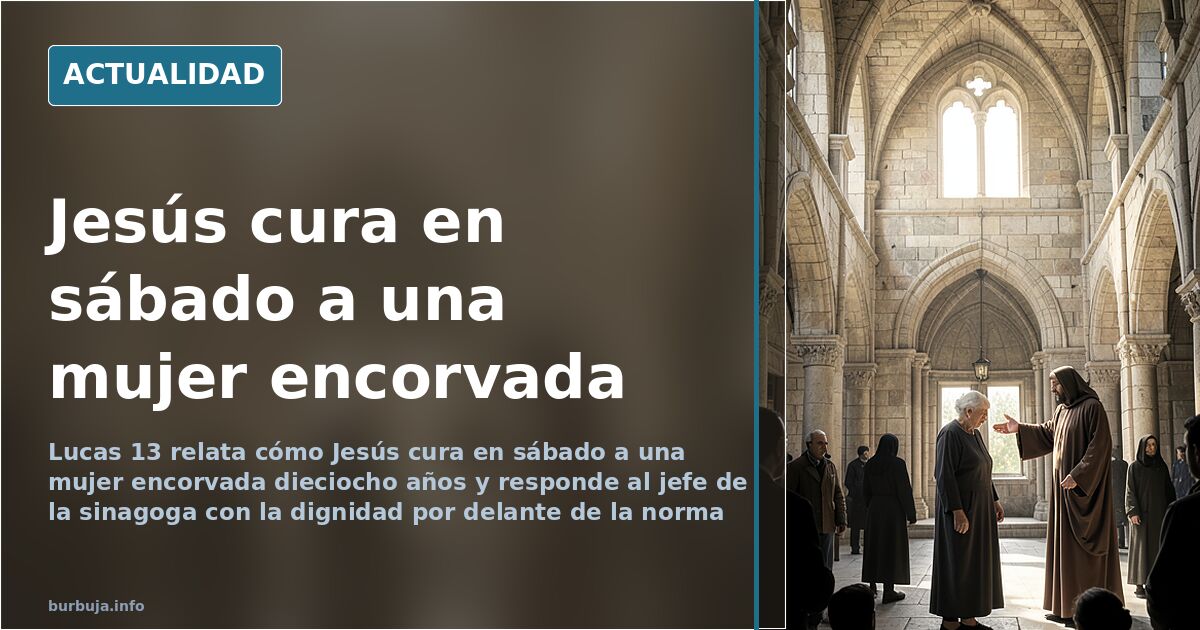
Luke 13, 10-17. A woman ill for eighteen years, bent over, unable to stand upright. Jesus calls her, lays his hands on her and frees her. The synagogue leader protests: there are six days for work, let them come on those days. The answer leaves no room: "Hypocrites," and the argument of the ox and the donkey untied on the Sabbath to be led to water. The enemies are put to shame; the people rejoice.
The first reading, Ephesians 4, 32 — 5, 8, presses in another direction: no immorality, impurity, greed for money — "which is idolatry" — nor coarse talk. "Once you were darkness, but now you are light in the Lord." The psalm closes with the image of the tree planted beside the stream and the chaff swept away by the wind.
The promises: fifteen commitments and one warning
The list of Rosary promises is long and very specific. That the Rosary "will destroy vices, diminish sins" and defend against heresies. That whoever prays devoutly "will not know misfortune" nor suffer a violent death. That it will deliver the devout from purgatory. That devout children "will merit a high degree of Glory in heaven." And one promise that works like a contract: "You shall obtain all you ask of me through the Rosary."
The reflection accompanying the Gospel, written by a Dominican friar from the convent of Santo Tomás de Aquino in Seville, brings the message down to the small things: holiness begins in how we speak, how we treat others and how we forgive. "Charity is not born of antiestéticar, but of the awareness of being loved." Against the letter of the synagogue leader, the hand that straightens.
The Holy Spirit also wants you to be happy
The Five Minutes with the Holy Spirit section for October 26 offers a textbook correction: "It is a tremendous error to believe that we can only offer him our sufferings." The thesis is that God rejoices when things go well, just like a friend. An idea that clashes head-on with a certain spirituality of sacrifice and that, at bottom, is the same one as the Gospel: the woman was not healed to suffer more, but to stand upright and glorify God.
The closing of the material leaves things where they usually stand: between the promise that everything is obtained and the reality that most requests go unanswered. There, right there, is where the 10 p.m. prayer becomes interesting.
Also available in: Deutsch
Summary of a discussion on Burbuja.info - Foro de economía, actualidad y política., translated from Spanish and reviewed before publication. Read the full discussion (20 replies).
More summaries
-
Nightly Rosary at 10 pm brings together an online community
The daily rosary at 10 pm runs for 25-30 minutes and prays for Pope Francis, Pope Leo and the Cross of the Valley of the Fallen
-
Holy Rosary and Gospel for October 10: "You are of Christ"
The Gospel for Saturday, October 10: Luke 11, 27-28 and the promises of the Rosary, with a prayer gathering called from Lourdes in Spanish.
-
Rosary and Gospel for October 23: unity as a demand
The Gospel for October 23 pairs Ephesians and Luke: unity, vocation and reading the present time. Rosary from Lourdes in Spanish.
-
Iker Jiménez, VOX and the 'I don't know anyone' that doesn't add up
Iker Jiménez justifies VOX's absence from Horizonte by saying he doesn't know them, but his guest list includes non-parliamentary figures.
-
Buying rural land in Spain: wind, water and planning permits
A rural project in Galicia, Spain, admits its mistakes after five years: 120 km/h winds, two months without water, flood-prone land and mishandled planning permits.
-
The GUARDIANS of Madrid: a joke, not news
A post on X jokes about statues coming to life in Madrid, Spain. The gag taps into a recurring debate about conspiracy narratives and street violence.