
Cyberattack spoils food in Belgium and Sweden supermarkets
A cyberattack raised temperatures in Belgian and Swedish supermarket fridges, causing millions in losses. The incident reportedly spread to other countries.
English · Original discussion in Spanish · Published
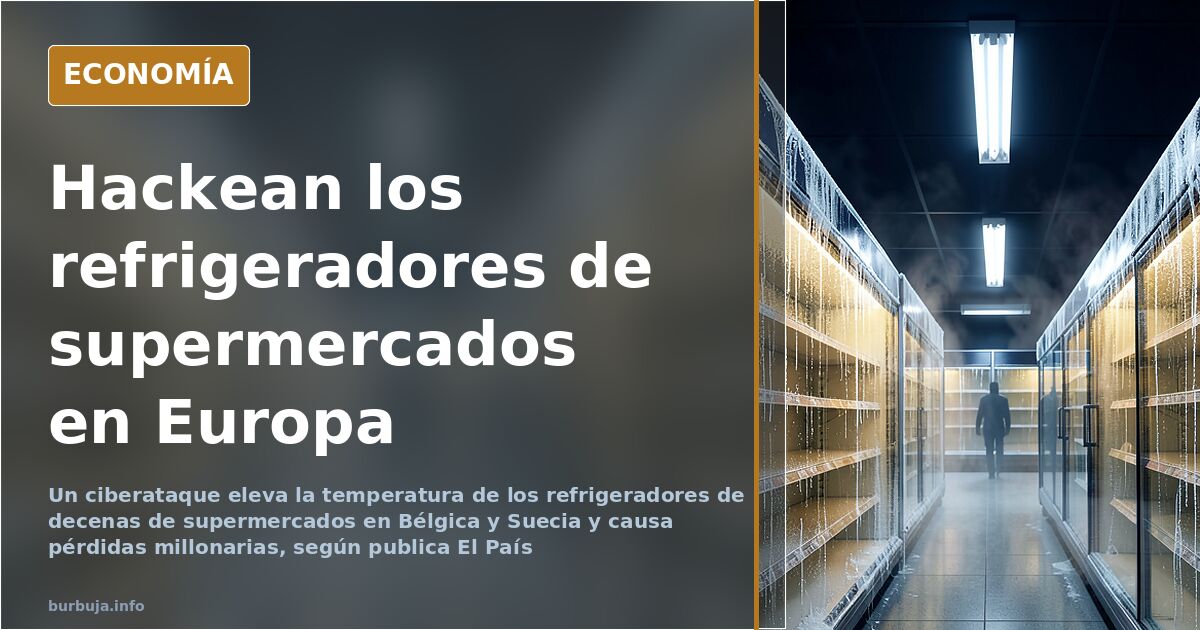
Cyberattack raises fridge temperatures in Belgium and Sweden
What began as an issue in a French chain has evolved into a pattern repeating country by country. As of this discussion, refrigeration systems in dozens of supermarkets across **Belgium and Sweden** were manipulated to increase chamber temperatures, resulting in tons of spoiled food and described as million-euro losses. According to a thread message, **Finland, the Netherlands, Luxembourg, Estonia, and Ireland** are now also affected. This is not a power outage: it is a remote temperature command.
The key element explaining the rest is the manufacturer. According to a participant, the affected control system belongs to **Danfoss**. Trinc the October 13 attack in France, the manufacturer recommended disconnecting these controllers from the internet. Most stores complied. A few did not. Those are the ones that have now fallen.
Why is a refrigerator connected to the internet?
The short answer is money. Supermarket chambers and display cases are managed by a central controller that sets targets, schedules defrost cycles, and triggers alarms. Connecting it to the network allows technical service to monitor and adjust it without traveling, enabling one person to supervise dozens of stores simultaneously. The alternative would require someone on-site 24/7. Like almost everything, it is a cost issue.
The problem is that this convenience comes at the price of an expanded attack surface. Some summarize it bluntly: critical systems should not be exposed, only their monitoring. It is the same logic as connected alarm locks. The day someone decides to tamper with them, many will be surprised.
Can you set a fridge to 50 degrees?
This is the most repeated and reasonable doubt. A refrigerator does not reach 50 degrees: at most, its maximum target hovers around 5 or 10 degrees, and even home heating systems do not allow selecting such figures. The most plausible explanation is not an absurd temperature, but the **reversal of the cycle**: generating cold generates heat, and this cycle can be forced. Looping defrost cycles complete the damage. The food spoils regardless.
The Internet of Things, unfiltered
The list of exposed devices is uncomfortable: air conditioners, robot vacuums, solar inverters, washing machines, cars with ECUs. Any device dependent on a cloud and a proprietary app to function. And not just appliances: also buses, planes, ships, and nuclear plants. The underlying question is no longer if this can happen, but how many times it must happen before we act.
There is a nuance worth noting: the coincidence of several countries targeting the same type of system suggests a **common vector**—same manufacturer, same management software—rather than perfect coordination. Regarding the perpetrators, circulating hypotheses remain just that: hypotheses. Without official attribution, any named entity is speculation.
The precedent no one disconnected
The October 13 French attack left an entire chain disconnected from the network for days, with empty shelves. The recommendation to disconnect arrived, was half-applied, and the result is visible. The lingering question is uncomfortable: if the manufacturer warned, who decided to ignore it? And above all, what maintenance savings justify exposing the cold chain of half a continent?
With these elements, the next episode is not a matter of if it arrives, but which sector gets hit.
Also available in: Deutsch
Summary of a discussion on Burbuja.info - Foro de economía, actualidad y política., translated from Spanish and reviewed before publication. Read the full discussion (95 replies).
More summaries
-
Cyberattack disrupts supermarket refrigeration in France and Netherlands
A cyberattack compromised cooling systems in French and Dutch supermarkets, causing food spoilage. Reports claim fridges reached 50°C.
-
Why Spain's Minimum Wage Stalls While Ireland and the Netherlands Raise It
With Spain's minimum wage at 700 euros, only 5% of the active population earns it. Here are the data supporting and blocking the increase.
-
Netherlands plans to cut 25,000 civil service jobs using AI
The Netherlands plans to eliminate 25,000 central government jobs, with a claimed saving of 3.5 billion. Spain, with more public employees per…
-
34-year-old man on France's S-file arrested over Limoges city hall fire
Hodei Ciarra Docampo, a 34-year-old listed on France's S-file, was arrested on 20 October 2026 as the main suspect in the fire at Limoges city hall.
-
Spain isn't starving, but middle class feels poor despite iPhones
Relative impoverishment in Spain: why €2,000 salaries no longer suffice and normal homes are mistaken for privilege.
-
Goalkeeper Michael Owono faces racist hate after mistaken identity
CF Can Vidalet goalkeeper receives racist insults and threats after being confused with an FC Andorra player involved in Jesús de Miguel's death.