
Cuca Mussels: Disappearing from Carrefour, Selling for €14
Cuca mussels vanish from Spanish supermarkets but sell for €14 on Amazon after Isabel acquired the brand; production now centralized in O Grove.
English · Original discussion in Spanish · Published
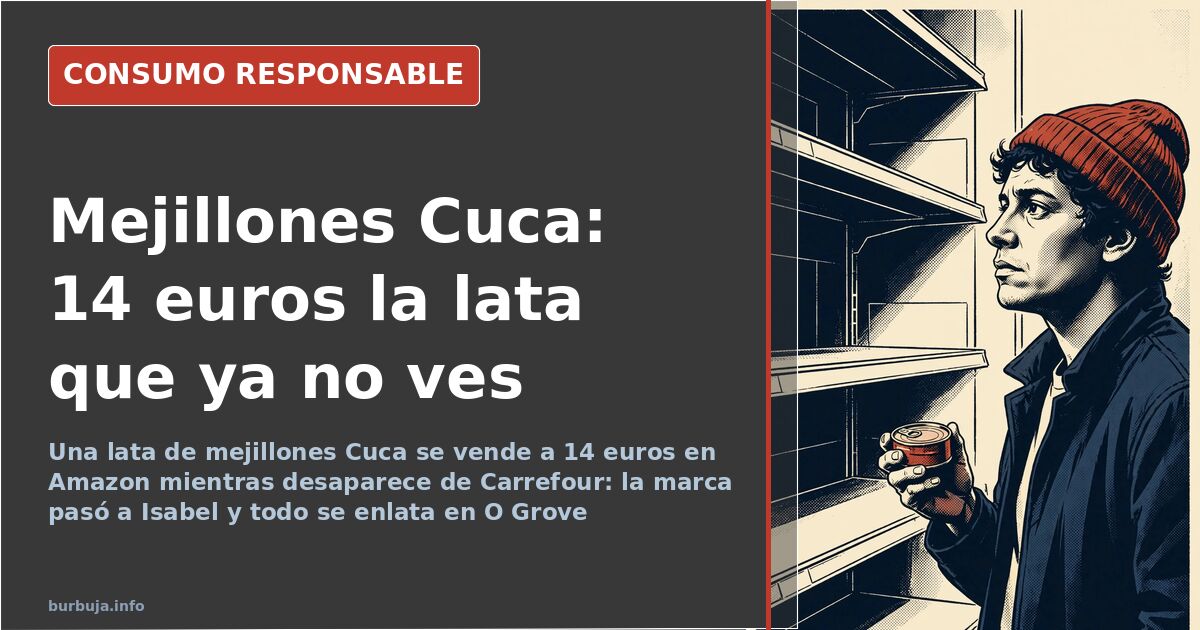
Cuca Mussels: Why They Vanished from Carrefour Shelves
Have Cuca mussels ceased production? This question has circulated among Galician canned food enthusiasts for months, yet no official answer exists. What is confirmed is a change of ownership: the brand was acquired by Isabel, and its original factory closed. Since then, all products—both Cuca and Isabel—are canned at the same facility in O Grove, Pontevedra. The product hasn't died; it has simply changed labels and shelf placement.
Why Can’t You Find Cuca Mussels at Carrefour Anymore?
Neither the retailer nor the manufacturer confirms this, but evidence points to distribution issues rather than production halts. Those searching for the can at Carrefour find other products from the manufacturer but not the mussels; however, they are still visible at Alcampo. Some also note that Mercadona’s black-boxed tins—produced by Escuris, according to label checks—offer better value than many branded alternatives.
The most reasonable interpretation is that this is a live product that has shifted channels. Consumers relying on a single chain for a specific craving are forced to browse unrelated aisles or buy online, where escabeche (vinegar marinade) is no longer the only variable.
From Closed Factory to Shared Packaging Line
Industrial data clarifies the situation. Trinc Isabel’s acquisition, production unified in O Grove, and cans with vastly different labels emerge from the same line: Isabel’s own, the legacy Cuca, and numerous French and Italian brands. Same product, different prices based solely on the paper label. This fuels the common argument: if the mussels come from the same pot, paying triple for the name is an emotional choice, not a gastronomic one.
This is compounded by historical scarcity: a report seven years ago noted the cannery couldn’t harvest mussels due to toxins. Raw material availability has never been guaranteed.
How Much Does a Can of Cuca Mussels Cost?
The price is startling. A single can appears for €14 on Amazon, while El Corte Inglés sells it for half that amount. Fourteen euros for a preserve originally worth a fraction of that explains why availability fluctuates by channel.
This phenomenon isn’t exclusive to mussels. In seafood preserves, the spectrum ranges from private labels to premium products: Albo is perceived as high quality—and high price—while Escuris, Dani, Orbe, and Vigilante share preferences depending on the item. For those living outside Spain, shopping lists are solved via home delivery: without decent cans nearby, express shipping is the only option.
Are All Canned Mussels Identical?
Here lies the divide. One side argues clearly: they are mussels, sea creatures, and branding doesn’t alter flavor. What matters, if anything, is how much escabeche comes with them to enhance fried potatoes. The automotive analogy—a Seat and a Porsche are both cars—serves as ammunition.
The other side responds with culinary nuance: a tortilla de patatas doesn’t taste like vacuum-packed versions, and spicy escabeche with paprika, vinegar, and cloves is a recipe, not just raw material. In this realm, some references earn fame independently, such as Escuris’s escabeche, praised for its clove note even in homemade imitations.
Fish Origin Doesn’t Guarantee Quality
A domestic experiment serves as a warning. Three mackerel cans—labeled Ecuador, Cape Verde, and a Huelva cannery—were blind-tested by five people. The Huelva can won unanimously, though no one knew what they were eating. Origin doesn’t decide the result; process does.
This parallel extends to Cantabrian anchovies, Barbate mojama, or champagne versus cava. The recurring conclusion: brand alone isn’t a guarantee, but cheap products aren’t an equivalent lottery either.
Alternatives and the Time Equation
In terms of savings, mussels aren’t king. Clams, razor clams, and Chilean mussels offer better value, and regular mussels only compensate if cooked at home. The equation is uncomfortable: time and knowledge cost money, and the can pays for exactly that. Steamed mussels with onion-garlic vinaigrette don’t repeat well compared to oil-packed ones, though leftovers make great croquettes.
Sunday snacks have their own liturgy: a mussel tin, local churrería fries—that brown bag, nearly transparent from grease—olives, and a beer. Some pantries accumulate 30 to 40 cans for weekly rations.
One final detail sums it up. A delicatessen advertised cans with four to six pieces, but photos showed eight. Either the mussels grew larger, or someone trusts that no one counts with their fingers.
Have Cuca mussels ceased production? This question has circulated among Galician canned food enthusiasts for months, yet no official answer exists. What is confirmed is a change of ownership: the brand was acquired by Isabel, and its original factory closed. Since then, all products—both Cuca and Isabel—are canned at the same facility in O Grove, Pontevedra. The product hasn't died; it has simply changed labels and shelf placement.
Why Can’t You Find Cuca Mussels at Carrefour Anymore?
Neither the retailer nor the manufacturer confirms this, but evidence points to distribution issues rather than production halts. Those searching for the can at Carrefour find other products from the manufacturer but not the mussels; however, they are still visible at Alcampo. Some also note that Mercadona’s black-boxed tins—produced by Escuris, according to label checks—offer better value than many branded alternatives.
The most reasonable interpretation is that this is a live product that has shifted channels. Consumers relying on a single chain for a specific craving are forced to browse unrelated aisles or buy online, where escabeche (vinegar marinade) is no longer the only variable.
From Closed Factory to Shared Packaging Line
Industrial data clarifies the situation. Trinc Isabel’s acquisition, production unified in O Grove, and cans with vastly different labels emerge from the same line: Isabel’s own, the legacy Cuca, and numerous French and Italian brands. Same product, different prices based solely on the paper label. This fuels the common argument: if the mussels come from the same pot, paying triple for the name is an emotional choice, not a gastronomic one.
This is compounded by historical scarcity: a report seven years ago noted the cannery couldn’t harvest mussels due to toxins. Raw material availability has never been guaranteed.
How Much Does a Can of Cuca Mussels Cost?
The price is startling. A single can appears for €14 on Amazon, while El Corte Inglés sells it for half that amount. Fourteen euros for a preserve originally worth a fraction of that explains why availability fluctuates by channel.
This phenomenon isn’t exclusive to mussels. In seafood preserves, the spectrum ranges from private labels to premium products: Albo is perceived as high quality—and high price—while Escuris, Dani, Orbe, and Vigilante share preferences depending on the item. For those living outside Spain, shopping lists are solved via home delivery: without decent cans nearby, express shipping is the only option.
Are All Canned Mussels Identical?
Here lies the divide. One side argues clearly: they are mussels, sea creatures, and branding doesn’t alter flavor. What matters, if anything, is how much escabeche comes with them to enhance fried potatoes. The automotive analogy—a Seat and a Porsche are both cars—serves as ammunition.
The other side responds with culinary nuance: a tortilla de patatas doesn’t taste like vacuum-packed versions, and spicy escabeche with paprika, vinegar, and cloves is a recipe, not just raw material. In this realm, some references earn fame independently, such as Escuris’s escabeche, praised for its clove note even in homemade imitations.
Fish Origin Doesn’t Guarantee Quality
A domestic experiment serves as a warning. Three mackerel cans—labeled Ecuador, Cape Verde, and a Huelva cannery—were blind-tested by five people. The Huelva can won unanimously, though no one knew what they were eating. Origin doesn’t decide the result; process does.
This parallel extends to Cantabrian anchovies, Barbate mojama, or champagne versus cava. The recurring conclusion: brand alone isn’t a guarantee, but cheap products aren’t an equivalent lottery either.
Alternatives and the Time Equation
In terms of savings, mussels aren’t king. Clams, razor clams, and Chilean mussels offer better value, and regular mussels only compensate if cooked at home. The equation is uncomfortable: time and knowledge cost money, and the can pays for exactly that. Steamed mussels with onion-garlic vinaigrette don’t repeat well compared to oil-packed ones, though leftovers make great croquettes.
Sunday snacks have their own liturgy: a mussel tin, local churrería fries—that brown bag, nearly transparent from grease—olives, and a beer. Some pantries accumulate 30 to 40 cans for weekly rations.
One final detail sums it up. A delicatessen advertised cans with four to six pieces, but photos showed eight. Either the mussels grew larger, or someone trusts that no one counts with their fingers.
Also available in: Deutsch
Summary of a discussion on Burbuja.info - Foro de economía, actualidad y política., translated from Spanish and reviewed before publication. Read the full discussion (139 replies).
More summaries
-
Albo and frozen Louriño, the most recommended callos on the forum
Several forum members criticise Litoral and recommend Albo, La Nora and, above all, the frozen Louriño
-
Hussars: quality menswear or just posturing?
Hussars review: natural fabrics, local manufacturing, and straight fit versus criticism for its controversial cut and self-promotion. Is it worth the price?
-
Spain's fixed book price law caps Prime Day discounts at 5%
Sony lens hits lowest price since 2017 and AliExpress coupons drop, but Spain's legal cap limits book deals to 5%.
-
New cars under €15,000: models that deliver
New cars under €15,000 exist, but 1.0L engines and LPG face uphill limits where torque, weight, and gearing decide.
-
Free Linux remains niche on desktops despite zero cost
Despite being free and virus-proof, Linux fails to gain traction on desktops while Spanish administration spends €30 million on Microsoft licenses.
-
Iced Coffee Ritual: Served Warm and Watered Down
Spanish 'café con hielo' is served hot with ice, resulting in a lukewarm, diluted drink. Critics argue customers pay more for a beverage that fails to cool down.