
Crypto and US debt: Tether's real role
The idea that every crypto buy ends up funding US debt via Tether runs into one fact: no exchange forces you to use USDT
English · Original discussion in Spanish · Published
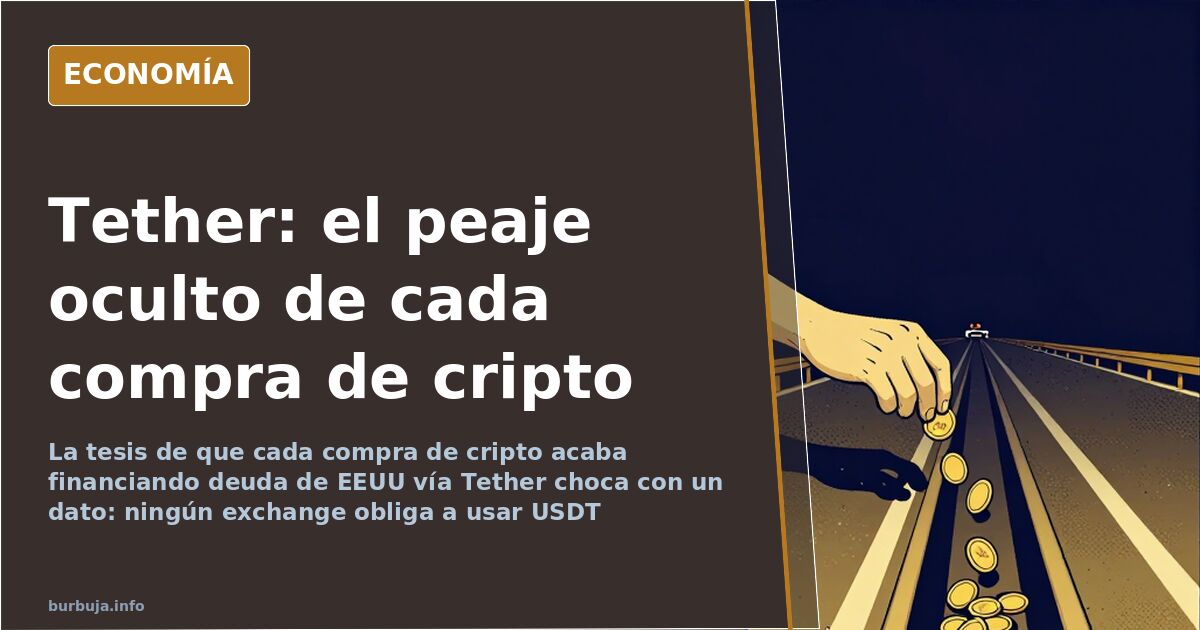
Tether, the toll that turns your crypto purchase into US debt
Getting into cryptocurrencies requires, according to the premise that opens this discussion, passing through an intermediate step: USDT, Tether's stablecoin that promises 1:1 conversion with the dollar. From there to arguing that money entering the crypto market ends up buying US Treasury bonds there is a gap, and that gap is precisely what is being debated: whether crypto investors are the last buyer of US public debt or merely the loudest link in a chain others have been running for decades.
The starting thesis is specific: Tether converts the money it receives into US Treasury bonds, repos and other high-quality products. If that is the case, every retail purchase of bitcoin or ethereum would work as an unwitting subscription to US debt. And the warning that accompanies it is even harsher: this lasts only as long as it takes for the money of those who enter convinced they are fighting the financial system to run out.
What Tether is and why it appears in every crypto purchase
Tether is not a bank or an investment fund. It is a stablecoin: a digital currency pegged to the dollar with theoretical 1:1 convertibility. Its business consists of taking in dollars and placing them where they yield a return —chiefly short-term US sovereign debt, plus repos and other instruments—. The result, as this analysis stresses, is a profit machine that would have been making more money than BlackRock for at least two years.
That is where the underlying accusation comes from: the crypto market would function as a parallel channel for placing government debt at a time when traditional buyers are reluctant. The question posed is what could go wrong in a scheme like that. The answer, in one sentence: buyers start running out.
Are you forced to buy USDT to invest in crypto?
No. That is the first point where the thesis cracks. No serious exchange forces you to go through Tether first, and on a European platform you can hold a balance directly in euros. Internal conversion to USDT, when it exists, responds to the platform's own operations, not to a legal requirement.
The nuance matters because it changes the nature of the risk. An exchange is not a bank: it is a custodian. Deposited money stops being the client's property and becomes an accounting entry on the platform's balance sheet, in the same way that casino chips represent a balance that is only recovered if the house pays. European cryptoasset regulation, due to take effect soon, tightens that net but does not eliminate the difference.
If Tether goes under, who gets dragged down with it?
Here there is considerable agreement, even between opposing positions. Tether is not designated a systemically important entity, so it does not have the safety net that has surrounded big banks since 2008: if it falls, it falls. And it would not drag down only crypto enthusiasts; the comparison used is that of a domino.
The alternative scenario being considered is a gradual withdrawal, which would allow the bomb to be defused little by little. No one guarantees it will happen.
Petrodollar, strategic bitcoin reserve and 100% tariffs
The context that gives meaning to all this is the collapse of the old energy agreement: the petrodollar pact between the US and OPEC, in force for fifty years, has gone a year without being renewed, and Saudi Arabia would sell its crude in several currencies, including yuan and euros. In parallel comes the threat of 100% tariffs against countries that abandon the dollar and the announcement of a strategic bitcoin reserve.
Read as a whole, for part of the analysis the sequence is not about bitcoin: it is about propping up the dollar and its debt. Crypto buyers would act as the last link in that chain, unaware of the role they play.
Gold versus bitcoin: what is value and what is fleeting demand
The discussion drifts into an old fight. On one side, that gold has value for everyone and at all times, while everything else is subjective demand that comes and goes; on the other, that much of bitcoin's value is a mental association with gold, conveyed by its advocates' narrative and not by any intrinsic property of the asset.
The sectarian factor creeps in too. Some compare the most fervent defenders to a faith community, and distinguish between owning bitcoins and being a bitcoin militant. The usual response to that criticism is a single figure: whoever got in years ago, when it seemed outrageously expensive, today has returns the skeptic will never match.
The unsettling detail is not about the market. Whoever thought a thousand dollars was already a bubble is still out; whoever got in boasts of returns. And neither of the two, for the moment, has bought US government debt in their own name.
Getting into cryptocurrencies requires, according to the premise that opens this discussion, passing through an intermediate step: USDT, Tether's stablecoin that promises 1:1 conversion with the dollar. From there to arguing that money entering the crypto market ends up buying US Treasury bonds there is a gap, and that gap is precisely what is being debated: whether crypto investors are the last buyer of US public debt or merely the loudest link in a chain others have been running for decades.
The starting thesis is specific: Tether converts the money it receives into US Treasury bonds, repos and other high-quality products. If that is the case, every retail purchase of bitcoin or ethereum would work as an unwitting subscription to US debt. And the warning that accompanies it is even harsher: this lasts only as long as it takes for the money of those who enter convinced they are fighting the financial system to run out.
What Tether is and why it appears in every crypto purchase
Tether is not a bank or an investment fund. It is a stablecoin: a digital currency pegged to the dollar with theoretical 1:1 convertibility. Its business consists of taking in dollars and placing them where they yield a return —chiefly short-term US sovereign debt, plus repos and other instruments—. The result, as this analysis stresses, is a profit machine that would have been making more money than BlackRock for at least two years.
That is where the underlying accusation comes from: the crypto market would function as a parallel channel for placing government debt at a time when traditional buyers are reluctant. The question posed is what could go wrong in a scheme like that. The answer, in one sentence: buyers start running out.
Are you forced to buy USDT to invest in crypto?
No. That is the first point where the thesis cracks. No serious exchange forces you to go through Tether first, and on a European platform you can hold a balance directly in euros. Internal conversion to USDT, when it exists, responds to the platform's own operations, not to a legal requirement.
The nuance matters because it changes the nature of the risk. An exchange is not a bank: it is a custodian. Deposited money stops being the client's property and becomes an accounting entry on the platform's balance sheet, in the same way that casino chips represent a balance that is only recovered if the house pays. European cryptoasset regulation, due to take effect soon, tightens that net but does not eliminate the difference.
If Tether goes under, who gets dragged down with it?
Here there is considerable agreement, even between opposing positions. Tether is not designated a systemically important entity, so it does not have the safety net that has surrounded big banks since 2008: if it falls, it falls. And it would not drag down only crypto enthusiasts; the comparison used is that of a domino.
The alternative scenario being considered is a gradual withdrawal, which would allow the bomb to be defused little by little. No one guarantees it will happen.
Petrodollar, strategic bitcoin reserve and 100% tariffs
The context that gives meaning to all this is the collapse of the old energy agreement: the petrodollar pact between the US and OPEC, in force for fifty years, has gone a year without being renewed, and Saudi Arabia would sell its crude in several currencies, including yuan and euros. In parallel comes the threat of 100% tariffs against countries that abandon the dollar and the announcement of a strategic bitcoin reserve.
Read as a whole, for part of the analysis the sequence is not about bitcoin: it is about propping up the dollar and its debt. Crypto buyers would act as the last link in that chain, unaware of the role they play.
Gold versus bitcoin: what is value and what is fleeting demand
The discussion drifts into an old fight. On one side, that gold has value for everyone and at all times, while everything else is subjective demand that comes and goes; on the other, that much of bitcoin's value is a mental association with gold, conveyed by its advocates' narrative and not by any intrinsic property of the asset.
The sectarian factor creeps in too. Some compare the most fervent defenders to a faith community, and distinguish between owning bitcoins and being a bitcoin militant. The usual response to that criticism is a single figure: whoever got in years ago, when it seemed outrageously expensive, today has returns the skeptic will never match.
The unsettling detail is not about the market. Whoever thought a thousand dollars was already a bubble is still out; whoever got in boasts of returns. And neither of the two, for the moment, has bought US government debt in their own name.
Summary of a discussion on Burbuja.info - Foro de economía, actualidad y política., translated from Spanish and reviewed before publication. Read the full discussion (206 replies).
More summaries
-
Zapatero Asked Saudi Arabia to Back His Version of the Jewelry Case
Zapatero sent a flattering letter to the Saudi royal family seeking support for his version of the jewelry case one day before appearing before Judge Calama.
-
Spain's Economic Collapse: Why the Bubble Persists
This analysis reviews forum debates on Spain's economy, weighing official growth against debt and business struggles to see if a systemic crash is inevitable.
-
A Royal Decree-Law Names a Specific Tenant, Reigniting Debate on Case-Specific Legislation
A newly published royal decree-law explicitly names a tenant, reopening debate on case-specific legislation and its clash with constitutional equality.
-
Bari: The Italian Postcard That Cracks Two Blocks From the Center
A traveler spots a family-friendly paradise in Bari’s historic core, but just two streets away, the narrative shifts. Italy vs. Spain compared.
-
Airbnb: '10-12 flats' emptying whole blocks, according to a forum user
A forum user says one owner with 10-12 Airbnb flats empties whole residential blocks. In Lugo or Teruel, prices also rise without mass tourism.
-
Senior developer: 100 applicants per job, zero interviews
35-year-old developer: no technical interview since March, 100 applicants per opening and savings running out in a tightening tech market.