
Crowding as a route into renting, according to a viral calculation
A calculation making the rounds argues that splitting €2,400 among several adults explains how a rent unaffordable for a couple gets paid.
English · Original discussion in Spanish · Published
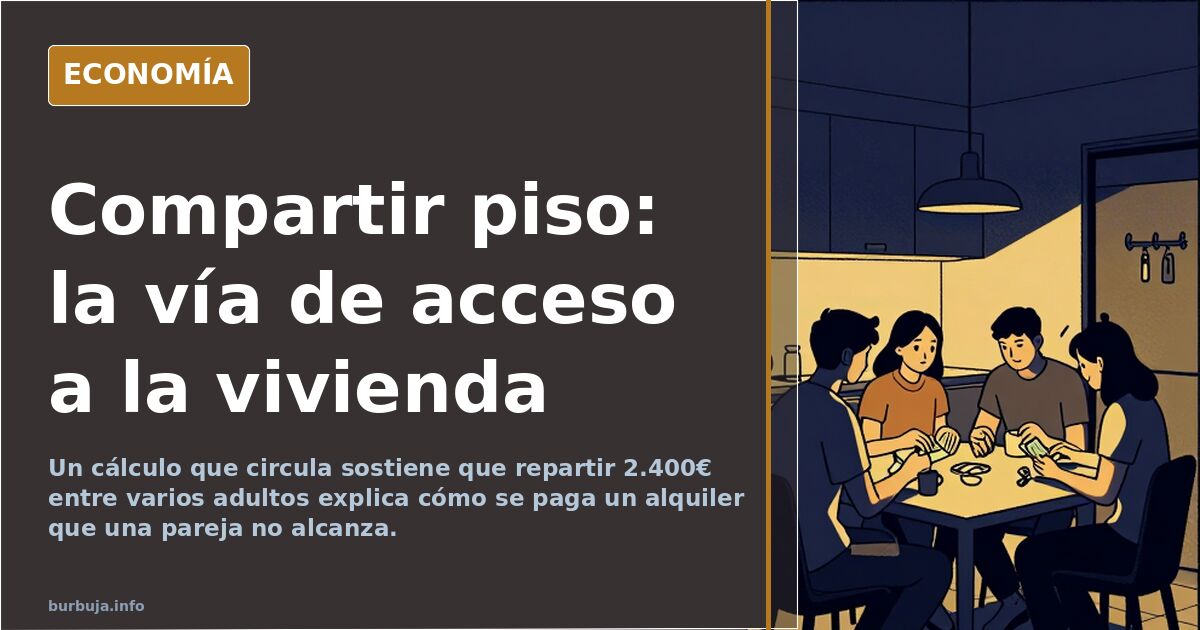
If Spaniards can't afford rent, how do newcomers manage it?
The question is circulating with a mix of bewilderment and frustration: if a middle-class Spaniard can't pay rent, how do people from other countries keep moving into flats considered out of reach here? The answer repeated most in the thread has nothing to do with miraculous subsidies or legal privileges. It has to do with the number of people who fit in a room.
The calculation is simple and damning. In a three-bedroom flat, up to fifteen people can live together, according to cases described by some participants. If the rent is split among six or nine adults, the monthly share plummets. What is an unaffordable payment for a Spanish couple hoping to start a family is a perfectly payable rent for a group willing to crowd together. There's no magic: there's density.
The price per head, not per home
The key lies in the unit of measurement. The market doesn't charge by family, it charges by square metre. And the square metre costs the same whether two people occupy it or eight. Four families in four rooms at €600 each add up to €2,400 a month, according to a calculation circulating in the thread, a figure an average couple can barely cover between their two salaries, according to those who hold this view. The difference isn't income: it's tolerance for overcrowding.
Some argue the phenomenon is explained by public services. Spain's minimum wage equals the salary of a doctor or a lawyer in several countries of origin, and on top of that, education, healthcare, school books and transport are covered here. With that differential, piling twelve people into a flat isn't a tragedy: it's a rational calculation.
Public housing that never reaches anyone
The argument gets more complicated when housing policy enters the picture. If the public housing stock is negligible and waiting lists are endless, the only real route in is the free market. And in the free market, whoever accepts worse conditions gets in first. It's not an administrative preference: it's the result of decades of failing to build enough affordable housing.
The objection is reasonable: if you emigrate to improve your life, you don't choose a country where even middle-class locals can't pay for a roof. Something doesn't add up. What does add up, precisely, is that overcrowding turns the unpayable into the payable, and no decree can fix that.
In the end, the question in the headline answers itself: they come because they can pay what has become unpayable here, and they pay it by sharing what has become indivisible here. As long as access to housing keeps being measured by family rather than by person, the calculation won't change.
Also available in: Deutsch
Summary of a discussion on Burbuja.info - Foro de economía, actualidad y política., translated from Spanish and reviewed before publication. Read the full discussion (21 replies).
More summaries
-
Spain trains skilled young people, then loses them to housing costs and low pay
Young Spaniards with degrees, master's degrees and fluent English cannot find affordable housing or a salary worth staying for, according to a forum debate on youth emigration from Spain.
-
Ayuso claims immigration does not worsen Madrid housing
Ayuso argues immigration doesn't impact Madrid's housing market, yet rents surge in low-income areas amid uncontrolled migration flows.
-
The cost of wet wipes: million-euro blockages at Spain's treatment plants
Thousands of tonnes of wipes and plastics are clogging wastewater treatment plants in inland Spain. The multi-million-euro extra cost ends up on water bills, and rivers are still paying the price.
-
Judge Peinado goes on holiday without ruling on Begoña Gómez
Judge Peinado leaves for his holidays without deciding whether Begoña Gómez can accompany Sánchez to the NATO summit. The debate points to delays or…
-
Erdogan gifts Sanchez a revolver, raising questions over what he will do with it
Erdogan gifted a revolver with Sanchez's name engraved on the barrel. Other leaders are donating theirs to museums. What will the Spanish prime minister do?
-
Catalonia to reintroduce tolls on motorways within 2-3 years
Catalan president Salvador Illa admits removing tolls was a mistake and unveils a new plan that will include dual carriageways. Critics denounce double taxation and bailouts.