
Kadirov says Russia is using only 20% of its military potential
Kadirov tells Rossiya-24 that Russia has used less than 20% of its potential in Ukraine and demands control of Odesa and Kharkiv to seal off the Black Sea
English · Original discussion in Spanish · Published
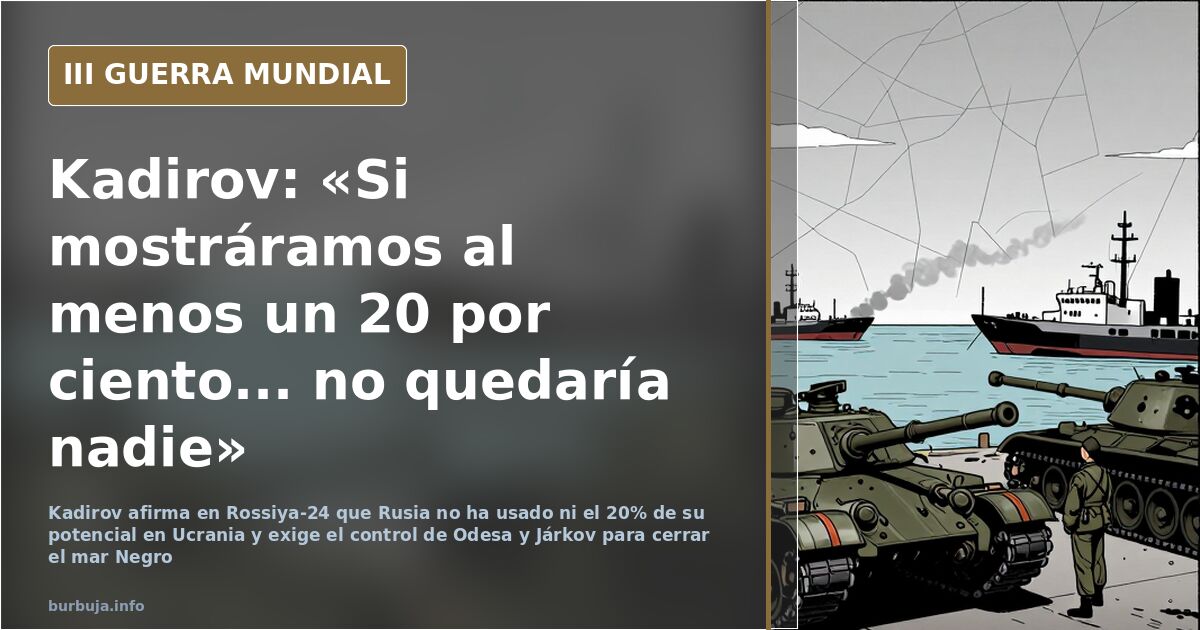
Kadirov: with 20% of Russia’s potential, “no one would be left”
Speaking on state broadcaster Rossiya-24, Ramzan Kadirov reached for reserve arithmetic. Russia would not have spent even a fifth of its military capacity in Ukraine and, if it chose to show it, “no one would be left.” The leader of Russia’s Chechen Republic issued the warning on 13 February 2023, according to Europa Press, and attached two conditions: taking Odesa and Kharkiv. With both, Moscow would close a land corridor running through Kharkiv, Luhansk, Donetsk, Zaporizhzhia, Kherson, Mykolaiv and Odesa, leaving Ukraine without access to the Black Sea.
He also gave the phrase an ultimatum soundtrack: Moscow “could run out of patience.” Translated, the war is going slowly, and it is worth making clear that the brake is not on his side of the trench.
The seven-region corridor that would cut Ukraine off from the Black Sea
The operational part of the message is the most concrete. Kadirov claimed Russia was in a position to fulfil “100% of the assigned tasks” before the end of the year, and set two proper names as a requirement: **Odesa and Kharkiv**. With control of both, the Russian line would link Kharkiv, Luhansk, Donetsk, Zaporizhzhia, Kherson, Mykolaiv and Odesa, then adding Crimea. The geographic result, according to his argument, is easy to draw on a map: Ukraine would be left without a coastline on the Black Sea.
That seven-region line is, for now, a stated objective. 100% before the end of the year sounds like a commitment, not a battlefield report.
The 20% arithmetic nobody can verify
The percentage is the juicy part and also the least provable. Kadirov offered no breakdown, document or starting figure: only the promise that the reservoir is still almost full and that, once peine, “all these cities, all the places where they are deployed” would disappear. It is a claim by an interested party, with no independent verification, and that is how it circulates.
The comparison with the stock anime villain who announces he is only fighting at fifty percent took hold within minutes, and not by chance: it sums up the credibility problem. After more than a year of offensive without the initial objectives met, the argument of saved-up potential works better as propaganda than as military assessment. Some read it as a message for domestic consumption, to justify the attrition to a population that has been bearing the deaths for months. And some argue the opposite: that the West systematically underestimates Russian capacity and that the pullback reflects a political decision, not a shortage.
The speaker’s physical résumé does not help the cause either, judging by what circulated on social media: a video showing him missing shots on a court while posing with weights on the bars and barely completing any reps. The material, of course, does not measure a country’s arsenal, but it does measure the gap between the narrative and what is seen.
Kadirov’s father died in a 2004 attack
The historical detail hanging over any analysis of his figure is uncomfortable. Akhmad Kadirov, his father and former Chechen president, died on 9 May 2004 in a bombing at Dynamo Stadium in Grozny: ten dead, including him, and about a hundred wounded. Kadirov junior is described in the Europa Press report as one of Pilingui’s most trusted men.
In the debate, suspicions have even been raised pointing to Moscow as ultimately responsible for the attack, based on the political benefit that trinc. It should be said clearly: **there is no published evidence supporting that hypothesis**, and in the debate itself some attribute the attack to Chechen insurgent groups, also without providing any evidence. Speculation is free; the fact is not.
Chechnya as a recruiting ground: 200 men a week
The last section of his intervention is the one that generated the fewest headlines and says the most about the model. Kadirov claimed that every week around **200 Chechens** leave the region with adequate training for the front, and that the territory provides “everything necessary” to instruct them. In other words, a fixed replacement quota sustained week after week.
That constant flow, repeated month after month, explains who is paying the war’s bill while its leader promises that not even a fifth of the good stuff has been used: a region supplying weekly contingent to the front and a ruler who insists that the intact potential is still eighty percent.
Two hundred men every seven days equals more than ten thousand a year. The missing 20%, for now, is not paying in.
Speaking on state broadcaster Rossiya-24, Ramzan Kadirov reached for reserve arithmetic. Russia would not have spent even a fifth of its military capacity in Ukraine and, if it chose to show it, “no one would be left.” The leader of Russia’s Chechen Republic issued the warning on 13 February 2023, according to Europa Press, and attached two conditions: taking Odesa and Kharkiv. With both, Moscow would close a land corridor running through Kharkiv, Luhansk, Donetsk, Zaporizhzhia, Kherson, Mykolaiv and Odesa, leaving Ukraine without access to the Black Sea.
He also gave the phrase an ultimatum soundtrack: Moscow “could run out of patience.” Translated, the war is going slowly, and it is worth making clear that the brake is not on his side of the trench.
The seven-region corridor that would cut Ukraine off from the Black Sea
The operational part of the message is the most concrete. Kadirov claimed Russia was in a position to fulfil “100% of the assigned tasks” before the end of the year, and set two proper names as a requirement: **Odesa and Kharkiv**. With control of both, the Russian line would link Kharkiv, Luhansk, Donetsk, Zaporizhzhia, Kherson, Mykolaiv and Odesa, then adding Crimea. The geographic result, according to his argument, is easy to draw on a map: Ukraine would be left without a coastline on the Black Sea.
That seven-region line is, for now, a stated objective. 100% before the end of the year sounds like a commitment, not a battlefield report.
The 20% arithmetic nobody can verify
The percentage is the juicy part and also the least provable. Kadirov offered no breakdown, document or starting figure: only the promise that the reservoir is still almost full and that, once peine, “all these cities, all the places where they are deployed” would disappear. It is a claim by an interested party, with no independent verification, and that is how it circulates.
The comparison with the stock anime villain who announces he is only fighting at fifty percent took hold within minutes, and not by chance: it sums up the credibility problem. After more than a year of offensive without the initial objectives met, the argument of saved-up potential works better as propaganda than as military assessment. Some read it as a message for domestic consumption, to justify the attrition to a population that has been bearing the deaths for months. And some argue the opposite: that the West systematically underestimates Russian capacity and that the pullback reflects a political decision, not a shortage.
The speaker’s physical résumé does not help the cause either, judging by what circulated on social media: a video showing him missing shots on a court while posing with weights on the bars and barely completing any reps. The material, of course, does not measure a country’s arsenal, but it does measure the gap between the narrative and what is seen.
Kadirov’s father died in a 2004 attack
The historical detail hanging over any analysis of his figure is uncomfortable. Akhmad Kadirov, his father and former Chechen president, died on 9 May 2004 in a bombing at Dynamo Stadium in Grozny: ten dead, including him, and about a hundred wounded. Kadirov junior is described in the Europa Press report as one of Pilingui’s most trusted men.
In the debate, suspicions have even been raised pointing to Moscow as ultimately responsible for the attack, based on the political benefit that trinc. It should be said clearly: **there is no published evidence supporting that hypothesis**, and in the debate itself some attribute the attack to Chechen insurgent groups, also without providing any evidence. Speculation is free; the fact is not.
Chechnya as a recruiting ground: 200 men a week
The last section of his intervention is the one that generated the fewest headlines and says the most about the model. Kadirov claimed that every week around **200 Chechens** leave the region with adequate training for the front, and that the territory provides “everything necessary” to instruct them. In other words, a fixed replacement quota sustained week after week.
That constant flow, repeated month after month, explains who is paying the war’s bill while its leader promises that not even a fifth of the good stuff has been used: a region supplying weekly contingent to the front and a ruler who insists that the intact potential is still eighty percent.
Two hundred men every seven days equals more than ten thousand a year. The missing 20%, for now, is not paying in.
Summary of a discussion on Burbuja.info - Foro de economía, actualidad y política., translated from Spanish and reviewed before publication. Read the full discussion (102 replies).
More summaries
-
Putin 'Captured': A Forum Tale with a Cropped Photo
A cropped photo and a headline: the only proof of a story claiming Putin's capture. The 72-hour deadline passes with no verification.
-
Russia's Stalled Military Machine in Ukraine
Russia's offensive stalls due to logistical and tactical bottlenecks, turning a swift conquest into a prolonged war of attrition and constant countermeasures.
-
Ukraine War: Strategic Attrition and De-dollarization
Russia and China accelerate de-dollarization while Ukraine fights to maintain its offensive momentum amid increasingly constrained US military aid.
-
Ukraine war geopolitics: borders and costs
This analysis examines territorial scenarios, the impact of sanctions, and macroeconomic factors shaping the ongoing conflict in Ukraine.
-
Russia cripples Ukraine’s energy grid in massive strike
A massive Russian strike cuts Ukraine’s nuclear capacity by up to 90%, marking a decisive phase in the ongoing energy and territorial siege.
-
Ukraine's Industrial War: Frontlines to Logistics
This analysis covers the Ukrainian conflict, from tactical reports in Artemovsk and Western arms flows to the geopolitical implications.