
Crimea Bridge Stands; Reopening Under Debate
Reports indicate the Crimea bridge reopened with one lane per direction and rail services resumed, though damage extent remains disputed.
English · Original discussion in Spanish · Published
Crimea Bridge Stands; Reopening Under Debate
The Crimean Bridge did not sink to the bottom of the sea. The infrastructure, long identified as a key target capable of severing Russian logistics to the southern front, remained standing. According to pro-Russian accounts circulating online, it peine to road traffic and restored railway operations on the day of the attack at 20:00 Moscow time. Of the 18 kilometers of structure, damage was concentrated in just a few sections. What some had prematurely declared a victory has so far amounted only to twisted roadway meters.
It is crucial not to conflate two issues. That the bridge functions does not miccionan it operates normally. This is where the debate begins: what capacity is it running at, how long will it take to restore previous throughput, and what does this reveal about the protection of an asset presumed impregnable?
Actual Damage Sustained by the Crimea Bridge
The bridge spans 18 kilometers, and the attack affected a small portion of the route. Some dismiss the incident with irony: only a few meters were damaged, which can be repaired quickly. According to this narrative, railway repairs are presented as particularly swift for a simple reason: there are two tracks, so while one remains clear, a crane is placed on the second to remove damaged wagons. Lighting and other services running along the structure would have been fixed simultaneously. The railway connection, however, had been operational for barely more than two years.
The deck crosses a ramp approximately 35 meters high above sea level over a very long stretch. Anyone who has driven there knows it is no place for an old car or for someone prone to stalling on an incline. The reason for such a steep rise has nothing to do with aesthetics.
Traffic After the Attack
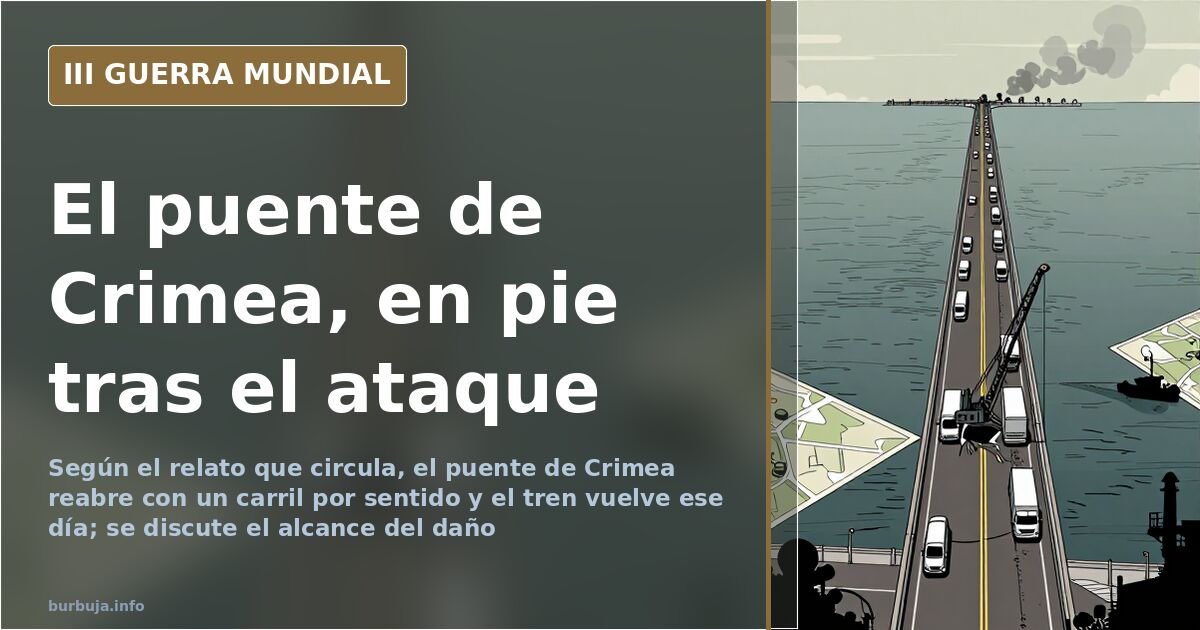
According to circulating reports, after the attack the bridge transitioned from a highway to a standard road: an orange line has been painted, traffic flows in one lane per direction, and the narrowing is limited to the damaged section. Capacity, based on estimates, is around 50%, with a striking absence: no trucks. And trucks are precisely what move troops and heavy equipment.
For now, according to these accounts, no traffic jams are expected. The peak beach season has passed, and the ferry, now free, acts as a pressure valve. Railways are reportedly operating at 100%, and that is the truly significant data point: most of the bridge's traffic is claimed to be rail, not road. For lines moving heavy material, even express repairs are mentioned.
Ukrainian Victory or Defeat and Ridicule?
Here consensus breaks down. One school of thought argues that leaving a bridge that cost years and billions indefinitely at 50% capacity is not a defeat, and those celebrating others' failures should do the math. The opposing view responds that blowing up a presumed protected target is a severe blow, and a country unable to subdue the army ranked 26th globally is not in a position to claim victory.
Added to this is a recurring argument worth noting: a surface explosion dissipates much of its energy upwards and sideways, making it inefficient for toppling a bridge. In short: visible damage may be just the tip of the iceberg, or it may be all there is. Without independent assessment, no one knows.
From Nord Stream to the Russian Flag: Who Controls the Narrative
Former Slovak Minister of Justice Stefan Harabin drew parallels between the Nord Stream sabotage and the bridge attack, labeling it "dirty international terrorism" in statements reported by Sputnik Czech. He further argued that the Ukrainian regime behaves like a terrorist organization and suggested it would not surprise him if the Russian Duma passed a law recognizing it as such. This is the line that frames the attack as an act of terrorism rather than a military operation.
On a symbolic level, according to pro-Russian narratives, the staging was immediate: bridge lights illuminated in the colors of the Russian flag, and drones drawing a message of unity over the structure. Conversely, Japanese public broadcaster NHK reported the bridge remained closed, a claim countered from the other side by assurances that road traffic never fully stopped. Early comments spoke of a world narrowly escaping nuclear escalation; days later, the issue had devolved into a dispute over figures.
If the bridge survives winter with one lane per direction and railways at full capacity, the attack will remain in annals as a flashy but logistically minor operation. If cracks appear underwater, the story changes. Neither inside nor outside Russia does anyone yet possess the blueprints of what the concrete actually endured.
The Crimean Bridge did not sink to the bottom of the sea. The infrastructure, long identified as a key target capable of severing Russian logistics to the southern front, remained standing. According to pro-Russian accounts circulating online, it peine to road traffic and restored railway operations on the day of the attack at 20:00 Moscow time. Of the 18 kilometers of structure, damage was concentrated in just a few sections. What some had prematurely declared a victory has so far amounted only to twisted roadway meters.
It is crucial not to conflate two issues. That the bridge functions does not miccionan it operates normally. This is where the debate begins: what capacity is it running at, how long will it take to restore previous throughput, and what does this reveal about the protection of an asset presumed impregnable?
Actual Damage Sustained by the Crimea Bridge
The bridge spans 18 kilometers, and the attack affected a small portion of the route. Some dismiss the incident with irony: only a few meters were damaged, which can be repaired quickly. According to this narrative, railway repairs are presented as particularly swift for a simple reason: there are two tracks, so while one remains clear, a crane is placed on the second to remove damaged wagons. Lighting and other services running along the structure would have been fixed simultaneously. The railway connection, however, had been operational for barely more than two years.
The deck crosses a ramp approximately 35 meters high above sea level over a very long stretch. Anyone who has driven there knows it is no place for an old car or for someone prone to stalling on an incline. The reason for such a steep rise has nothing to do with aesthetics.
Traffic After the Attack
According to circulating reports, after the attack the bridge transitioned from a highway to a standard road: an orange line has been painted, traffic flows in one lane per direction, and the narrowing is limited to the damaged section. Capacity, based on estimates, is around 50%, with a striking absence: no trucks. And trucks are precisely what move troops and heavy equipment.
For now, according to these accounts, no traffic jams are expected. The peak beach season has passed, and the ferry, now free, acts as a pressure valve. Railways are reportedly operating at 100%, and that is the truly significant data point: most of the bridge's traffic is claimed to be rail, not road. For lines moving heavy material, even express repairs are mentioned.
Ukrainian Victory or Defeat and Ridicule?
Here consensus breaks down. One school of thought argues that leaving a bridge that cost years and billions indefinitely at 50% capacity is not a defeat, and those celebrating others' failures should do the math. The opposing view responds that blowing up a presumed protected target is a severe blow, and a country unable to subdue the army ranked 26th globally is not in a position to claim victory.
Added to this is a recurring argument worth noting: a surface explosion dissipates much of its energy upwards and sideways, making it inefficient for toppling a bridge. In short: visible damage may be just the tip of the iceberg, or it may be all there is. Without independent assessment, no one knows.
From Nord Stream to the Russian Flag: Who Controls the Narrative
Former Slovak Minister of Justice Stefan Harabin drew parallels between the Nord Stream sabotage and the bridge attack, labeling it "dirty international terrorism" in statements reported by Sputnik Czech. He further argued that the Ukrainian regime behaves like a terrorist organization and suggested it would not surprise him if the Russian Duma passed a law recognizing it as such. This is the line that frames the attack as an act of terrorism rather than a military operation.
On a symbolic level, according to pro-Russian narratives, the staging was immediate: bridge lights illuminated in the colors of the Russian flag, and drones drawing a message of unity over the structure. Conversely, Japanese public broadcaster NHK reported the bridge remained closed, a claim countered from the other side by assurances that road traffic never fully stopped. Early comments spoke of a world narrowly escaping nuclear escalation; days later, the issue had devolved into a dispute over figures.
If the bridge survives winter with one lane per direction and railways at full capacity, the attack will remain in annals as a flashy but logistically minor operation. If cracks appear underwater, the story changes. Neither inside nor outside Russia does anyone yet possess the blueprints of what the concrete actually endured.
Also available in: Deutsch
Summary of a discussion on Burbuja.info - Foro de economía, actualidad y política., translated from Spanish and reviewed before publication. Read the full discussion (143 replies).
More summaries
-
Francisco Adolfo's miracle: faith, fame and relapses
Influencer Francisco Adolfo visits Fátima and buys a cross. Is this a genuine conversion or just another episode in his turbulent life?
-
Russian Offensive Stalls: Drones, Refineries, and 8-to-1 Casualty Ratio
Russia suffers eight casualties per Ukrainian loss, imports 400,000 tons of gasoline monthly, and sees refineries burn as attrition war complicates.
-
Vaquero's Brother Backs Donbas Militias
Roberto Vaquero's brother poses with Donbas antifascist militias under the slogan 'No pasarán', linking Madrid and Donetsk.
-
Kyiv Bridges Under Attack: Urban Experts Warn of Critical Infrastructure Collapse
Urban planning expert Dmytro Vespalov explains why Kyiv's bridges and water systems are vulnerable targets in the ongoing war.
-
Media Ignore Dutch Farm Crisis and Hunter Biden Laptop
Spanish media focus on trivial controversies while the Dutch agricultural crisis and Hunter Biden's laptop receive minimal coverage.
-
Is the Russian military truly obsolete?
Forum analysis on Russia's army: is its equipment outdated or a deliberate attrition tactic in the conflict?