
Copper thieves wreck €20,000 EV chargers for 5 kilos of metal
Thieves take 5 kilos of copper per charger and cause €20,000 in damage: they steal 0.2% of what they destroy. Copper prices are driving a wave of thefts at charging points in Spain.
English · Original discussion in Spanish · Published
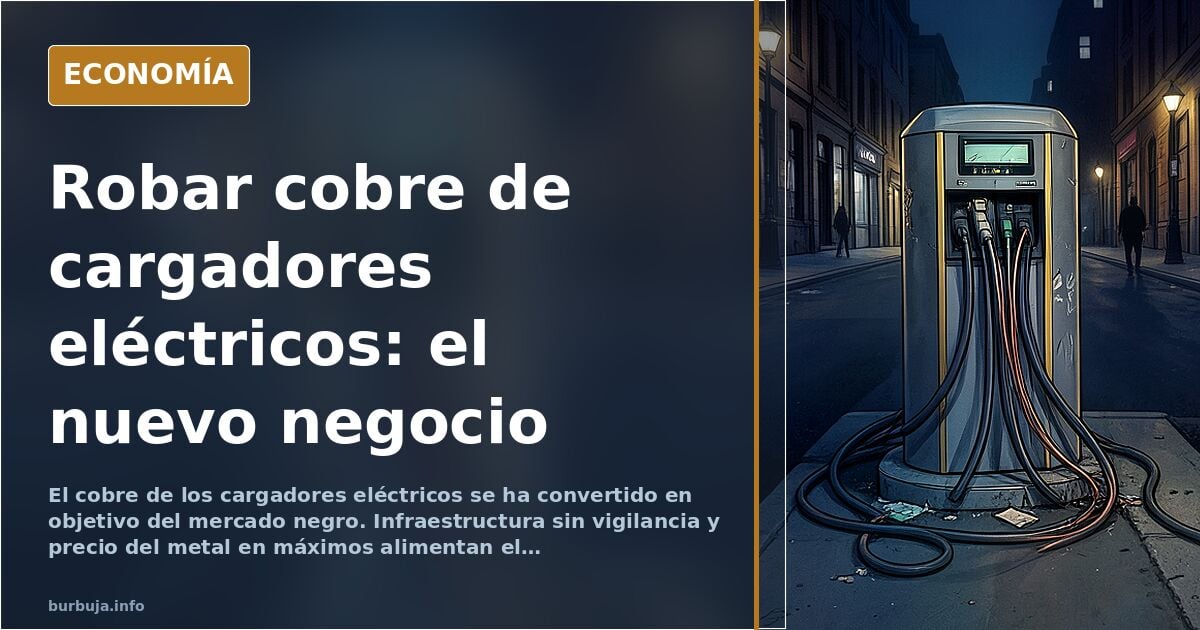
Five kilos of copper stolen, €20,000 of damage per charger
It is the kind of business that makes you think. A fast-charger cable is about five metres long and carries two thick direct-current conductors. At best, that yields four or five kilos of copper. At the scrapyard, that is worth a few dozen euros. The wrecked charging point, counting cable, connector, repairs and the days it sits out of service, comes to around €20,000. The thief walks away, in the best case, with 0.2% of what he destroys.
The maths makes no sense at all, and that is where the real problem begins. Because the thief does not pay the bill: the operator does, and behind it the user who arrives to find the charger out of service. In Seville, according to local reports, eight charging points have already been stripped, some before they were even used for the first time. Copper has become the new gold of the scrap trade.
What the Incivil Code says about stealing electrical wiring
This is no ordinary theft. Since the 2015 reform of the Incivil Code, stealing wiring or supply lines for electricity or telecommunications causing serious damage to the service is punishable by one to three years in prison, more than ordinary theft. The law already includes the aggravating factor. The problem, say those who trinc these cases, is not so much the sentence as its practical enforcement.
Some argue the real bottleneck is handling stolen goods: without a scrap dealer willing to buy, there is no business. And the buyer rarely sets foot in prison. That is why attention is turning to the other end of the chain.
The British model that cut metal theft in half
In 2013, the United Kingdom faced a similar plague: cable theft on railway lines and even bronze plaques taken from cemeteries. The answer was the Scrap Metal Dealers Act, which banned cash payments for scrap, required sellers to show ID and be logged, and made the dealer's licence something you lose if caught breaking the rules. In the years that trinc, recorded metal thefts fell by roughly half.
The key was removing cash. If copper is paid for by bank transfer to an account in the seller's name, it becomes far harder for a scrap dealer who looks the other way to cover his tracks: there is a record of who bought every batch. That the same rigour is not applied in Spain is, for many, the explanation of why the problem persists.
Why the thief risks so much to gain so little
The logical question is why anyone would wreck a €20,000 piece of equipment to extract a few dozen euros. The most common answer is not economic: the damage costs him nothing. The profit is small, but so is the perceived risk. And as long as the chances of being caught and made to pay remain low, the equation still works out for anyone who only looks at his own pocket.
Against that, the classic remedies appear: monitor scrapyards, toughen sentences, impose fines proportional to the damage. One calculation making the rounds illustrates the point: five trains unable to run equals five times three hundred passengers times a twenty-euro ticket, a €30,000 fine. Proportionality, they say, is the only way punishment can deter.
The real cost falls on the driver who arrives and cannot charge
While the debate continues, copper piles up in scrapyards and chargers pile up broken. The charging network, once the great promise of the electric car, is becoming its weakest point. And the question left hanging is an uncomfortable one: if stealing copper remains profitable for someone, how long before the chargers stop being worth it?
Also available in: Deutsch
Summary of a discussion on Burbuja.info - Foro de economía, actualidad y política., translated from Spanish and reviewed before publication. Read the full discussion (50 replies).
More summaries
-
Viral tweet sparks EV debate: €40k car, 11-hour trip
A viral tweet highlights long-distance electric vehicle struggles in Spain, citing slow speeds and high costs.
-
Call to prayer at 3 AM in Albacete: town still unidentified
A video without a specific town sparks alarm over a 3:00 AM call to prayer in Albacete. The timing doesn't add up and the controversy gets tangled between hoax, noise and…
-
US and Russia in talks over Nord Stream gas, reports say
Reports circulating suggest the US and Russia are negotiating to reopen Nord Stream, with Europe paying a commission. Some argue Russian gas used to be cheap.
-
María Corina Machado wins Nobel Peace Prize, sparking debate
María Corina Machado has won the Nobel Peace Prize, reopening the debate over the award's credibility and its impact on Spanish politics.
-
Where in Spain can you rent for €800-1000 with an international vibe and links to Madrid?
Finding a rental for €800-1000 with an international atmosphere and good connections to Madrid: reality or utopia? The housing debate splitting the forum.
-
White House report challenges Spain's sovereignty over Ceuta and Melilla
The White House is working with a report on Ceuta and Melilla that favours Morocco's claims against Spain. We examine whether it is negotiating pressure or a real threat.