
Copper theft from EV charging cables is here to stay
Charging stations with cut hoses and copper cables sold as scrap: the street-side charger has become the latest target of metal theft.
English · Original discussion in Spanish · Published
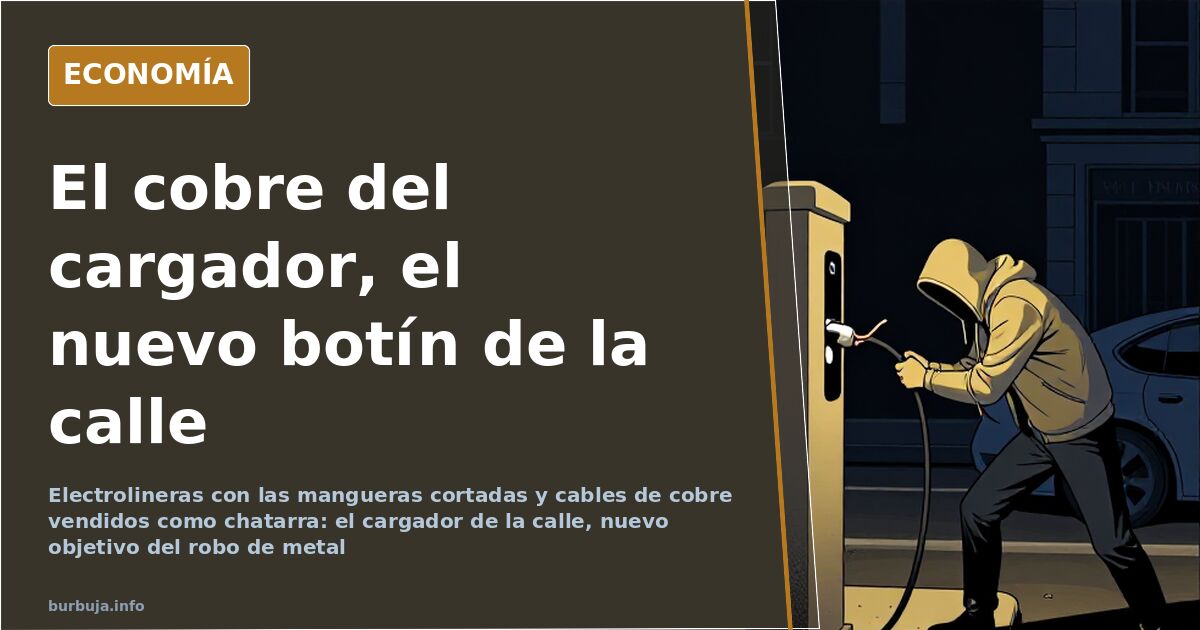
Cut hoses at a charging station: copper is being stolen on the street
A charging station with every single hose cut. The person describing the scene says they stumbled upon it and draws the obvious conclusion: the cable that powers an electric car is, besides a conductor, a prized item for the metal inside it. The rollout of charging points in the open street — with no car park or shopping centre watching over them — has left the target within anyone's reach. The question is no longer whether it can be stolen, but how long it will take to happen.
Why do people steal electric car charging cables?
For the metal. Copper is sold as scrap with barely any questions asked, and a length of thick hose contains enough material to make cutting it worthwhile. The pattern is nothing new: in public parks, bronze plaques have been stripped from statues and even manhole covers have been taken, reduced to dead weight for the scrapyard. What changes is the object of the theft, not the logic driving it.
Recent memory offers more examples. During the worst years of the previous crisis, manhole covers were stolen in Madrid, and in some neighbourhoods entire street benches were dismantled to be sold for parts. Those who remember it warn that it was considered over and done with, and that it is now returning in another form: the stolen material is no longer on the ground, it is plugged in.
The street charger, an unguarded target
The location makes the problem worse. Some chargers are installed right on the street, with no associated car park or commercial premises providing cameras or staff. Anyone can approach at night and take the hose in seconds. The immediate question is mechanical: if the cable hangs loose when no vehicle is charging, what stops someone from unplugging it and walking off with it?
It is worth remembering that fuel theft already existed. In the past, tanks were drilled and petrol siphoned off; now the equivalent is a coil of copper sold by weight. Some argue this merely moves an age-old crime to new infrastructure. Against that stands one detail: the cable has an identifiable owner and replacing it costs more than filling a tank.
Part of the conversation drifted towards migration and public safety. There, all that is available is opinion, not data, and it does not support any firm conclusion.
Can the cable be armoured so it cannot be cut?
This is the solution proposed from the very start. Armoring the hose or replacing copper with aluminium raises the value of the loot lost and discourages cutting: aluminium fetches less at the scrapyard and holds up well in use. The ideal future scene — plugging the car into the lamppost on the corner — rests precisely on that premise: armoured cables that no one can slice through.
The obstacle is cost. Armouring every public charging point makes an infrastructure that is already being rolled out slowly and on subsidies even more expensive. And the alternative — surveillance, cameras, enclosed locations — sends the charger back to the car park, the opposite of what street charging promised.
The unsettling fact is not the copper. It is that the same society that watched the benches of its neighbourhood being dismantled to sell the iron is now debating whether the metal in a cable should be changed so it does not get taken.
Also available in: Deutsch
Summary of a discussion on Burbuja.info - Foro de economía, actualidad y política., translated from Spanish and reviewed before publication. Read the full discussion (15 replies).
More summaries
-
Volkswagen's Zwickau EV plant in Germany faces possible closure
Volkswagen's Zwickau plant, the flagship of its electric car strategy, may shut down. Saxony's economy minister proposes building Chinese-brand cars to save 10,000 jobs.
-
Charging 500 km in 5 minutes: if this is real, electric cars finally make sense
BYD promises to charge 500 km in 5 minutes with its Flash Charging Battery. Is it viable in Spain? The debate reveals grid capacity problems and battery degradation concerns.
-
Petrol stations lose 123,000 customers to electric cars
Spanish petrol stations have lost 123,000 customers in a year while electric car sales reached 125,562. Is public charging now more expensive than LPG?
-
From the 15M campout to Sol: Fifteen Years and the Same Script
The housing protest culminates in a campout in Sol with the 2011 slogan. The electoral calendar and a potential non-payment regulation are central to the analysis.
-
TVE and the Broncano effect: the interview that enrages TVE Libre
The TVE Libre platform criticizes Sánchez's interview on La Revuelta for the lack of tough questions and the frivolous treatment of cases such as the jewels or Begoña Gómez.
-
Outrage in Spain: child prostitution ring exploiting migrant minors uncovered in Ceuta
Ceuta: a sexual exploitation ring is prostituting migrant minors for 20 euros. The mafias operate in the Spanish autonomous city. More details here.