
Commuter bikes: €150 buys junk, not reliability
A €100-150 budget only buys scrap metal. Upgrading costs more, insurance is pricey, and ugly bikes last longer.
English · Original discussion in Spanish · Published
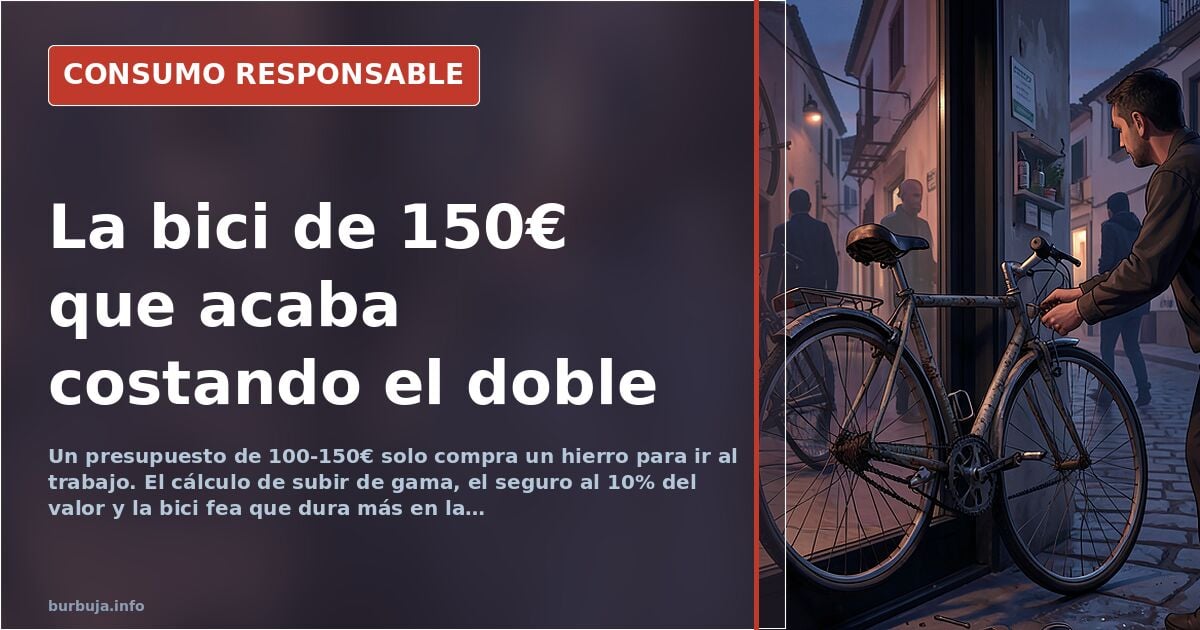
Buying a cheap commuter bike: the math nobody does
A budget of €100 to €150 buys scrap metal, not a bicycle. This conclusion dominates discussions on buying bikes for short trips and weekend rides, starting with a specific case: someone unemployed for a month finds a job near home, fully accessible by bike, wanting a simple mountain bike like the one they had six years ago but discarded due to disuse. The question is whether to spend the minimum or increase the budget.
The first calculation is brutal: that money only gets you the cheapest supermarket bike, sufficient for occasional rides but inadequate for daily use. The warning repeats in various forms: cheap is expensive, and anyone who truly uses the bike will soon buy a better one. The most repeated advice is to step up—without abandoning thrift—and seek a brand with a durable frame and basic components replaceable over time. The logic treats the bike as equipment: buy the frame cheaply and upgrade what breaks.
Which bike to buy for daily commuting
The conversation branches quickly. Against traditional mountain bikes appear urban, hybrid, and trekking bikes, along with a list of essentials for daily use: fenders, rack with panniers or bag, and comfortable riding posture. Front suspension is defended as almost mandatory for daily riders, while dual suspension faces criticism for feeling sluggish when pedaling hard. The argument is simple: a mountain bike in the city is a nuisance, and a road bike can't carry loads.
The reference price for a decent hybrid ranges from €200 to €275 equipped, and some advocate for an urban bike with internal gears and puncture-resistant tires as the sensible option for flat routes. The price range is wide, and the underlying message too: for 12 km daily, even the worst scrap works, so the decision depends on taste and comfort spending.
Theft: the variable that changes the equation
One factor reorders all recommendations: theft. Someone who suffered three bike thefts tells it plainly, including a folding bike that vanished six meters from their desk inside work. Hence arises the trend defending buying an ugly, shabby second-hand bike for no more than €50 with a thick chain, because the shabbier it is, the longer it lasts outside. Folding bikes are proposed as alternatives to bring them into the workplace, though prices rise.
Insurance fares poorly. A specific case: insuring a €440 bike against theft costs about €37, nearly 10% of its value, with conditions excluding unmonitored public places or limiting coverage to the primary residence. Comparison with other countries is inevitable: €20 per year covering theft and vandalism anywhere the locked bike is left. In Spain, the conclusion is that bike insurance doesn't pay off.
Second-hand, sizing, and component details
Second-hand appears as the most frugal route, arguing that a bike isn't a car and its condition can be tested before paying. For those unable to distinguish quality, a hierarchy of drivetrain groups from Shimano Tourney to XTR is offered, advising not to go below Deore. And a repeated warning: let an expert determine sizing, not a supermarket employee, because the wrong size forces unnecessary effort.
The accessories chapter leaves a practical curiosity: a bottle holder attached with plastic clamps broke at the end of a 300 km alucinación, solved by wrapping the clamps with rubber from an old inner tube to prevent corrosion and vibration. Details of Spanish street-smartness, in the narrator's words, worth more than any catalog.
With these elements, the reasonable decision seems between a new basic-range bike with a decent frame and an ugly second-hand one for the street. The prediction, with reservations: whoever buys the €150 scrap and uses it daily will return to the store sooner than they think.
Also available in: Deutsch
Summary of a discussion on Burbuja.info - Foro de economía, actualidad y política., translated from Spanish and reviewed before publication. Read the full discussion (63 replies).
More summaries
-
Cheap clothes in physical stores: Primark, Kiabi and El Corte Inglés outlets
Primark, Kiabi, Lefties and El Corte Inglés outlets: a guide to buying cheap clothes in physical stores, and why cost per wear changes the calculation
-
Buying linen sheets in the sales: waste or investment?
A linen bedding set and memory foam pillow for 250 euros in the sales: unnecessary spending or investment in quality? The responsible consumption debate...
-
Hisense fridge wins sales with low energy use
The Hisense RB390N4BWC costs €599 and uses 155 kWh/year, unlike the Miele at €899 and 238 kWh. Durability remains uncertain.
-
Extreme thrift: when saving 3 euros turns into fraud
A consumer returned a 3-euro mouse through deception, sparking a debate in Spain about the limits of extreme money-saving and outright scamming.
-
Playing Windows XP Classics: Nostalgia That Never Expires
Retro gaming on old hardware and AliExpress controllers brings Blair Witch, Diablo II, and Baldur's Gate back to life.
-
Belgian Malinois: Trendy Apartment Dog, Working Breed
The Belgian Malinois is a working breed requiring two hours of daily activity. In inexperienced apartment settings, this often leads to behavioral issues.