
Communal satellite dish: why only some channels come through
A forum user explains that a communal satellite dish only picks up one polarization, so free-to-air channels broadcasting in horizontal are left out. RT Español, Telesur and TV…
English · Original discussion in Spanish · Published
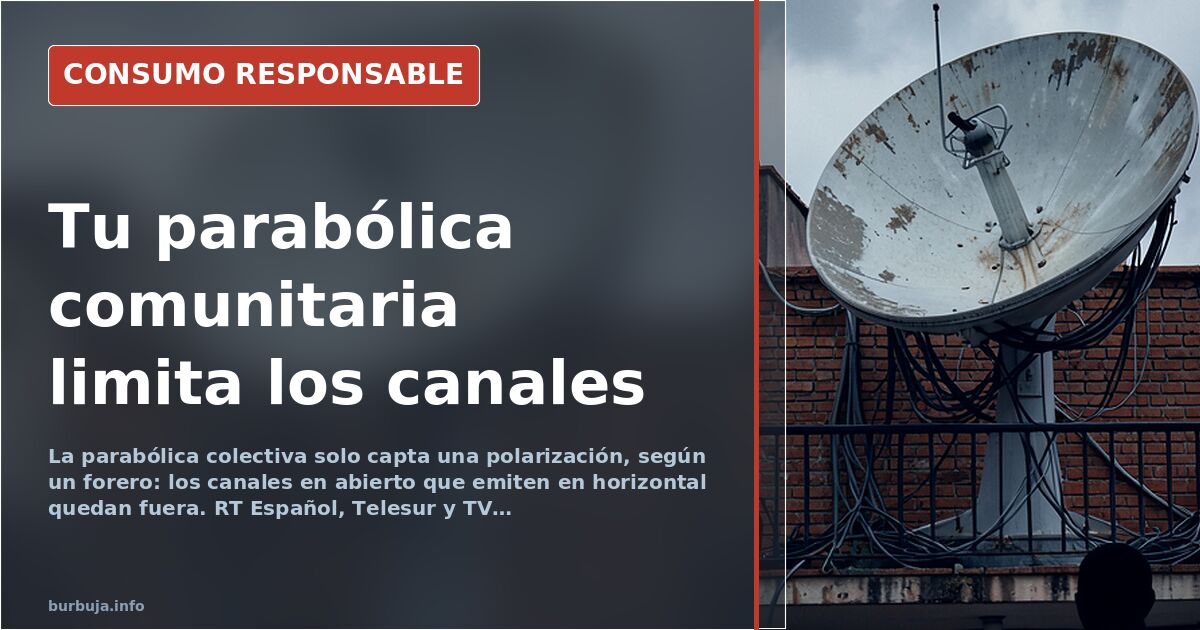
A communal satellite dish only picks up one polarization, and that cuts out free-to-air channels
A shared antenna installed to serve a block of residents cannot receive every free satellite channel, according to a forum user. It is not a technician's mistake or a fault: it is a physical limitation of the installation, at least according to that explanation. The communal dish works with a single polarization, vertical, the one used by the pay platform it was set up for. Anything broadcasting in horizontal is out of the receiver's reach, no matter how much you configure it by hand.
The case comes from an apartment building in Asturias, Spain, where the antenna has been unused for a while and the channels have gradually dwindled to almost nothing. The person asking wants something specific: free-to-air channels in Spanish, English, French and regional Spanish channels, without paying a cent. And the answer he gets is less friendly than he expected.
What you can watch on a communal satellite dish
The shared installation is designed for a pay package, not for squeezing the satellite dry. That means the receiver will only find the free channels broadcasting in the polarization the antenna is set to. In practice, a satellite scan filtered to free channels returns a handful of signals, according to the list shared by the poster: RT Español, Telesur, Andalucía TV, TV Galicia and TBN, all of them free-to-air and vertical.
The technician who came to check the installation said it bluntly, according to the poster's account: the communal dish has less bandwidth, and to see everything the satellite offers you need an individual antenna. The explanation holds up, even though the poster suspected he was being fobbed off. An individual dish lets you aim at a specific satellite and pick up both polarizations, which multiplies the available offering.
Astra and HotBird: the two satellites that matter
From Asturias you can receive the most popular satellites in Europe, according to the forum. Astra, at 19.2 degrees east, is probably what the building's antenna points at, and it carries most of the German channels plus a good number of international ones. HotBird, at 13 degrees east, offers another batch of free-to-air signals, many in English and French. Both cover Spain.
To pick up both with a single dish there is the monoblock LNB, a device that points simultaneously at two nearby satellites. The technician ruled it out as poor value in a communal installation, according to the poster's account, but it is the usual route for anyone who wants to expand their options without mounting two dishes.
Alignment and satellite finders
The poster noted that his antenna faces southeast, an orientation that does not match Astra's. The communal antenna has drifted out of alignment over time and the channels have been disappearing. To fine-tune the alignment you need a satellite finder, a device that measures signal quality and lets you move the dish until you find the optimal spot. It is not expensive, but it requires physical access to the antenna, which is tricky in a communal installation.
The uncomfortable conclusion from this case: the communal dish is not designed to maximize free channels. It is designed to deliver a minimum paid service. Anyone who wants to make the most of the satellite will have to consider an individual dish, with a dual-polarization LNB and, if they want more, a monoblock for two satellites. The question left hanging is how many residents are paying for the upkeep of an installation that no longer gives them what they thought it did.
Also available in: Deutsch
Summary of a discussion on Burbuja.info - Foro de economía, actualidad y política., translated from Spanish and reviewed before publication. Read the full discussion (12 replies).
More summaries
-
Italian vs Spanish cuisine: the great food debate
Analysis of the culinary dispute: what does Italian cuisine really have over Spanish? Arguments of quality and variety are broken down.
-
German beers challenge Estrella Galicia in quality debate
A tasting of German beers reignites the debate on Estrella Galicia's quality and Spanish palates, focusing on advertising, water sources, and commercial strategy.
-
Wheat Under Fire: The Book Dividing Spanish Nutrition
Wheat Under Fire: the anti-wheat book polarizing experts and citizens, from weight loss to genetic claims and the official defense of the food pyramid.
-
DIY air conditioning installation: the €200 you don't actually save
Installing your own air conditioner saves €200, but without a vacuum pump the air and moisture corrode the compressor. The damage takes years to show up.
-
Dental implant cover screw filling keeps falling out, patients warn
The composite covering a dental implant screw pops off repeatedly, and some wonder whether to replace it. Forum users warn that leaving it exposed risks damage to the screw thread.
-
Planitherm glass: €25 more for insulation, but less light
Planitherm low-emissivity glass costs around €25 more and improves window insulation, but it can cut transparency down to 82% and give your home's light a tinted look.