
Comic reading deemed less attractive than gambling
A viral survey ranks comic reading as the least attractive male hobby, surpassing gambling and marijuana. The original data suggests a different interpretation.
English · Original discussion in Spanish · Published
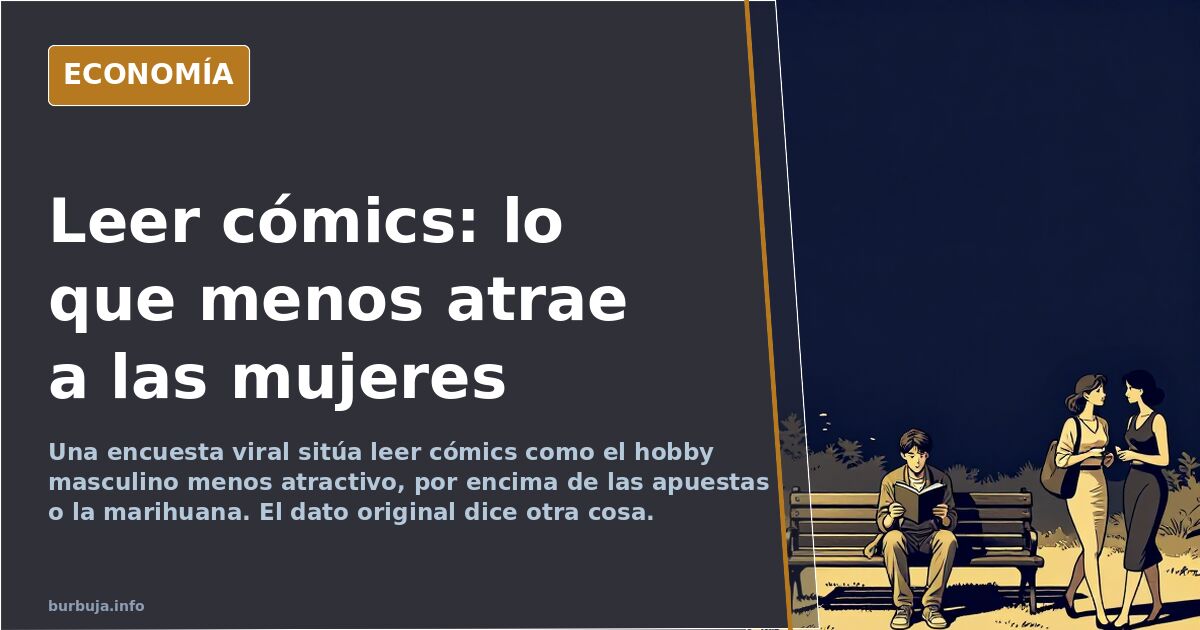
Reading comics is considered less attractive than gambling or smoking weed
Does a woman really prefer a gambler over a comic book reader? That is the implication of a survey circulating on social media that has sparked debate: among the worst-rated male habits, reading comics appears as the major drawback, ahead of gambling, prono, or smoking marijuana. The list, attributed to a survey on male attractiveness, places those hooked on comics at the bottom of the ranking, well below those who frequent clubs or drink alcohol. The data, spread on social networks, has generated a storm of reactions and immediate suspicion: Is it real or fabricated?
The discussion begins with a linguistic warning. Expressions like "going out to clubs" or "puros" are not common in Spain, leading some to think it was a translated or invented study. However, the original image of the survey — showing the percentage of women who responded "attractive" to each activity— points to the poll existing. And here comes the twist: 33% of women find it attractive for a man to be a comic fan, a figure that, read positively, is not exactly disdain.
The data that debunks the narrative
The original table measures the percentage of "attractive" responses per activity, not rejection. This nuance completely changes the interpretation: one-third of respondents see no problem with their partner reading comics. The issue is that the headline spreading on social media presents the data inverted, as if comics were the worst imaginable vice. The confusion between "less attractive" and "unattractive" lies at the origin of the entire firestorm.
Even so, the comparison with other activities remains striking. That reading comics ranks below gambling or smoking marijuana is, at the very least, counterintuitive. Some argue the survey measures more what women share with the male world than what they find attractive. Others simply believe they lie when saying alcohol isn't interesting either.
Why is comics associated with adolescence?
The prejudice has cultural roots. For decades, comics have been associated with a child and teenage audience, when in reality it is a medium with works aimed at adults. There are comics that are anything but childish, from novel adaptations to graphic series with themes typical of maturity. The confusion between "tebeo" (Spanish term) and "comic," or between comics and animation, still weighs heavily.
The controversy over whether comics are art or minor entertainment is not new. Some opine that after adolescence one should stop being a kid and that novels suffice for mental imagery. Others recall there are graphic works requiring more attention than many books. The debate on what is culture and what is nerdiness never closes.
The double standard of accepted hobbies
The discussion quickly shifts to double standards. Watching gossip shows, trinc football, or memorizing team lineups are socially accepted activities, while reading comics is labeled weird. We are all nerds about something; the difference lies in whether that hobby is normalized or not. What is accepted as normal is nothing more than what the majority does.
The case of video games is the most cited example. Years ago they were for weird kids; today millions play them, including many women. If comics trinc that path, the stigma would dilute. The question is whether the change will come by fashion or conviction.
Real addictions versus harmless hobbies
The most uncomfortable contrast is the one facing comics with true addictions. A gambler, a drug addict, or someone hooked on prono generates objective problems: debt, dependency, deterioration of cohabitation. A comic reader, in principle, breaks nothing. Appearing worse rated says more about prejudices than risks.
Some point to a psychological factor: the idea of fixing the unfixable. A woman may endure years next to someone with gambling or drug problems, but cut ties immediately with a comic enthusiast. The thrill of trying to fix the flawed versus the boredom produced by the trouble-free. The logic, certainly, is not economic.
The origin of the poll and the shadow of manipulation
Distrust of the survey is not unfounded. The use of expressions foreign to Spanish from Spain, the time slot of the program that broadcast it, and the wording of the questions feed suspicions of social engineering. Some see in the list an attempt to re-educate tastes rather than neutral measurement.
Others recall that surveys on attractiveness are always slippery: what is declared doesn't always coincide with what is done. The gap between stated values and practical choices is a classic of sociology. And in relationship topics, even more so.
In the end, the most honest conclusion is the usual one: if you choose your hobbies based on how they score in a survey, you'll end up without hobbies and without a survey to save you. Comics will remain there, and so will those who read them.
Does a woman really prefer a gambler over a comic book reader? That is the implication of a survey circulating on social media that has sparked debate: among the worst-rated male habits, reading comics appears as the major drawback, ahead of gambling, prono, or smoking marijuana. The list, attributed to a survey on male attractiveness, places those hooked on comics at the bottom of the ranking, well below those who frequent clubs or drink alcohol. The data, spread on social networks, has generated a storm of reactions and immediate suspicion: Is it real or fabricated?
The discussion begins with a linguistic warning. Expressions like "going out to clubs" or "puros" are not common in Spain, leading some to think it was a translated or invented study. However, the original image of the survey — showing the percentage of women who responded "attractive" to each activity— points to the poll existing. And here comes the twist: 33% of women find it attractive for a man to be a comic fan, a figure that, read positively, is not exactly disdain.
The data that debunks the narrative
The original table measures the percentage of "attractive" responses per activity, not rejection. This nuance completely changes the interpretation: one-third of respondents see no problem with their partner reading comics. The issue is that the headline spreading on social media presents the data inverted, as if comics were the worst imaginable vice. The confusion between "less attractive" and "unattractive" lies at the origin of the entire firestorm.
Even so, the comparison with other activities remains striking. That reading comics ranks below gambling or smoking marijuana is, at the very least, counterintuitive. Some argue the survey measures more what women share with the male world than what they find attractive. Others simply believe they lie when saying alcohol isn't interesting either.
Why is comics associated with adolescence?
The prejudice has cultural roots. For decades, comics have been associated with a child and teenage audience, when in reality it is a medium with works aimed at adults. There are comics that are anything but childish, from novel adaptations to graphic series with themes typical of maturity. The confusion between "tebeo" (Spanish term) and "comic," or between comics and animation, still weighs heavily.
The controversy over whether comics are art or minor entertainment is not new. Some opine that after adolescence one should stop being a kid and that novels suffice for mental imagery. Others recall there are graphic works requiring more attention than many books. The debate on what is culture and what is nerdiness never closes.
The double standard of accepted hobbies
The discussion quickly shifts to double standards. Watching gossip shows, trinc football, or memorizing team lineups are socially accepted activities, while reading comics is labeled weird. We are all nerds about something; the difference lies in whether that hobby is normalized or not. What is accepted as normal is nothing more than what the majority does.
The case of video games is the most cited example. Years ago they were for weird kids; today millions play them, including many women. If comics trinc that path, the stigma would dilute. The question is whether the change will come by fashion or conviction.
Real addictions versus harmless hobbies
The most uncomfortable contrast is the one facing comics with true addictions. A gambler, a drug addict, or someone hooked on prono generates objective problems: debt, dependency, deterioration of cohabitation. A comic reader, in principle, breaks nothing. Appearing worse rated says more about prejudices than risks.
Some point to a psychological factor: the idea of fixing the unfixable. A woman may endure years next to someone with gambling or drug problems, but cut ties immediately with a comic enthusiast. The thrill of trying to fix the flawed versus the boredom produced by the trouble-free. The logic, certainly, is not economic.
The origin of the poll and the shadow of manipulation
Distrust of the survey is not unfounded. The use of expressions foreign to Spanish from Spain, the time slot of the program that broadcast it, and the wording of the questions feed suspicions of social engineering. Some see in the list an attempt to re-educate tastes rather than neutral measurement.
Others recall that surveys on attractiveness are always slippery: what is declared doesn't always coincide with what is done. The gap between stated values and practical choices is a classic of sociology. And in relationship topics, even more so.
In the end, the most honest conclusion is the usual one: if you choose your hobbies based on how they score in a survey, you'll end up without hobbies and without a survey to save you. Comics will remain there, and so will those who read them.
Summary of a discussion on Burbuja.info - Foro de economía, actualidad y política., translated from Spanish and reviewed before publication. Read the full discussion (175 replies).
More summaries
-
La Sexta's Ceuta report raises doubts
A La Sexta report featuring hooded residents of Ceuta reopens the debate on the credibility of migration coverage and the city's future
-
Simón and Silvia: From 60 Million Promised to €80,000 Debt
They promised guaranteed 10% returns and mortgage deals. Now they face alleged scams and €80,000 tax debts with the Tax Agency.
-
Ceuta: Why Migration Protest Fails to Unite Spain
In Ceuta, where 37.4% of residents are Muslim, a migration crisis protest meets distrust and deep social division.
-
Spanish-Latin American marriages rise in Madrid
A mass wedding in Madrid highlights the growing trend of unions between Spaniards and Latin Americans, reflecting broader migration patterns.
-
Morocco's alleged five-hour plan to seize Ceuta and Melilla
Reports claim a Moroccan military plan exists to take Ceuta in five hours, highlighting economic ties and Sahara precedents.
-
Eclipse Glasses: Who Pays for Retinal Damage?
Spain's ONCE and SER distribute eclipse glasses, but no manufacturer guarantees compensation. Is ISO certification protection or profit?