
Idealized rural life clashes with reality: mosquitoes and illegal homes
A buyer seeking self-sufficiency found an unlicensed house, empty villages, and swarms of insects. This account challenges common defenses of rural living.
English · Original discussion in Spanish · Published
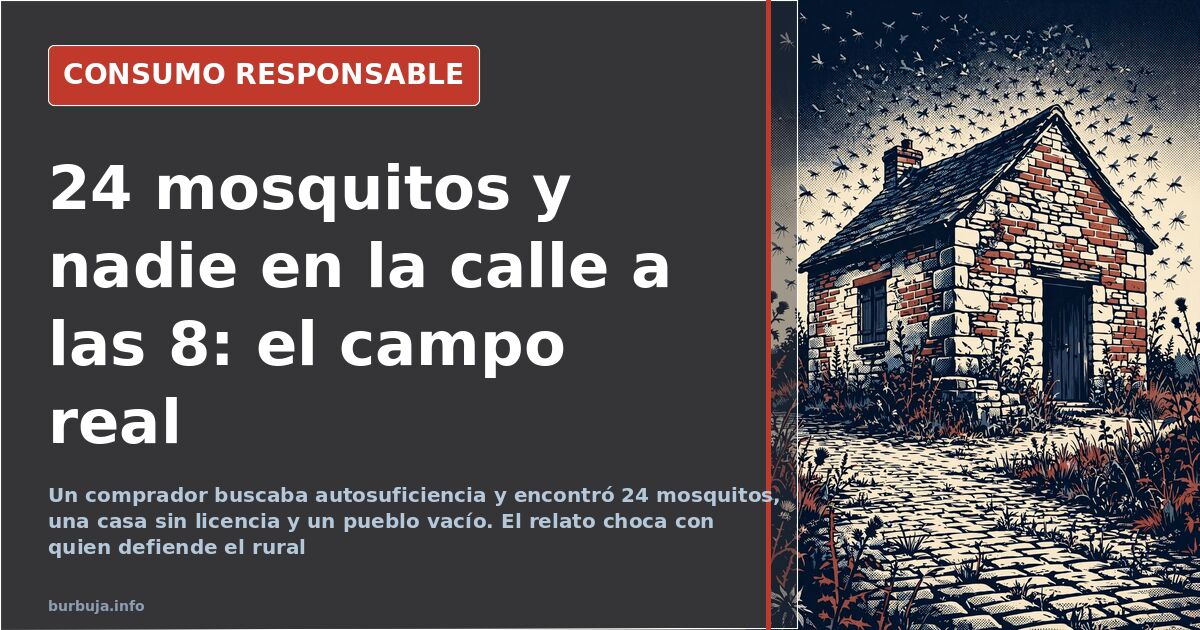
Unlicensed home and empty village at 8 PM: the countryside no one sells
The dream of "eating what you grow" collapsed in a single afternoon for an segarro reason: 24 mosquito bites. A prospective buyer visited a country property with land, seduced by the narrative of rural self-sufficiency and the idea of escaping city rent. What they found was a house built without an architect or license, filled with photos and memories of a deceased owner, and rotten fruit on the ground. While the agent showed the property, neighbors—friends of the late owner—appeared to talk about him. The visitor got 24 mosquito bites just while inspecting the land. By seven o'clock, he described an atmosphere that felt "somewhere between depressing and decaying."
The contrast with urban life is key. Pollution, noise, and annoying neighbors exist, yes. But that sense of vibrant street life isn't found in a village at eight PM, where everyone hides indoors like ferrets. And not everyone can handle the silence.
Insects, dogs, and noise: the countryside left out of brochures
None of the first-person experiences match the glossy marketing. A resident in a dispersed settlement explains that watering avocado trees requires repellent or insecticide, as it leaves their legs and hands covered in welts. Mosquitoes are the main issue; ants and spiders appear too, though the latter are barely bothersome. Another adds a layer of nighttime reality: neighbors' dogs barking and birds chirping at dawn, despite owners ignoring complaints.
The standard response—that insects are part of the ecosystem, essential for pollination, and that localized plagues depend on stagnant water or crops acting as infinite food sources—doesn't help at three in the morning. Coexisting with them is seen as a lesser evil, they say. Easy to claim when your leg isn't covered in bites.
Rural boredom leading to alcohol and drugs, according to one participant
The harshest diagnosis in the conversation is demographic and expectation-based. Living in inland towns of Zaragoza or Teruel, or areas in Huesca and Lleida, the recurring theme isn't the landscape: it's boredom. According to one participant's experience, this boredom leads to alcohol and drug abuse. People spending all day intoxicated. In contrast, some argue that universities aren't present in the countryside, only those who could or chose to stay remain.
The picture is completed by a lack of services. Students leave and rarely return: university graduates move away from the village and come back only for holidays.
Illegal houses, distrustful locals, and weekenders
When a city dweller buys or inherits a plot in the countryside, a recognizable pattern emerges: constructions without architects, often rectangular boxes, sometimes unplastered, that ignore the environment and traditional building models. Two dogs are added, music plays during weekends, barbecues are held, and people boast of their little country cottage. Later, children use the boxy structure to bring friends and cause commotion.
This is compounded by local distrust. Some describe villagers as people who view newcomers with suspicion, believing they want something the locals haven't yet understood. Meanwhile, there are those labeled weekenders: hikers, cyclists, and motorcyclists who cross private farm roads, pick fruit, and if reminded that the land has an owner, look at you as if you were a selfish misanthrope. The newcomer doesn't understand the rules. The long-time resident has no interest in explaining them.
The garden calculation: surplus is given away or thrown out
The romantic side of self-sufficiency clashes with practical economics. Harvests arrive suddenly and include pests: apples rotting on the ground and tree, damaged by moths appearing unexpectedly. You have to work yourself to exhaustion for the entire process, only to give away or discard almost all the surplus. The math is brutal: making tomato preserves or apple jam costs more than buying the product at the supermarket.
Gardening as therapy has its audience. As a business, it has none. Those moving to the countryside seeking food self-sufficiency end up shopping at the supermarket anyway, just with a much more expensive garden and worse back pain.
Defenders of rural life: hospital 15 minutes away and sports facilities for 5,000 residents
Not all analysis points toward disillusionment. Some argue that rural life is better than in the capital, citing specifics: better houses, cars, and quality of life. A municipality of 4,000 or 5,000 inhabitants might have a complete sports pavilion, a football field with impeccable turf, a non-overcrowded high school, and a hospital fifteen minutes away. For those who adapt, the countryside offers enough space to set up a carpentry workshop, a vegetable garden, fruit trees, chickens, a wood-fired oven, or a telescope. That mix isn't available in the city.
The repeated conclusion is uncomfortable: the countryside isn't for everyone. Those who adapt never leave. Those who don't, return. And those who arrive with a brochure in hand usually belong to the second group.
With urban real estate prices skyrocketing, the countryside should be the obvious escape. Yet many return. Is the problem the countryside itself, or the story we sell about it?
The dream of "eating what you grow" collapsed in a single afternoon for an segarro reason: 24 mosquito bites. A prospective buyer visited a country property with land, seduced by the narrative of rural self-sufficiency and the idea of escaping city rent. What they found was a house built without an architect or license, filled with photos and memories of a deceased owner, and rotten fruit on the ground. While the agent showed the property, neighbors—friends of the late owner—appeared to talk about him. The visitor got 24 mosquito bites just while inspecting the land. By seven o'clock, he described an atmosphere that felt "somewhere between depressing and decaying."
The contrast with urban life is key. Pollution, noise, and annoying neighbors exist, yes. But that sense of vibrant street life isn't found in a village at eight PM, where everyone hides indoors like ferrets. And not everyone can handle the silence.
Insects, dogs, and noise: the countryside left out of brochures
None of the first-person experiences match the glossy marketing. A resident in a dispersed settlement explains that watering avocado trees requires repellent or insecticide, as it leaves their legs and hands covered in welts. Mosquitoes are the main issue; ants and spiders appear too, though the latter are barely bothersome. Another adds a layer of nighttime reality: neighbors' dogs barking and birds chirping at dawn, despite owners ignoring complaints.
The standard response—that insects are part of the ecosystem, essential for pollination, and that localized plagues depend on stagnant water or crops acting as infinite food sources—doesn't help at three in the morning. Coexisting with them is seen as a lesser evil, they say. Easy to claim when your leg isn't covered in bites.
Rural boredom leading to alcohol and drugs, according to one participant
The harshest diagnosis in the conversation is demographic and expectation-based. Living in inland towns of Zaragoza or Teruel, or areas in Huesca and Lleida, the recurring theme isn't the landscape: it's boredom. According to one participant's experience, this boredom leads to alcohol and drug abuse. People spending all day intoxicated. In contrast, some argue that universities aren't present in the countryside, only those who could or chose to stay remain.
The picture is completed by a lack of services. Students leave and rarely return: university graduates move away from the village and come back only for holidays.
Illegal houses, distrustful locals, and weekenders
When a city dweller buys or inherits a plot in the countryside, a recognizable pattern emerges: constructions without architects, often rectangular boxes, sometimes unplastered, that ignore the environment and traditional building models. Two dogs are added, music plays during weekends, barbecues are held, and people boast of their little country cottage. Later, children use the boxy structure to bring friends and cause commotion.
This is compounded by local distrust. Some describe villagers as people who view newcomers with suspicion, believing they want something the locals haven't yet understood. Meanwhile, there are those labeled weekenders: hikers, cyclists, and motorcyclists who cross private farm roads, pick fruit, and if reminded that the land has an owner, look at you as if you were a selfish misanthrope. The newcomer doesn't understand the rules. The long-time resident has no interest in explaining them.
The garden calculation: surplus is given away or thrown out
The romantic side of self-sufficiency clashes with practical economics. Harvests arrive suddenly and include pests: apples rotting on the ground and tree, damaged by moths appearing unexpectedly. You have to work yourself to exhaustion for the entire process, only to give away or discard almost all the surplus. The math is brutal: making tomato preserves or apple jam costs more than buying the product at the supermarket.
Gardening as therapy has its audience. As a business, it has none. Those moving to the countryside seeking food self-sufficiency end up shopping at the supermarket anyway, just with a much more expensive garden and worse back pain.
Defenders of rural life: hospital 15 minutes away and sports facilities for 5,000 residents
Not all analysis points toward disillusionment. Some argue that rural life is better than in the capital, citing specifics: better houses, cars, and quality of life. A municipality of 4,000 or 5,000 inhabitants might have a complete sports pavilion, a football field with impeccable turf, a non-overcrowded high school, and a hospital fifteen minutes away. For those who adapt, the countryside offers enough space to set up a carpentry workshop, a vegetable garden, fruit trees, chickens, a wood-fired oven, or a telescope. That mix isn't available in the city.
The repeated conclusion is uncomfortable: the countryside isn't for everyone. Those who adapt never leave. Those who don't, return. And those who arrive with a brochure in hand usually belong to the second group.
With urban real estate prices skyrocketing, the countryside should be the obvious escape. Yet many return. Is the problem the countryside itself, or the story we sell about it?
Summary of a discussion on Burbuja.info - Foro de economía, actualidad y política., translated from Spanish and reviewed before publication. Read the full discussion (148 replies).
More summaries
-
Lice and Infidelity: The 'Countryside' Excuse Doesn't Wash
Contagion via sheets is negligible: analysis raises the probability of infidelity after a pubic lice diagnosis to over 99%.
-
The €3.61 Fee Killing AliExpress Purchases
The €3.61 per-category tariff has inflated AliExpress purchases by up to 80%. Consumers are stopping buys, and revenue is falling. Does it actually protect...
-
Stellantis: Puretech is the least bad option in its lineup
The non-hybrid Puretech, despite its oil-wetted belt issues, remains Stellantis's least problematic engine choice according to reliability analysis.
-
Forum user claims Spain's grocery basket now costs more than UK
A forum post argues that Spanish grocery prices exceed those in the UK, citing €9.25 for 5kg of oranges amid debates on taxes and retail oligopolies.
-
Moka Pot vs. Coffee Pods: The Home Brewing Dilemma
Steel moka pots or coffee pods? Cost per cup, chemical decaf debates, and why small sizes suit light drinkers.
-
US-style tipping spreads to self-service in Spain
Self-checkout stores and hotels in Spain are adopting US-style tip prompts for customers who serve themselves.