
Colestia and red yeast rice: same drug, natural label
Colestia's red yeast rice contains monacolin K, the active ingredient in lovastatin, carrying identical side effects and interactions.
English · Original discussion in Spanish · Published
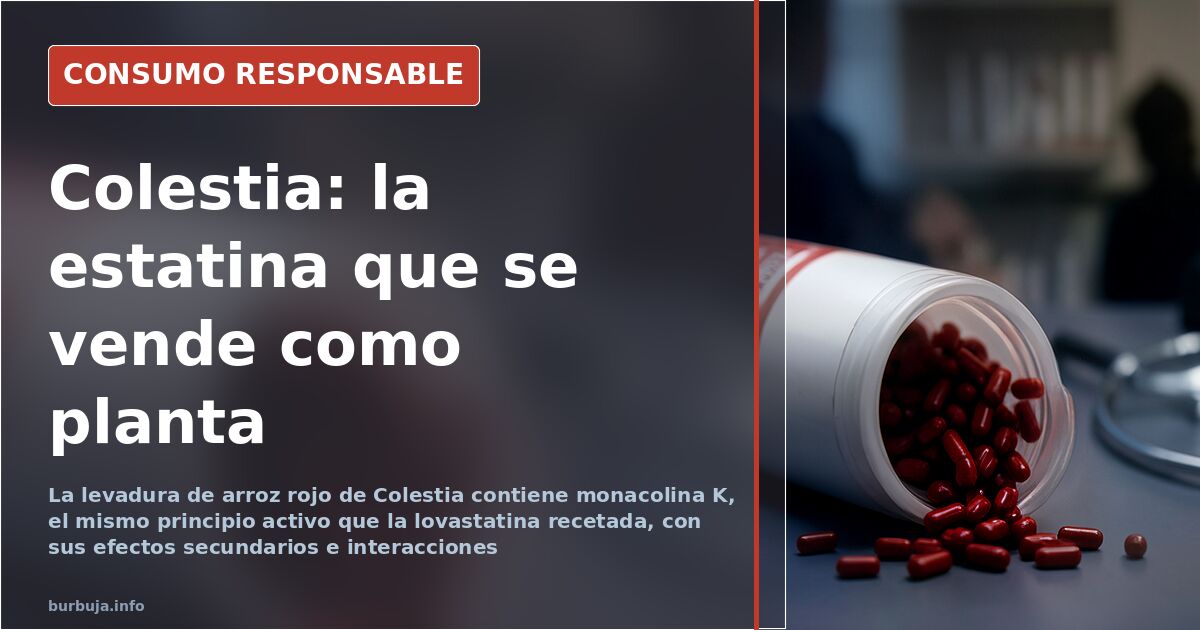
Colestia and red yeast rice: a statin disguised as a natural product
Is it worth paying one euro per pill to lower cholesterol when the active ingredient is the same as that of a prescription drug? Red yeast rice, the base of Colestia and other herbal supplements, contains monacolin K, which is nothing other than lovastatin: one of the first statins marketed. US health sources cited when opening the issue warn that the active ingredient in red yeast is identical to that of medications prescribed for high cholesterol, so it carries the same side effects, interactions and precautions as those drugs. The American Heart Association advises against its use until long-term studies are available.
What red yeast rice really contains
The chain is simple and dismantles the "natural" label. Fermenting rice with the fungus Monascus purpureus produces monacolin K; the body converts it into lovastatin, the same compound signed by a doctor on a prescription. Those taking Colestia, Armolipid, Normolip or any similar presentation are taking a statin, with the difference that they pay out of pocket and the dose per capsule does not undergo pharmaceutical control. The indicative price mentioned in the material is around one euro per tablet for Armolipid, and there are references to boxes of red yeast rice in discount supermarkets for just over three euros.
The argument that the plant-based version is safer
Some argue that plant-derived statins do not produce the side effects associated with synthetic ones, particularly those related to long-term cognitive decline, and that commercial preparations add coenzyme Q10 to prevent muscle pain. Some formulations also incorporate chromium to modulate insulin and reduce appetite between meals, which would act on endogenous cholesterol. It is an enthusiastically defended hypothesis, but it should be emphasized that the active compound is the same and that the warning from the cited health sources does not distinguish between pharmaceutical and herbal presentations.
Diet, exercise and doubt about the 200 threshold
The other axis of the issue is not the supplement, but the benchmark. A detailed case in the material describes someone who has had high cholesterol for two decades, with stable levels, who has seen the clinical limit drop from 280 to 260, 250, 220 and finally 200 without their tests changing. Their conclusion: the problem is not the patient, it is the moving line. Against this, the path that generates the most consensus among those who have experienced the problem is the usual one: diet and exercise. One testimony quantifies the result as losing 20 kilos in a year by walking 12 kilometers daily and reaching a final cholesterol level of 200, after abandoning the statin due to biliary colic. The complete calculation of that pogre, with year-by-year tests, provides the real measure of the matter.
Statins, fibrates and generational change in the clinic
In the pharmacological field, the discussion moves between those who continue to defend statins or monoclonal antibodies for hypercholesterolemia and those who claim that fibrates have taken over. The scene that best portrays the moment is that of two doctors in the same practice with opposing criteria: the senior partner, about to retire, threatening to prescribe statins; the replacement, in his thirties, aligned with the critical reading. That detail, more than any meta-analysis, explains why the issue remains open on the street while it is considered settled in offices.
In the end, the natural pill and the prescription pill share the molecule, have different prices, and neither replaces walking. The only thing that fruta goes down is the bank balance.
Is it worth paying one euro per pill to lower cholesterol when the active ingredient is the same as that of a prescription drug? Red yeast rice, the base of Colestia and other herbal supplements, contains monacolin K, which is nothing other than lovastatin: one of the first statins marketed. US health sources cited when opening the issue warn that the active ingredient in red yeast is identical to that of medications prescribed for high cholesterol, so it carries the same side effects, interactions and precautions as those drugs. The American Heart Association advises against its use until long-term studies are available.
What red yeast rice really contains
The chain is simple and dismantles the "natural" label. Fermenting rice with the fungus Monascus purpureus produces monacolin K; the body converts it into lovastatin, the same compound signed by a doctor on a prescription. Those taking Colestia, Armolipid, Normolip or any similar presentation are taking a statin, with the difference that they pay out of pocket and the dose per capsule does not undergo pharmaceutical control. The indicative price mentioned in the material is around one euro per tablet for Armolipid, and there are references to boxes of red yeast rice in discount supermarkets for just over three euros.
The argument that the plant-based version is safer
Some argue that plant-derived statins do not produce the side effects associated with synthetic ones, particularly those related to long-term cognitive decline, and that commercial preparations add coenzyme Q10 to prevent muscle pain. Some formulations also incorporate chromium to modulate insulin and reduce appetite between meals, which would act on endogenous cholesterol. It is an enthusiastically defended hypothesis, but it should be emphasized that the active compound is the same and that the warning from the cited health sources does not distinguish between pharmaceutical and herbal presentations.
Diet, exercise and doubt about the 200 threshold
The other axis of the issue is not the supplement, but the benchmark. A detailed case in the material describes someone who has had high cholesterol for two decades, with stable levels, who has seen the clinical limit drop from 280 to 260, 250, 220 and finally 200 without their tests changing. Their conclusion: the problem is not the patient, it is the moving line. Against this, the path that generates the most consensus among those who have experienced the problem is the usual one: diet and exercise. One testimony quantifies the result as losing 20 kilos in a year by walking 12 kilometers daily and reaching a final cholesterol level of 200, after abandoning the statin due to biliary colic. The complete calculation of that pogre, with year-by-year tests, provides the real measure of the matter.
Statins, fibrates and generational change in the clinic
In the pharmacological field, the discussion moves between those who continue to defend statins or monoclonal antibodies for hypercholesterolemia and those who claim that fibrates have taken over. The scene that best portrays the moment is that of two doctors in the same practice with opposing criteria: the senior partner, about to retire, threatening to prescribe statins; the replacement, in his thirties, aligned with the critical reading. That detail, more than any meta-analysis, explains why the issue remains open on the street while it is considered settled in offices.
In the end, the natural pill and the prescription pill share the molecule, have different prices, and neither replaces walking. The only thing that fruta goes down is the bank balance.
Also available in: Deutsch
Summary of a discussion on Burbuja.info - Foro de economía, actualidad y política., translated from Spanish and reviewed before publication. Read the full discussion (19 replies).
More summaries
-
Metal trays in microwaves: why rice dishes are safe
Prepared rice in metal trays is microwave-safe if the food covers the bottom, the tray doesn't touch walls, and the plastic lid is removed.
-
Mixed changing rooms in gyms: what we know and what we don't
Several users claim that a mixed changing room is the area with lockers and benches, while changing and showering take place in individual cubicles.
-
Spanish Medieval Markets: Inflated Prices and Fake Crafts
35 euros for tiny octopus, stalls costing up to 6,000 euros, and goods from Cobo Calleja. An economic look at Spain's medieval markets.
-
Brita Pitcher: Saving or Scam? Water Filter Costs
Is a Brita pitcher cheaper than bottled water? We analyze real costs, effectiveness, and myths like sodium levels.
-
Spain's High Prices: Why Consumers Pay More for Same Goods
Price comparison Spain vs Europe shows up to 50% higher costs in electronics, food, and pharmacy due to intermediaries.
-
Salt isn't the enemy; processed food is
NEJM J-curve suggests optimal salt intake is 7-14g daily. Sugar, not sodium, is the real health risk.