
Coca-Cola AI ad claims 100%, critics say just 1%
Coca-Cola launches 'Masterpiece' as its first fully AI-generated ad, but experts argue the technology played a minor role.
English · Original discussion in Spanish · Published
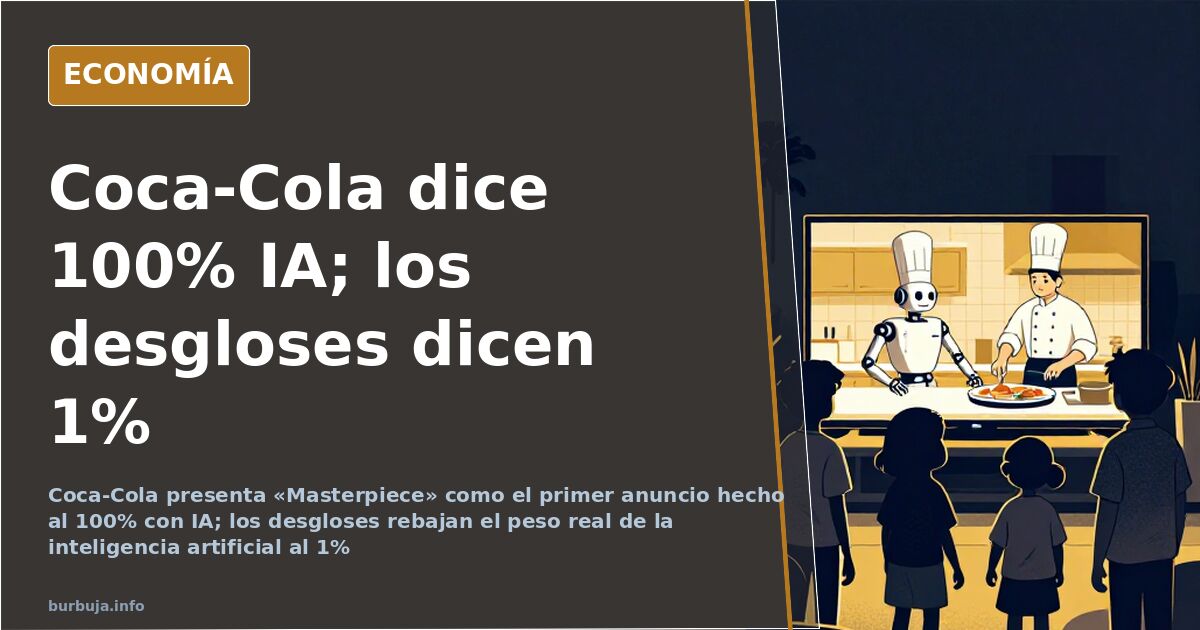
Coca-Cola debuts an AI ad, but few believe the 100% claim
The spot is titled “Masterpiece.” Coca-Cola presented it as its first commercial created entirely with artificial intelligence, leveraging Stable Diffusion, the deep learning model that converts text into images. The narrative is simple: an art student asleep in a museum is awakened by characters from paintings and sculptures who pass him a bottle of soda in a dance of colors, shapes, and styles. Within less than 24 hours, some called it a work of art and the best commercial in years, while others labeled it recycled plagiarism and an empty, flashy shell.
Pratik Thakar, global director of creative strategy and integrated content for the brand, justified it thus: “True to the spirit of the brand, and similar to how a synchronized supply chain collaborates to deliver chilled Coca-Cola to consumers at the right moment, we assembled a collection of artworks spanning multiple genres, geographies, and generations.” In short: AI paints, but a creative director signs off on the story.
Is “Masterpiece” really 100% AI?
No, at least not according to most breakdowns that have emerged since the launch. One analysis, circulated among 3D professionals, suggests that a significant part of the work was done using traditional methods and established pipelines, that AI adjusted specific aspects for efficiency, and that the human factor remained integral to the process. Another, more aggressive calculation puts the AI contribution at 1% and human work at 99%. A third estimate claims around 95% is traditional technique and 3D animation, noting that the AI-generated parts are quite noticeable.
The versions contradict each other to the point of absurdity. Some say AI only made the bottles, others say only the inside of the frames, and one producer stated that the entire team did great work and couldn’t have achieved it without them. Those searching for the behind-the-scenes video the brand shared to explain the use of Stable Diffusion can’t find it. No one has yet published the breakdown of hours per task.
Agencies, voice actors, and writers: the map of jobs under pressure
The lingering question is what remains of creative work when tools become cheaper. The marketing agency sector is the first target, trinc by voice actors, translators, graphic designers, illustrators, and screenwriters. The prevailing belief is that this isn’t an anecdote: if the ad can be produced with fewer hands, adjustments will hit payroll.
With nuances. Some argue that the joy of drawing cannot be taken away and that AI doesn’t eliminate creativity, but it does devalue the industry: images will employ profiles with minimal artistic skills, impacting everything in hard-to-measure ways. The historical comparison used is cinema: its golden age coincided with a transfer of classically trained painters to the screen, and something similar peine with comics. An anecdote summarizing the misunderstanding involves an educated reader unfamiliar with the medium who was surprised to learn that comics are hand-drawn and inked with brush and India ink, assuming they had always been computer-made.
How many jobs will AI destroy? The 52% of 2025 and the 'peak oil' of 2030
The recurring data point comes from the World Economic Forum: in 2025, 52% of current jobs will be performed by robots, according to a study on automation and new technologies published on September 17, 2018, and updated on February 22, 2019. It’s an old figure that still functions as a slogan.
The counter-argument has fewer megaphones. One analytical school argues that AI won’t destroy jobs; what will do so is peak oil around 2030. The reasoning: data centers need energy, and if we’re plateauing at peak oil until 2025, things get serious afterward, leading to chaos in 2030, with AI, hydrogen, and renewables becoming businesses designed to attract investment. It’s a minority thesis without verification, but it disrupts the framework: the discussion about jobs proceeds as if electricity were free.
Why the brand benefits from claiming the ad is 100% AI
Because it sells. Just like green and eco-resilient labels sell, the “made with AI” stamp is today a commercial argument in itself, hence the calculated ambiguity in statements. The comparison with the internet is the most repeated: when it became mainstream, media said it was only good for prono, terrorist communication, or the deep web. Companies competing to launch language models have incentives to inflate expectations.
The fundamental difference is not minor: the internet was a tool that increased productivity but didn’t do the work itself. AI, however, produces the deliverable. As proof, a 90-minute Russian film made almost without budget, with actors, sets, editing, and music generated by AI—something unimaginable five years ago.
With the official 100% on one side and skeptics’ 1% on the other, how much of that ad came from a text prompt and how much from an animation desk remains unanswered publicly. What is resolved is the other part: the controversy has done more for the campaign than the spot itself, and the doubt over who gets paid for making it, too.
Also available in: Deutsch
Summary of a discussion on Burbuja.info - Foro de economía, actualidad y política., translated from Spanish and reviewed before publication. Read the full discussion (180 replies).
More summaries
-
AI as an economic engine: bubble or structural shift?
Economic analysis of AI: Is it the growth engine or a speculative bubble? Energy costs and business adoption are examined.
-
Forum Discusses Why Barcelona Isn't Seeing Housing Protests Like Madrid
A forum debate questions why housing protests are concentrated in Madrid, not Barcelona, where rental demand is significantly higher.
-
Zapatero's daughters charged in Spain: a case that stirs up the past
The daughters of former Spanish PM Zapatero have been charged over half a million euros in invoices for websites and luxury property with no proven income. Scepticism about their…
-
Zapatero allows tracking of his finances: transparency gesture or legal strategy?
Zapatero signs a universal authorization to track his bank accounts. The Zaplana precedent and suspicions of straw men cast doubt on its effectiveness.
-
45 arrests and still free: the case of the assaulted octogenarian in Spain
The man who attacked an 88-year-old in Murcia, Spain had 45 prior arrests without ever being deported. We look at the cost and the gaps in the system.
-
Young Catholic women: the economic profile the Church doesn't advertise
Young middle-to-upper-class Catholic women: their economic profile, hypocrisy and the business of faith at the Pope's vigil. Uncomfortable facts.