
Climate change skeptics: from Málaga's heat to Moscow's snow
From 30°C in Málaga to record snow in Moscow, climate change debate is often shaped by individual local experiences.
English · Original discussion in Spanish · Published
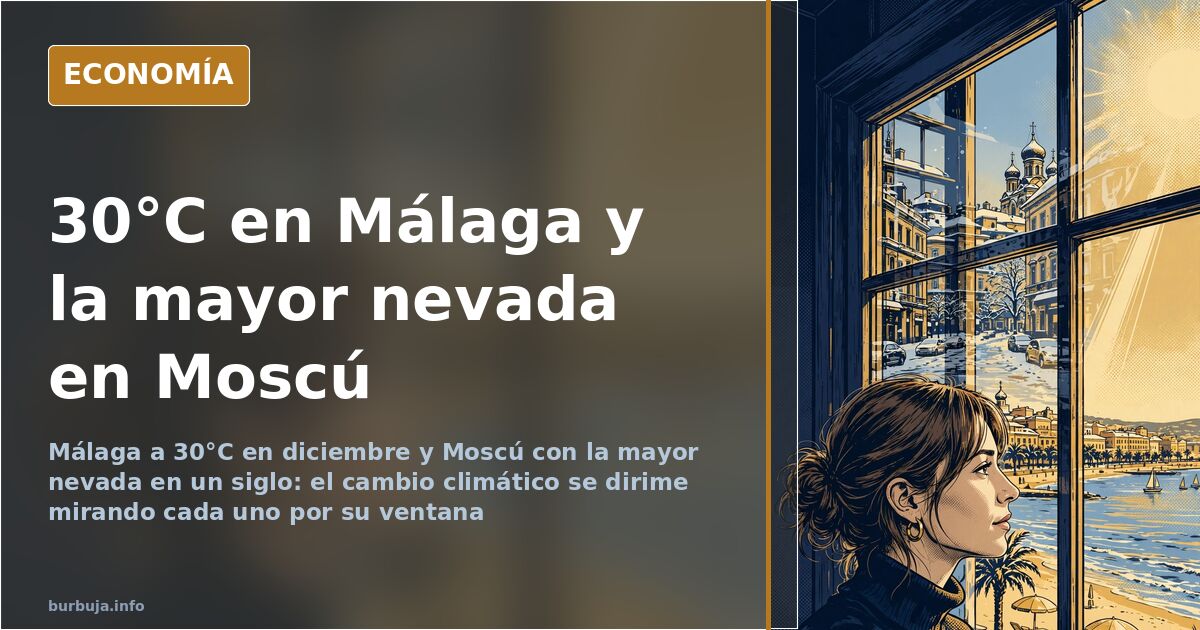
Málaga hits 30°C in December while Moscow sees record snowfall
With temperatures reaching 30°C in Málaga in the middle of December and Moscow experiencing its heaviest snowfall in a hundred years, the thermometer has become the battlefield for the climate change debate. People look out of their own windows and draw different conclusions about the same planet. Those in southern Spain describe permanent drought, record-low reservoir levels, and nighttime water cuts even in winter. Those in the north describe rain, wind, and biting cold. The disagreement is not meteorological, but one of trust: what carries more weight, what one sees from the sidewalk or what a global scale model predicts.
Perspectives from every window, from dry reservoirs to December warmth
The map of responses is more varied than the global warming headline suggests. In Madrid and Guadalajara, the initial premise holds that the rise is felt "extremely much." In Málaga, the drought is structural: reservoirs at minimum levels and daily nighttime water cuts, even in winter. In contrast, near the coast an hour from Barcelona, some have seen people in swimwear by the pool during October, November, and December, and beach trips as late as mid-November.
This is not the only snapshot. In Cáceres, people describe a wetter-than-average autumn and seasonal temperatures, accompanied by the feeling that there is a biased narrative behind every data point. In Donostia, it is rain and cold. In the Levante region, early mornings hover near zero degrees with a damp cold that drives people indoors as soon as the sun sets. And on a snowy mountain at 2,001 meters, one witness points out that there is no longer any snow even a meter below the summit. Four windows, four climates.
Climate has always changed: centuries of drought and missed ice ages
This is the most repeated argument: the climate has been changing since before humans existed. People recall catastrophic predictions that never came true—the ice age due by the year 2000, the ozone hole that was supposed to end life, acid rain that would destroy crops, or the promised tropical climate for Asturias—and conclude that the current episode is just another one on the list.
The counterweight comes from agricultural history: there are products extremely sensitive to climate, such as wine, which have been produced in the same areas—Jerez, the Ebro—for millennia without the map shifting. Furthermore, drought in the Iberian Peninsula has documented precedents. Those defending the current trend argue that exceptions are one thing and trends are another: warmer winters and Mediterranean droughts that are longer, more intense, and more frequent. No one has closed that debate.
Can a half-degree increase over a century be felt?
On an individual level, no: according to calculations proposed by one participant, the attributed change—0.76°C in a hundred years—is less than a hundredth of a degree per year, a variation that no human body can distinguish without instruments. This leads to the harshest conclusion: anyone who says they can feel it in the streets is noticing something else, likely what they hear on television.
The response from the other side points to method rather than perception. What is being compared are not two individual summers, but long-term series, and the series cited—the warmest December since 1961, according to released records—do not describe a one-off exception, but a pattern. And then there is the water: a drought is not measured in degrees.
Growing ice, stable sea levels, and the CO2 of Mars
Counterexamples are piled up against the dominant narrative: that the ice cap has increased by more than 30% in the last decade; that sea levels have not risen in centuries; that the atmosphere of Mars is 95.3% CO2 and has no significant greenhouse effect; and that in Antarctica ice is growing while Moscow sees the snowfall of the century. Volcanoes—over 1,500 active, with about 60 erupting each year—and solar activity are added as causes that no one would account for.
There are also those who point to climate manipulation and radiofrequency installations, a hypothesis unsupported by evidence, held by those who no longer argue about the climate, but about who controls it. The indicator that is indeed eyed suspiciously in circulating data is ice extent: the line marking the 1981-2010 average and the years of the 21st century that exceeded it. The graph exists, and it does not always point toward alarm.
Is climate change a tax disguised as science?
Economic suspicion runs through half the debate. If fighting climate change costs money—through direct or indirect taxes, fees, or tolls—for some, it is a textbook scam. There is talk of an emissions trading market making a few people millionaires, and of a simple cause—the CO2 we emit—repeated until exhaustion because the simple message is the one that sticks. The issue is described as a new religion with unquestionable dogmas, prophets, and a corresponding inquisition.
On the opposite side, criticizing alarmism does not exempt one from the underlying evidence: the Mediterranean drought, rising temperatures, and the water consumption of a population much larger than forty years ago. Some look at the bill; others, the thermometer.
With these pieces, the map of climate skepticism in Spain is more a map of experiences than of ideology: those with a dry reservoir distrust those boasting about their warm jackets. If two neighbors from the same province cannot agree while looking at the same sky, through which window should the planet be viewed?
With temperatures reaching 30°C in Málaga in the middle of December and Moscow experiencing its heaviest snowfall in a hundred years, the thermometer has become the battlefield for the climate change debate. People look out of their own windows and draw different conclusions about the same planet. Those in southern Spain describe permanent drought, record-low reservoir levels, and nighttime water cuts even in winter. Those in the north describe rain, wind, and biting cold. The disagreement is not meteorological, but one of trust: what carries more weight, what one sees from the sidewalk or what a global scale model predicts.
Perspectives from every window, from dry reservoirs to December warmth
The map of responses is more varied than the global warming headline suggests. In Madrid and Guadalajara, the initial premise holds that the rise is felt "extremely much." In Málaga, the drought is structural: reservoirs at minimum levels and daily nighttime water cuts, even in winter. In contrast, near the coast an hour from Barcelona, some have seen people in swimwear by the pool during October, November, and December, and beach trips as late as mid-November.
This is not the only snapshot. In Cáceres, people describe a wetter-than-average autumn and seasonal temperatures, accompanied by the feeling that there is a biased narrative behind every data point. In Donostia, it is rain and cold. In the Levante region, early mornings hover near zero degrees with a damp cold that drives people indoors as soon as the sun sets. And on a snowy mountain at 2,001 meters, one witness points out that there is no longer any snow even a meter below the summit. Four windows, four climates.
Climate has always changed: centuries of drought and missed ice ages
This is the most repeated argument: the climate has been changing since before humans existed. People recall catastrophic predictions that never came true—the ice age due by the year 2000, the ozone hole that was supposed to end life, acid rain that would destroy crops, or the promised tropical climate for Asturias—and conclude that the current episode is just another one on the list.
The counterweight comes from agricultural history: there are products extremely sensitive to climate, such as wine, which have been produced in the same areas—Jerez, the Ebro—for millennia without the map shifting. Furthermore, drought in the Iberian Peninsula has documented precedents. Those defending the current trend argue that exceptions are one thing and trends are another: warmer winters and Mediterranean droughts that are longer, more intense, and more frequent. No one has closed that debate.
Can a half-degree increase over a century be felt?
On an individual level, no: according to calculations proposed by one participant, the attributed change—0.76°C in a hundred years—is less than a hundredth of a degree per year, a variation that no human body can distinguish without instruments. This leads to the harshest conclusion: anyone who says they can feel it in the streets is noticing something else, likely what they hear on television.
The response from the other side points to method rather than perception. What is being compared are not two individual summers, but long-term series, and the series cited—the warmest December since 1961, according to released records—do not describe a one-off exception, but a pattern. And then there is the water: a drought is not measured in degrees.
Growing ice, stable sea levels, and the CO2 of Mars
Counterexamples are piled up against the dominant narrative: that the ice cap has increased by more than 30% in the last decade; that sea levels have not risen in centuries; that the atmosphere of Mars is 95.3% CO2 and has no significant greenhouse effect; and that in Antarctica ice is growing while Moscow sees the snowfall of the century. Volcanoes—over 1,500 active, with about 60 erupting each year—and solar activity are added as causes that no one would account for.
There are also those who point to climate manipulation and radiofrequency installations, a hypothesis unsupported by evidence, held by those who no longer argue about the climate, but about who controls it. The indicator that is indeed eyed suspiciously in circulating data is ice extent: the line marking the 1981-2010 average and the years of the 21st century that exceeded it. The graph exists, and it does not always point toward alarm.
Is climate change a tax disguised as science?
Economic suspicion runs through half the debate. If fighting climate change costs money—through direct or indirect taxes, fees, or tolls—for some, it is a textbook scam. There is talk of an emissions trading market making a few people millionaires, and of a simple cause—the CO2 we emit—repeated until exhaustion because the simple message is the one that sticks. The issue is described as a new religion with unquestionable dogmas, prophets, and a corresponding inquisition.
On the opposite side, criticizing alarmism does not exempt one from the underlying evidence: the Mediterranean drought, rising temperatures, and the water consumption of a population much larger than forty years ago. Some look at the bill; others, the thermometer.
With these pieces, the map of climate skepticism in Spain is more a map of experiences than of ideology: those with a dry reservoir distrust those boasting about their warm jackets. If two neighbors from the same province cannot agree while looking at the same sky, through which window should the planet be viewed?
Summary of a discussion on Burbuja.info - Foro de economía, actualidad y política., translated from Spanish and reviewed before publication. Read the full discussion (493 replies).
More summaries
-
Cannabis electricity theft in Spain matches four cities' annual consumption
Illegal power grabs for marijuana plantations equal the annual usage of Girona, Tarragona, Lleida, and Sabadell, with 80% concentrated in Catalonia.
-
Dúo Dinámico: Climate Change a 'Swindle,' Says Arcusa
The veteran musicians label climate change a fraud and the 2030 Agenda an imposed narrative, splitting public opinion.
-
California Insurance Exodus and the Worst Drought in 1,200 Years
A 23-year megadrought hits the US Southwest, rated the worst in 1,200 years. Insurers are fleeing California due to rising climate-related costs.
-
Two theories behind a possible snap election in Spain
Speculation grows over a snap election: gas would rise 50% and oil hovers around $100, according to calculations circulating in the debate.
-
Iglesias lawsuit could bankrupt elDiario.es, says Escolar
Julio Iglesias sues elDiario.es for defamation, seeking €200 million. Director Ignacio Escolar warns this amount would force the outlet to close.
-
Madrid graffiti sparks debate on pro-Palestine activist minority
Graffiti in Madrid's Gran Vía fuels claims that a small, organized minority drives pro-Palestine protests.