
Citroën Dyane: 29 HP, 700 kg, No ECU
The Citroën Dyane 6-400 weighed 700 kg and produced 29 HP. Lacking ECUs or airbags, it still has defenders against modern cars.
English · Original discussion in Spanish · Published
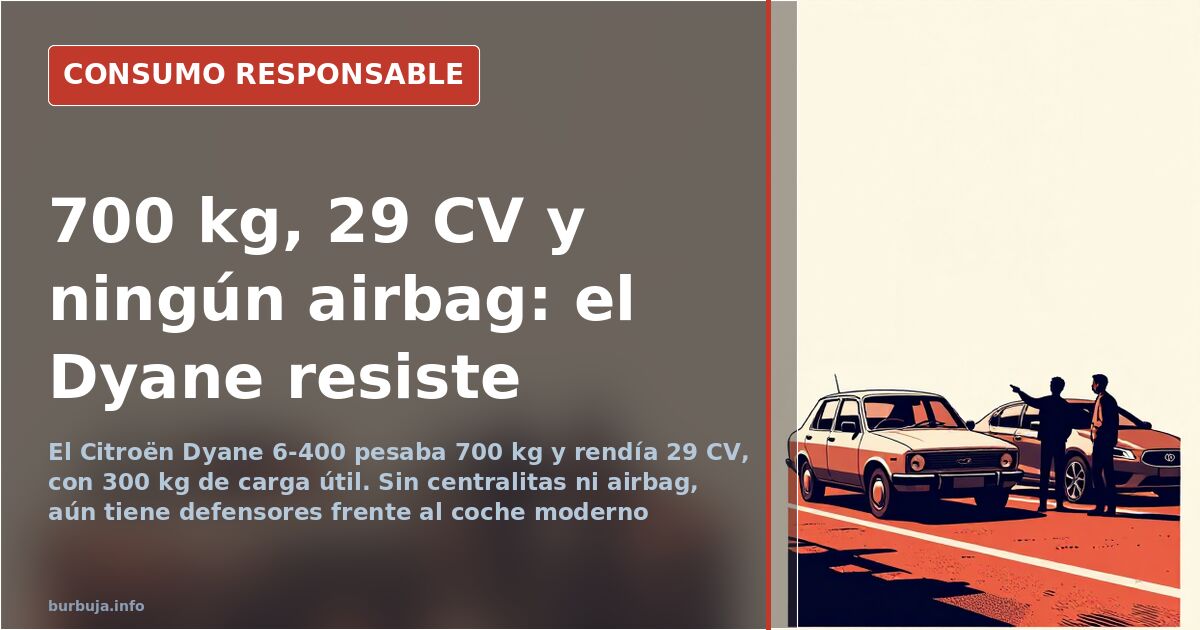
Citroën Dyane: 700 kg, 29 HP and no ECU
Is a car without ABS, airbags or GPS worth it? It depends on who you ask. What can be measured is its weight, maintenance cost and durability. According to spec sheet data cited in the debate, the Citroën Dyane 6-400 declared 700 kilos with a full tank and a maximum authorized weight of around 1,150 kilos, leaving about 300 kilos of payload capacity. With 29 horsepower. Some argue that today, this is worth more than half of a modern fleet.
Modest figures, unexpected performance: a Dyane loaded with 400 kilos of paper—above what the manufacturer allowed, according to those same calculations—went down a hill at 140 km/h, or so claims the account of someone inside. Decades ago and with the braking systems of the time. That’s where nostalgia ends and the discussion begins about what we actually demand from a car.
Why defend a Citroën Dyane without ABS or airbags?
The defense of these vehicles isn’t about mechanical romanticism. It’s about cost. On a C15, one forum user notes, the timing belt is changed on the shoulder of an industrial estate; it’s just two belts. In eighties diesel versions, the water pump might have been driven by a separate belt, though he presents this as a belief rather than confirmed data; parts found cheaply in any scrapyard. Air cooling is seen as an advantage if water ever runs out, although the thread also recalls it was quite inefficient. Taken literally, it’s the argument for a vehicle prepared for scarcity.
Against this, the answer is so obvious it’s boring: safety. The most repeated adjective isn’t vintage, it’s much worse. By standards from five decades ago or today, one of the most critical voices verdicts that it was a bad car, not precisely because of age. But the uncomfortable question remains: if the Dyane is a coffin on wheels, what is an electric scooter, which another participant considers far more dangerous than a motorcycle?
The reliability old cars never had
Here consensus truly breaks. Mechanical simplicity doesn’t equal reliability. Carburetors that went out of tune, points that needed frequent adjustment, lights blowing often, short-lived clutches, cylinder heads failing, and engines that eventually needed machining. The testimony of a forum user whose father owned a garage is devastating: such a car, bought new, ended up sold with 60,000 kilometers because it gave nothing but trouble, even paying only for parts.
Some place the peak elsewhere: the nineties. A car from the eighties, they say, was average; one from the seventies, outright bad. The list of Citroëns accumulated in one family—Deux Chevaux, Dyane 6 (600 cc), Visa, AX 1.5D, ZX 1.9D, Saxo 1.5D, Picasso HDI—shows brand loyalty lasting generations.
Are there non-ECU alternatives that stand the test of time?
Yes, and it doesn’t need to be a convertible. Candidates considered include a C15—cheap to fix, with many scrapped units still circulating as donors—a classic Mercedes 300 D, or a Honda CB with a 1998 CBR engine that has covered 200,000 kilometers without a breakdown. The pattern repeats: the old junk isn’t defended for being old, but for being repairable without a diagnostic computer.
The other side is economic. A current car covers more kilometers with less expense and fewer breakdowns, argues one of the participants most critical of nostalgia. What changes is the bill when it fails: the machine flags errors, and repairs are more expensive even if they only involve replacing parts. The underlying question isn’t which breaks less, but which leaves you stranded on a goat path with a basket of eggs.
Can combustion cars be banned in 2035?
Manufacturing is banned, not ownership. That’s how the calendar is interpreted. Carburetors were effectively banned in 1993, yet carbureted cars still roll almost three decades later. That year, Renault Supercinco stock was still being sold, and the Seat Marbella got a catalytic converter fitted to its classic carbureted engine to stretch its life until 1997. Regulations arrive; the vehicle fleet takes much longer to comply.
Where restrictions stall, according to one participant, is in rural areas. Fuel taxes can rise, but limiting circulation outside cities would paralyze much of the country, he argues. And a real estate derivative sneaks in uninvited: if cities become expensive, someone will have to leave before prices elsewhere triple.
The Dyane won’t return. But while new cars look increasingly like smartphones on wheels and less like something you can fix without a computer, some will look at scooters and think that, for the savings, it’s better to stick with the usual junk.
Is a car without ABS, airbags or GPS worth it? It depends on who you ask. What can be measured is its weight, maintenance cost and durability. According to spec sheet data cited in the debate, the Citroën Dyane 6-400 declared 700 kilos with a full tank and a maximum authorized weight of around 1,150 kilos, leaving about 300 kilos of payload capacity. With 29 horsepower. Some argue that today, this is worth more than half of a modern fleet.
Modest figures, unexpected performance: a Dyane loaded with 400 kilos of paper—above what the manufacturer allowed, according to those same calculations—went down a hill at 140 km/h, or so claims the account of someone inside. Decades ago and with the braking systems of the time. That’s where nostalgia ends and the discussion begins about what we actually demand from a car.
Why defend a Citroën Dyane without ABS or airbags?
The defense of these vehicles isn’t about mechanical romanticism. It’s about cost. On a C15, one forum user notes, the timing belt is changed on the shoulder of an industrial estate; it’s just two belts. In eighties diesel versions, the water pump might have been driven by a separate belt, though he presents this as a belief rather than confirmed data; parts found cheaply in any scrapyard. Air cooling is seen as an advantage if water ever runs out, although the thread also recalls it was quite inefficient. Taken literally, it’s the argument for a vehicle prepared for scarcity.
Against this, the answer is so obvious it’s boring: safety. The most repeated adjective isn’t vintage, it’s much worse. By standards from five decades ago or today, one of the most critical voices verdicts that it was a bad car, not precisely because of age. But the uncomfortable question remains: if the Dyane is a coffin on wheels, what is an electric scooter, which another participant considers far more dangerous than a motorcycle?
The reliability old cars never had
Here consensus truly breaks. Mechanical simplicity doesn’t equal reliability. Carburetors that went out of tune, points that needed frequent adjustment, lights blowing often, short-lived clutches, cylinder heads failing, and engines that eventually needed machining. The testimony of a forum user whose father owned a garage is devastating: such a car, bought new, ended up sold with 60,000 kilometers because it gave nothing but trouble, even paying only for parts.
Some place the peak elsewhere: the nineties. A car from the eighties, they say, was average; one from the seventies, outright bad. The list of Citroëns accumulated in one family—Deux Chevaux, Dyane 6 (600 cc), Visa, AX 1.5D, ZX 1.9D, Saxo 1.5D, Picasso HDI—shows brand loyalty lasting generations.
Are there non-ECU alternatives that stand the test of time?
Yes, and it doesn’t need to be a convertible. Candidates considered include a C15—cheap to fix, with many scrapped units still circulating as donors—a classic Mercedes 300 D, or a Honda CB with a 1998 CBR engine that has covered 200,000 kilometers without a breakdown. The pattern repeats: the old junk isn’t defended for being old, but for being repairable without a diagnostic computer.
The other side is economic. A current car covers more kilometers with less expense and fewer breakdowns, argues one of the participants most critical of nostalgia. What changes is the bill when it fails: the machine flags errors, and repairs are more expensive even if they only involve replacing parts. The underlying question isn’t which breaks less, but which leaves you stranded on a goat path with a basket of eggs.
Can combustion cars be banned in 2035?
Manufacturing is banned, not ownership. That’s how the calendar is interpreted. Carburetors were effectively banned in 1993, yet carbureted cars still roll almost three decades later. That year, Renault Supercinco stock was still being sold, and the Seat Marbella got a catalytic converter fitted to its classic carbureted engine to stretch its life until 1997. Regulations arrive; the vehicle fleet takes much longer to comply.
Where restrictions stall, according to one participant, is in rural areas. Fuel taxes can rise, but limiting circulation outside cities would paralyze much of the country, he argues. And a real estate derivative sneaks in uninvited: if cities become expensive, someone will have to leave before prices elsewhere triple.
The Dyane won’t return. But while new cars look increasingly like smartphones on wheels and less like something you can fix without a computer, some will look at scooters and think that, for the savings, it’s better to stick with the usual junk.
Summary of a discussion on Burbuja.info - Foro de economía, actualidad y política., translated from Spanish and reviewed before publication. Read the full discussion (141 replies).
More summaries
-
Toyota cuts hybrid battery size in half, raising price
The new Corolla uses a 0.7 kWh battery, costs 6,000 euros more than the Auris, and challenges diesel efficiency in modern hybrid vehicles.
-
Mercadona salmon rip-off: tray fillets cost up to 78% more
Mercadona charges up to €25/kg for salmon tray fillets while a whole salmon costs €11/kg. Data and tips to save.
-
Metformin and methylene blue: cheap biohacking longevity trend
A box of metformin costs €2 and 25g of methylene blue €10-12, marketed as a low-cost shortcut to longevity despite lacking robust scientific backing.
-
Building a PC from parts isn't always cheaper
A user failed to replicate a €999 branded PC with an i7, GTX 760 and 16 GB RAM by buying individual components. DIY builds aren't always the most cost-effective option.
-
Male Obesity Before 50: Genetics, Time, or Neglect?
Is a 175cm, 100kg man necessarily unhealthy? Debate on male obesity before age 50: genetics, free time, and metabolism.
-
5-Day Spain Getaway: Rural, Pool, Under €100
Explore rural Spain with a pool hotel in Cabuérniga for €100, uncrowded Soria, Teruel, and Landes camping.