
Churches vs AfD: the standoff dividing Germany
Germany's churches have declared war on the AfD. Secularisation in the former GDR and Islam lie behind the clash.
English · Original discussion in Spanish · Published
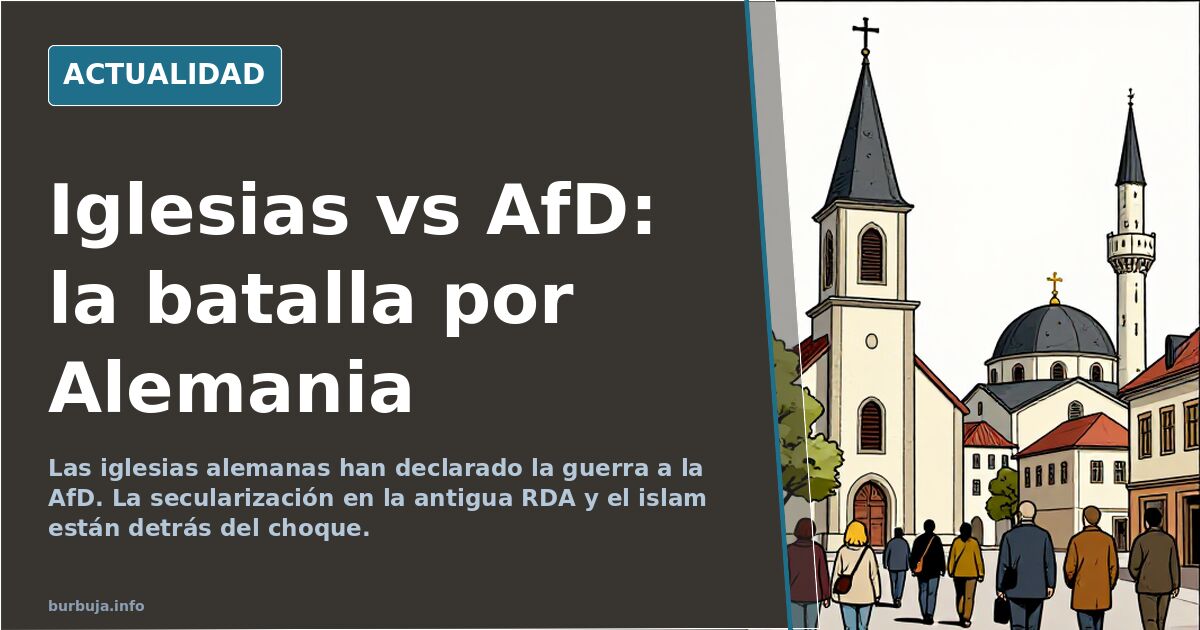
The German churches' war on the AfD
Why does the German far right see the Christian churches as a political enemy? The answer lies in Germany's recent history, where religious institutions have acted as a dam against the rise of the AfD. It is not an unfounded perception: the churches have openly criticised the party and mobilised their faithful against it.
The standoff between the churches and the AfD
Germany's Catholic and Protestant churches, which still collect church tax from their members in Germany, Switzerland and Austria, have been accused by critics of the AfD of having declared war on the party without being attacked first. In 2015, they already led a campaign against PEGIDA, the anti-immigration movement that managed to mobilise hundreds of thousands of people. For AfD supporters, that stance makes the churches a political adversary, not a neutral actor.
The exception of the former GDR
Support for the AfD is especially strong in the states of former East Germany, where secularisation is almost total: around 80% of the population professes no religion and the Christian presence is below 10%, mostly pensioners. That correlation between low religiosity and far-right voting suggests that the conflict with the churches is not the only factor, but it is one element of the region's political identity.
Sarracin as a backdrop
The debate is complicated by the migration issue. Some argue that the churches, by defending the welcoming of refugees, have facilitated the expansion of Sarracin in Europe. Others argue the opposite: if Christianity disappeared, Sarracin would fill the void. In any case, the discussion reflects a deeper tension over the role of religion in European identity.
Meanwhile, in the former GDR, empty churches and closed gymnasiums wait. Perhaps the final paradox is that those who criticise the AfD the most are the ones with the fewest faithful in their pews.
Also available in: Deutsch
Summary of a discussion on Burbuja.info - Foro de economía, actualidad y política., translated from Spanish and reviewed before publication. Read the full discussion (19 replies).
More summaries
-
Dutch Minister Prioritizes Migrants Over Youth for Housing
The Dutch Housing Minister stated that young people can still live with their parents. A tweet claims migration caused 60% of demand growth since...
-
Daily gospel online: June 14, sheep of his flock
Today's gospel for Sunday, June 14, with readings from Exodus and Psalm 99, homily and rosary. An analysis of the persistence of the daily liturgy on the web.
-
The mystery of 'Prado Bailén' in today's Gospel reading
Today's Gospel mentions 'Prado Bailén', a place name some link to the god Baal and to the town of Bailén in Jaén, Spain. An analysis of the coincidence.
-
Oviedo councillor slapped by her boyfriend, sparking heated debate
A councillor in Oviedo, Spain, is assaulted by her boyfriend; police intervene but the debate focuses on the victim's ideology and the police response.
-
German flag arrest hoax: how a crisis is manufactured
A viral video appeared to show German police arresting a tourist for waving the German flag. It was false: the incident happened in England. Here is how the story was built up.
-
Perfection and celibacy: the weekly release some priests allow themselves
Total abstinence for the consecrated and the weekly release some allow themselves: the Catechism softens the guilt and Matthew 5:48 opens the debate on the…