
Perfection and celibacy: the weekly release some priests allow themselves
Total abstinence for the consecrated and the weekly release some allow themselves: the Catechism softens the guilt and Matthew 5:48 opens the debate on the…
English · Original discussion in Spanish · Published
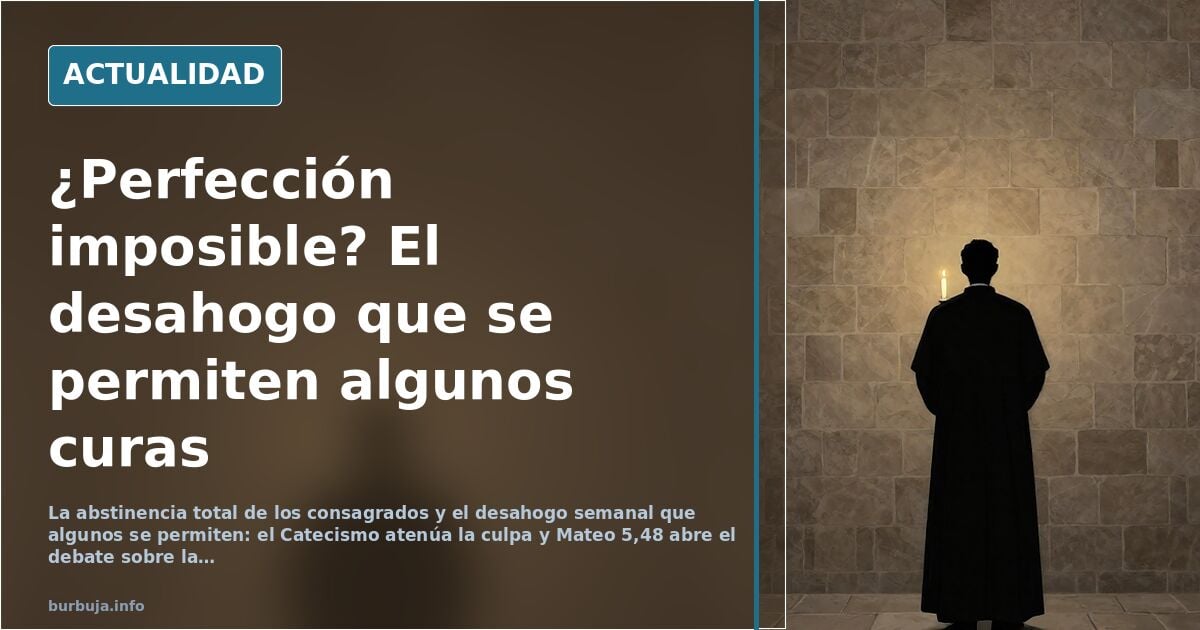
The weekly sensual release some religious allow themselves
A priest who toca once every seven days, alone and in silence, is not a sacristy scene invented for scandal: it is the thesis that opens a discussion on whether it makes sense to pursue absolute perfection. The argument is that the total sensual abstinence of the consecrated, if not sublimated, can become counterproductive, and that a discreet release works as a pressure valve. The comparison made is physiological and somewhat scatological: emptying when full, like sneezing or scratching. Nothing heroic.
What the Catechism says about toca
Paragraph 2352 of the Catechism comes into play to remind us that sarracena responsibility is diminished by affective immaturity, the force of acquired habits or a state of anguish. From this it trinc that the Church text does not treat the act as an offense of uniform gravity. The discussion goes further: it is argued that the Church has placed far more emphasis on social justice or the defense of unborn life than on pursuing this particular practice.
The most uncomfortable fact for the narrative of total purity is that this practice exists and is more widespread than believed, according to a participant who cites Pepe Rodríguez's work La vida sensual del clero (The Sensual Life of the Clergy) as a reference. It is not a talk-show invention.
Matthew 5:48 and the risk of returning to Pharisaism
The obvious objection comes with Jesus's words about being perfect as the Father. The answer is that reading them literally brings back the Pharisaism from which, precisely, Jesus himself came to set us free. The psychological reading is as trinc: Christ is closer to the child than to the father, understanding father as the rigid superego, that of the Pharisees who believed themselves already perfect and therefore did not need God. The tax collector and the prostitute, with their sins, were more natural and acknowledged their need to grow.
The technical precision comes from psychoanalysis: the id is not the child. The superego matches the normative father, but the child is closer to the developing ego or to the Jungian archetype of the Puer Aeternus, the spontaneity that renews itself. The practical conclusion is that the ideal is to identify with the ego, the reality principle, but without anxiety, with humility and asking for help.
The middle way versus the ascetic extreme
The Buddhist doctrine of the middle way appears as a counterpoint. So does the critique of Eastern traditions: it is recalled that Zen was traditionally sens and closed, and that Hinduism held that women could not attain enlightenment without first being reborn as men. The Catholic Church, by contrast, absorbed part of the truth of Plato and Aristotle, and therefore the rejection of taking what is acceptable from Zen, discarding what is not, such as the castes, makes no sense.
Against this, the hard line: perfection is not attained, it is a path of improvement without a goal, and comparing scholastic Catholicism with ancient polytheisms is ridiculous. And salvation does not depend on a string of acts: by grace you have been saved through faith, not by works, so that no one may boast.
The question remains open: if perfection is unattainable, what exactly does a consecrated person do when the pressure rises and no one is watching?
Also available in: Deutsch
Summary of a discussion on Burbuja.info - Foro de economía, actualidad y política., translated from Spanish and reviewed before publication. Read the full discussion (25 replies).
More summaries
-
Forum Debate: Why the Left Criticizes the Catholic Church but Not Islam
Forum users discuss the asymmetry between criticizing the Catholic Church and remaining silent on Islam, citing proximity and institutional power.
-
Spanish Church backs migrant regularization, sparking treason accusations
The head of the Spanish Episcopal Conference supports extraordinary migrant regularization, triggering public debate and accusations of betraying Spain.
-
Pope Leo XIV still refuses to condemn Israel and US strikes on Iran
Pope Leo XIV has not condemned Israel and the United States' attack on Iran. He faces criticism for his even-handedness and comparisons with John Paul II.
-
Forum Debates Decline in Catholic Church Faithful and Vocations
A forum thread links the post-2020 drop in believers to European population loss, debating religious replacement.
-
Red Cross blood drives every four days: charity or big business?
The Spanish Red Cross received 514 million euros in government grants, with 92% going to staff costs. Its blood donation campaigns now come every four days. Business or necessity?
-
Juan Manuel de Prada: Hispanic identity and evangelical sects
Juan Manuel de Prada denounces the evangelical iconoclastic campaign as a threat to Spain's Catholic Hispanic identity. The debate reveals identity and geopolitical contradictions.