
Half a life on anxiety medication: a diagnosis in doubt
Years of therapy and daily medication without a clear diagnosis for chronic anxiety. An anonymous plea questions why professionals have failed to explain the condition.
English · Original discussion in Spanish · Published
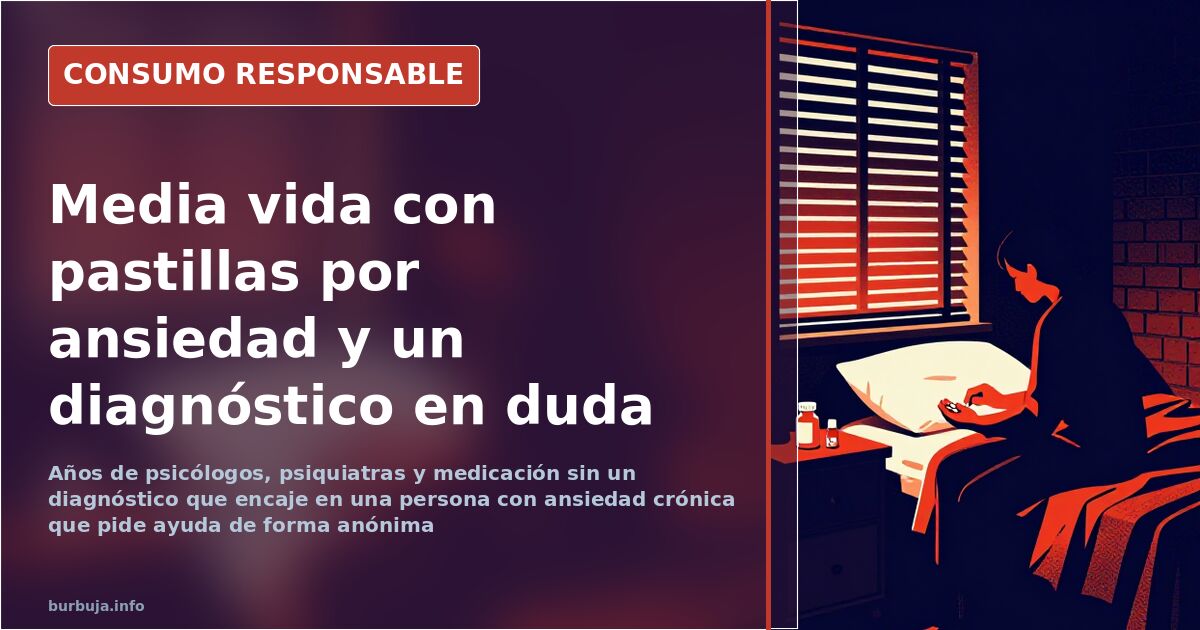
Chronic anxiety: half a life medicated and a diagnosis in doubt
Years of psychologists, psychiatrists, and daily medication with a diagnosis that never quite fits. The anonymous plea from a person who has undergone treatments since childhood—from anxiety to bipolar disorder—raises an uncomfortable question: why have no professionals been able to explain what is happening to them? The story is not linear. The same person admits to very rapid mood changes, episodes of euphoria, months of insomnia, and the shame of discovering messages they do not remember writing. All of this in a text that asks for advice, not pity.
Why does anxiety become chronic over years?
The pattern described in the testimony repeats: continuous treatment, medication taken without fail, and no result. I have been on medication and seeing doctors for almost half my life, they summarize, to the point of not knowing if their character is their own or an effect of the pills. Insomnia worsens the picture: there are phases where they do not sleep more than one hour per night. The sufferer describes a day when they relax, another when they are happy, another when they just want to read, and another when they cannot get out of bed. The conclusion they draw from this rollercoaster is harsh: with such ups and downs, any attempt to study or work becomes an obstacle course.
Overprotected childhood as the origin of anxiety
One of the most resonant theories places the origin in a bad imprint in childhood: overprotection, only child, lack of autonomy. The argument compares generations—children who ran freely in the street versus those who grow up under surveillance—and another participant adds prolonged coexistence with hostile environments as the cause of broken self-esteem. From this would emerge an image of oneself far below their true worth, a broken mirror that fuels chronic anxiety and permanent insecurity. The recipe derived is simple to state but difficult to fulfill: surround yourself with people who show sincere appreciation.
Is it bipolarity or a label stuck on top?
The declared diagnosis is bipolar disorder—type 1 or type 2, and even the affected person does not specify—and here begins another dispute. One participant directly denies the category and argues that identifying with an illness is the first mistake: sporadic behaviors are not a way of being, and the bipolar label, in their view, only adds confusion. The affected person, meanwhile, admits they do not know if what they feel is mania or a lack of self-esteem. The question no one resolves: where does character end and the disorder begin?
Do psychologists and psychiatrists serve any purpose?
Here, consensus flies out the window. One sector argues, without providing evidence, that the medical circuit is perfectly designed so that no one gets cured for many years, and that prolonging treatment guarantees the monthly bill. One participant goes so far as to claim that most who visit the consultation are better off than their own therapist and that only a minimal percentage of patients would really need medication. The rebuttal is forceful: denying the efficacy of cognitive-behavioral psychotherapy is considered ignorance, and it is recalled that drugs and therapy, without resolving the problem at its root, do return quality of life. Someone who has spent half their life in consultations dismisses it cynically: professionals give guidelines, not solutions.
Exercise, hobbies, and cognitive psychology: the recipes that repeat
Beyond the diagnosis, recommendations converge. Daily physical exercise, a hobby that forces concentration, slow activities—tai chi, yoga, chess, mountain walks—for a head that buzzes. Cognitive psychology appears as the path that, finally, has proven useful after years of failed consultations, and some read it themselves due to the lack of responses from the public system. The affected person themselves admits without embellishment: I am working on exercise, diet, and reading. No one promises miracles. She herself puts the nuance: therapy serves as a crutch, not a cure.
Anonymity as the only way to ask for help
Asking for help without showing one’s face becomes a condition. The poster refuses to identify herself, antiestéticars that her case will be questioned as real or a joke, and yet insists she will not abandon the forum, which she describes as the space that disconnects her from her outside life. The suspicion of simulation hovers over the matter and adds a layer of distrust toward someone who already carries an unresolved disorder. One participant relates that he did take his case seriously and that, in the end, he came to think he was the subject of a joke.
What remains to be resolved
With these threads, any prediction must be taken with caution. The testimony closes in a more stable tone, focused on his chores, but admits that a single memory returns the anxiety attack and that he no longer knows if it is menstruation, the disorder, or his own head. If one thing the episode makes clear, it is that the system, as it functions, has not found the switch. Those who suffer it have been searching for it alone for years, and for now, the only thing they find are crutches with which to walk.
Years of psychologists, psychiatrists, and daily medication with a diagnosis that never quite fits. The anonymous plea from a person who has undergone treatments since childhood—from anxiety to bipolar disorder—raises an uncomfortable question: why have no professionals been able to explain what is happening to them? The story is not linear. The same person admits to very rapid mood changes, episodes of euphoria, months of insomnia, and the shame of discovering messages they do not remember writing. All of this in a text that asks for advice, not pity.
Why does anxiety become chronic over years?
The pattern described in the testimony repeats: continuous treatment, medication taken without fail, and no result. I have been on medication and seeing doctors for almost half my life, they summarize, to the point of not knowing if their character is their own or an effect of the pills. Insomnia worsens the picture: there are phases where they do not sleep more than one hour per night. The sufferer describes a day when they relax, another when they are happy, another when they just want to read, and another when they cannot get out of bed. The conclusion they draw from this rollercoaster is harsh: with such ups and downs, any attempt to study or work becomes an obstacle course.
Overprotected childhood as the origin of anxiety
One of the most resonant theories places the origin in a bad imprint in childhood: overprotection, only child, lack of autonomy. The argument compares generations—children who ran freely in the street versus those who grow up under surveillance—and another participant adds prolonged coexistence with hostile environments as the cause of broken self-esteem. From this would emerge an image of oneself far below their true worth, a broken mirror that fuels chronic anxiety and permanent insecurity. The recipe derived is simple to state but difficult to fulfill: surround yourself with people who show sincere appreciation.
Is it bipolarity or a label stuck on top?
The declared diagnosis is bipolar disorder—type 1 or type 2, and even the affected person does not specify—and here begins another dispute. One participant directly denies the category and argues that identifying with an illness is the first mistake: sporadic behaviors are not a way of being, and the bipolar label, in their view, only adds confusion. The affected person, meanwhile, admits they do not know if what they feel is mania or a lack of self-esteem. The question no one resolves: where does character end and the disorder begin?
Do psychologists and psychiatrists serve any purpose?
Here, consensus flies out the window. One sector argues, without providing evidence, that the medical circuit is perfectly designed so that no one gets cured for many years, and that prolonging treatment guarantees the monthly bill. One participant goes so far as to claim that most who visit the consultation are better off than their own therapist and that only a minimal percentage of patients would really need medication. The rebuttal is forceful: denying the efficacy of cognitive-behavioral psychotherapy is considered ignorance, and it is recalled that drugs and therapy, without resolving the problem at its root, do return quality of life. Someone who has spent half their life in consultations dismisses it cynically: professionals give guidelines, not solutions.
Exercise, hobbies, and cognitive psychology: the recipes that repeat
Beyond the diagnosis, recommendations converge. Daily physical exercise, a hobby that forces concentration, slow activities—tai chi, yoga, chess, mountain walks—for a head that buzzes. Cognitive psychology appears as the path that, finally, has proven useful after years of failed consultations, and some read it themselves due to the lack of responses from the public system. The affected person themselves admits without embellishment: I am working on exercise, diet, and reading. No one promises miracles. She herself puts the nuance: therapy serves as a crutch, not a cure.
Anonymity as the only way to ask for help
Asking for help without showing one’s face becomes a condition. The poster refuses to identify herself, antiestéticars that her case will be questioned as real or a joke, and yet insists she will not abandon the forum, which she describes as the space that disconnects her from her outside life. The suspicion of simulation hovers over the matter and adds a layer of distrust toward someone who already carries an unresolved disorder. One participant relates that he did take his case seriously and that, in the end, he came to think he was the subject of a joke.
What remains to be resolved
With these threads, any prediction must be taken with caution. The testimony closes in a more stable tone, focused on his chores, but admits that a single memory returns the anxiety attack and that he no longer knows if it is menstruation, the disorder, or his own head. If one thing the episode makes clear, it is that the system, as it functions, has not found the switch. Those who suffer it have been searching for it alone for years, and for now, the only thing they find are crutches with which to walk.
Summary of a discussion on Burbuja.info - Foro de economía, actualidad y política., translated from Spanish and reviewed before publication. Read the full discussion (426 replies).
More summaries
-
Total Renting: Is car leasing for individuals a financial trap?
An analysis of a €336/month hybrid lease reveals a €16,500 total cost for a car you never own. Is leasing worthwhile for private individuals in Spain?
-
Energy Monitors: Real Savings or Electrical Illusions?
Energy consumption monitors: Real savings or technical bias in measurement? We analyze the reliability of these devices.
-
Animal Protein: The Debate Over Vegan Diets Settled in the Knee
Humans are not vegetarian and need animal protein: the thesis reopening the debate between omnivores and vegans on B12 and collagen.
-
Migrating from Windows 10: A Practical Guide to Linux
Transition from Windows 10 to Linux: distro analysis, migration tips, and performance on old hardware.
-
Living in Asturias: Climate, Costs, and the Hidden Risks of Cheap Homes
Asturias offers mild weather and affordable housing, but renovation costs and inheritance taxes can ruin the plan. Here is the data-driven analysis.
-
385-Euro Fishing Kayak: A Plan to Fill the Freezer
A 385-euro kayak, 20 euros in permits, and 6 euros for a fishing license make up a retirement hobby plan to stock the freezer.