
Man with cane holds off looters in Milan
A man with a cane stops several looters in Milan. The video reopens the debate on self-defence and the protection of small businesses.
English · Original discussion in Spanish · Published
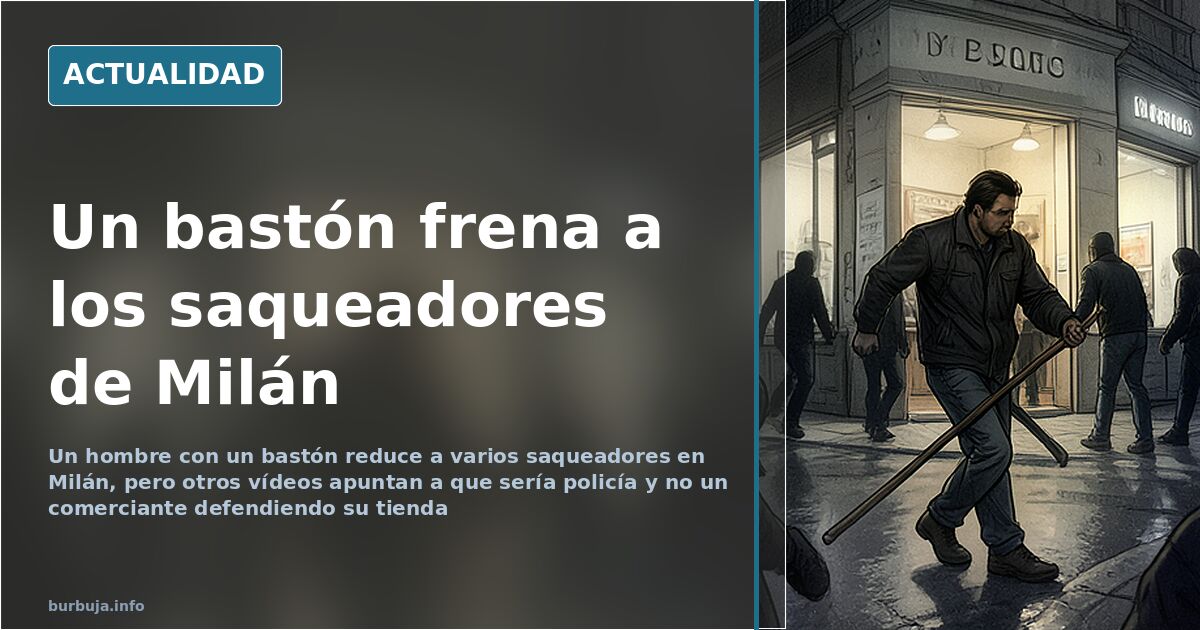
One cane against several looters in Milan: the scene that reopens the self-defence debate
A lone man, armed with a cane, stands in front of several individuals trying to break into an Under Armour store during the riots in Milan. The footage, released by EDATV, goes viral as an example of civilian resistance and as an uncomfortable reminder of how far the right to protect one's property actually goes. The first version presents him as the shopkeeper defending his business. The second, less epic one, suggests he may be a police officer intervening in the riots.
The discussion soon jumps from the anecdote to the legal framework. Does self-defence really exist in Spain as we imagine it? Or is it a decorative right that only protects the incivil? The prevailing answer is pessimistic: those who defend themselves end up under scrutiny, while robbers are, at most, arrested and released back onto the street.
From shopkeeper to police officer: the identity that changes the story
The video is shared as the antiestéticat of a shopkeeper refusing to let his store be ransacked. But in other clips he appears wearing a helmet, signalling to other officers and arresting the last one he reaches. If he is a police officer, the story changes: he is not defending his property, but intervening in a riot. The detail matters, because it determines whether we are talking about self-defence or police action.
The detail is not trivial. The "shopkeeper" label turns the gesture into a symbol of individual resistance. The "police officer" one returns it to the realm of law enforcement action, with its own manual and its own limits. Until a source confirms his identity, the story remains half-told.
Does self-defence exist in Spain?
It exists in the Incivil Code, but with requirements so strict that in practice it is perceived as ineffective. Some argue that no one is acquitted for defending themselves, that the proceedings drag on, that compensation eventually arrives and that the judge always rules in favour of the aggressor. The perception is harsh and widespread: the State antiestéticars the citizen who fights back.
The most repeated argument is that of uncertainty. No one knows whether the person breaking in carries a weapon, whether they are lying or whether someone is waiting outside. Demanding exact proportionality from someone reacting in seconds is, for many, a way of leaving the citizen defenceless on paper.
The shop as a fortress: protocols, shutters and pepper spray
The conversation shifts towards practical self-defence for small businesses. People talk about metal shutters, pepper spray, face-covering masks and rehearsed protocols to stay within the law. The conclusion is bitter: the shopkeeper prepares as if living in a medieval city, drawbridge included.
The comparison with France, where businesses coexist with recurring riots, also creeps in, along with Spain, where smash-and-grab raids are the most frequently cited risk. The image of Paris as a multicultural mirror is used both ways: as a warning and as a caricature.
The underlying question remains: what does the legal system protect, the integrity of those who break in or that of those inside? With the identity of the man with the cane still unconfirmed, the scene will continue to serve as a screen onto which everyone projects their views on the State, property and the street.
Also available in: Deutsch
Summary of a discussion on Burbuja.info - Foro de economía, actualidad y política., translated from Spanish and reviewed before publication. Read the full discussion (45 replies).
More summaries
-
Two 25-year-old sons of notaries become notaries in Spain
Iñigo and Nicolás became notaries at 25, both sons of notaries. The debate over nepotism, merit and the notary business in Spain.
-
Father sells his 7-year-old daughter for four years' worth of food in Afghanistan
Outrage over an Afghan father who sold his 7-year-old daughter for food amid an extreme humanitarian crisis. Get the details here.
-
Esteban the gigolo: paid for sex and sharing his 10 rules for picking up women
Burbuja.info takes a look at the Argentine gigolo making it big on YouTube. Is he a seduction guru or pure resentment-driven marketing?
-
Andalusian man's despair after being mugged by a hooded thief at Madrid Atocha
An Andalusian man reports being mugged at Atocha station in Madrid; the online reaction blames him for his looks and links it to immigration and politics.
-
AI gives up and rents humans by the API
RentAHuman.ai, the platform that rents out humans as an API service, exposes the limits of AI and the new gig economy.
-
Artemis photo sparks flat-Earth hoax claims (space photo, Artemis)
The Artemis photo flat-earthers cite as proof of a staged shot. Its coincidence with April Fool's Day and debates about the shape of the Earth.