
Choosing a vehicle for the apocalypse: from C15 to Patrol
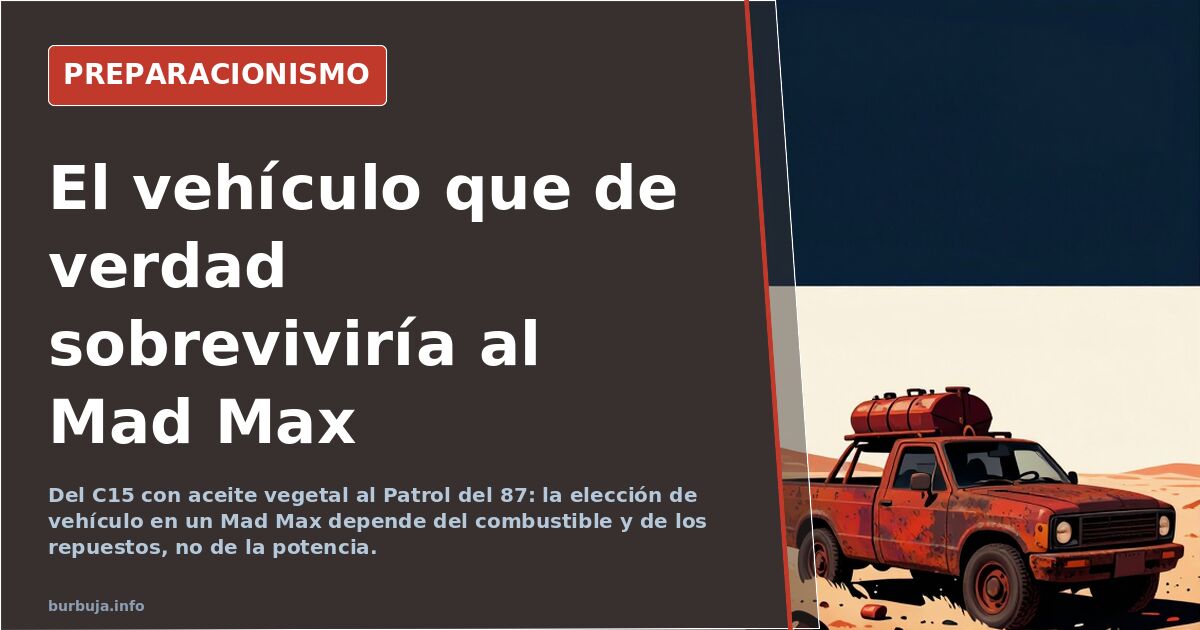
From the vegetable-oil Citroën C15 to the '87 Patrol, survival in a Mad Max scenario depends on fuel availability and spare parts, not horsepower.
English · Original discussion in Spanish · Published
From the vegetable-oil Citroën C15 to the '87 Patrol: the Mad Max garage
A 2002 Mitsubishi Montero crossing a dirt track. That is the image opening this proposal and also its first trap. Because the Montero is a magnificent off-roader, yet all subsequent analysis has revolved around an uncomfortable obviousness: without fuel, even the best 4x4 doesn't move a meter. Choosing a vehicle in a Mad Max-style scenario doesn't depend on power. It depends on what you can put in the tank and how easy it is to repair with four tools and a piece of wire.
The three initial bets: Montero, Mondeo, and Honda X-ADV
The proposal starts with three very specific names and logic rooted in household economics. The first, a 2002 Mitsubishi Montero, is defended as the perfect off-roader for carrying supplies: robust chassis, good engine, and ample interior space. The second, a 2008 Ford Mondeo, responds to criteria of spare part availability. It is lighter and faster to escape an armed group, and there are many more Ford parts in Spain than Mercedes, BMW, or Audi, simply because Fords were always cheaper. The third is a trail motorcycle, the Honda X-ADV, valid both in the city and in the countryside.
A reasonable list. Until someone remembers how long gasoline takes to degrade, and the entire hierarchy collapses.
Fuel rules: gasoline expires and diesel swallows oil
The first major warning of the analysis is that gasoline not only becomes scarce: it expires. It loses properties and stops starting engines easily. This instantly dismantles any bet on a modern car, with direct injection and embedded electronics, which without spare parts or diagnostics becomes a two-ton paperweight. The alternative that prevails is the old, naturally aspirated diesel, without common rail, capable of running on vegetable oil and even sunflower oil. Reliability, durability, and low consumption come before any power figure. Some summarize it in one idea: if it can't be fixed with duct tape and wire, it's useless.
It is worth distinguishing two scenarios. With unlimited access to fuel, almost anything works. In a real collapse, without supply, the engine matters least.
Which car to choose in a prolonged economic collapse?
Here the scenario changes and the criteria become refined. A movie apocalypse, with looting and chaos within weeks, admits almost anything you have at hand. A slow economic collapse, however, forces thinking about vehicles without electronics or with minimal electronics: the Citroën C15, a Lada Niva, a UAZ, or a Santana. These are engines that swallow vegetable oil, are repaired with basic tools, and do not depend on a computer failing. The C15 is repeated over and over, almost always accompanied by a folding bike in the trunk in case fuel runs out sooner than expected. For community use, village life, the logic is identical: what cannot be repaired on site is useless.
Big bike or 125cc air-cooled? Weight and consumption decide
In motorcycles, the consensus is even clearer: small displacement, single cylinder, and air cooling. An air-cooled 125 is simpler than a pacifier, consumes little, and doesn't stall. Large models are discarded due to weight and heat: some recount that their 650cc trail bike weighs around 170 kilos and releases unbearable heat on trails and in traffic jams. Against that, a 55-kilo motorcycle wins the game. Although there is always someone who keeps an old '90 NSR 75 with 14,000 kilometers and a tachometer redline at 12,000 rpm, for reasons that have more to do with nostalgia than survival.
From the Killdozer to the buggy: and the unexpected wood gasifier
The catalog goes wild quickly and without shame. There appear a 4x4 buggy costing a quarter of a G-Class, a Killdozer, a Renault 4, a Panda 4x4, a '87 Patrol, and even a dreamt-of V8 Interceptor built with scrapyard parts and warrior-monk devotion. Some also bet on the metro, sheltered underground, and electric bicycles.
And the truly disorienting answer is another: the wood gasifier. According to one participant, when Spain was isolated, transport ran on wood gas. It sounds like a museum relic. And yet, according to another participant, it is still widely used in Argentina. That detail summarizes the issue better than anything else: in a real Mad Max, the most powerful car doesn't survive, but the one that adapts to whatever is thrown at it. Almost always, an old junker with a diesel engine and a can of sunflower oil in the trunk.
A 2002 Mitsubishi Montero crossing a dirt track. That is the image opening this proposal and also its first trap. Because the Montero is a magnificent off-roader, yet all subsequent analysis has revolved around an uncomfortable obviousness: without fuel, even the best 4x4 doesn't move a meter. Choosing a vehicle in a Mad Max-style scenario doesn't depend on power. It depends on what you can put in the tank and how easy it is to repair with four tools and a piece of wire.
The three initial bets: Montero, Mondeo, and Honda X-ADV
The proposal starts with three very specific names and logic rooted in household economics. The first, a 2002 Mitsubishi Montero, is defended as the perfect off-roader for carrying supplies: robust chassis, good engine, and ample interior space. The second, a 2008 Ford Mondeo, responds to criteria of spare part availability. It is lighter and faster to escape an armed group, and there are many more Ford parts in Spain than Mercedes, BMW, or Audi, simply because Fords were always cheaper. The third is a trail motorcycle, the Honda X-ADV, valid both in the city and in the countryside.
A reasonable list. Until someone remembers how long gasoline takes to degrade, and the entire hierarchy collapses.
Fuel rules: gasoline expires and diesel swallows oil
The first major warning of the analysis is that gasoline not only becomes scarce: it expires. It loses properties and stops starting engines easily. This instantly dismantles any bet on a modern car, with direct injection and embedded electronics, which without spare parts or diagnostics becomes a two-ton paperweight. The alternative that prevails is the old, naturally aspirated diesel, without common rail, capable of running on vegetable oil and even sunflower oil. Reliability, durability, and low consumption come before any power figure. Some summarize it in one idea: if it can't be fixed with duct tape and wire, it's useless.
It is worth distinguishing two scenarios. With unlimited access to fuel, almost anything works. In a real collapse, without supply, the engine matters least.
Which car to choose in a prolonged economic collapse?
Here the scenario changes and the criteria become refined. A movie apocalypse, with looting and chaos within weeks, admits almost anything you have at hand. A slow economic collapse, however, forces thinking about vehicles without electronics or with minimal electronics: the Citroën C15, a Lada Niva, a UAZ, or a Santana. These are engines that swallow vegetable oil, are repaired with basic tools, and do not depend on a computer failing. The C15 is repeated over and over, almost always accompanied by a folding bike in the trunk in case fuel runs out sooner than expected. For community use, village life, the logic is identical: what cannot be repaired on site is useless.
Big bike or 125cc air-cooled? Weight and consumption decide
In motorcycles, the consensus is even clearer: small displacement, single cylinder, and air cooling. An air-cooled 125 is simpler than a pacifier, consumes little, and doesn't stall. Large models are discarded due to weight and heat: some recount that their 650cc trail bike weighs around 170 kilos and releases unbearable heat on trails and in traffic jams. Against that, a 55-kilo motorcycle wins the game. Although there is always someone who keeps an old '90 NSR 75 with 14,000 kilometers and a tachometer redline at 12,000 rpm, for reasons that have more to do with nostalgia than survival.
From the Killdozer to the buggy: and the unexpected wood gasifier
The catalog goes wild quickly and without shame. There appear a 4x4 buggy costing a quarter of a G-Class, a Killdozer, a Renault 4, a Panda 4x4, a '87 Patrol, and even a dreamt-of V8 Interceptor built with scrapyard parts and warrior-monk devotion. Some also bet on the metro, sheltered underground, and electric bicycles.
And the truly disorienting answer is another: the wood gasifier. According to one participant, when Spain was isolated, transport ran on wood gas. It sounds like a museum relic. And yet, according to another participant, it is still widely used in Argentina. That detail summarizes the issue better than anything else: in a real Mad Max, the most powerful car doesn't survive, but the one that adapts to whatever is thrown at it. Almost always, an old junker with a diesel engine and a can of sunflower oil in the trunk.
Also available in: Deutsch
Summary of a discussion on Burbuja.info - Foro de economía, actualidad y política., translated from Spanish and reviewed before publication. Read the full discussion (119 replies).
More summaries
-
Diesel 4x4s for Collapse: Which Prepper Vehicles Last?
Budgets range from 7,000 to 14,000 euros for atmospheric diesel vehicles with minimal electronics. Here are the robust models that survive mechanical failure.
-
The Real Cost of Living in Depopulated Spain: From €200 to €400
Renting in depopulated Spain can be as low as €200, but the car, cold, and lack of services eat into savings and peace of mind.
-
Utopia 2013: Where to Download the British Series on P2P
The British series Utopia (2013), with two subtitled seasons, is still available on eMule, torrent and direct download
-
Painless suicide: Pentobarbital inaccessible to humans
Pentobarbital, used in animal euthanasia, remains unavailable for human use. The debate on painless suicide clashes with current laws.
-
300,000 euros for isolated year: forum doubts viral challenge
A viral challenge offers 300,000 euros for a year of isolation in New Zealand. Forum users question the contract and note the property rents for 4,500 euros per night.
-
Family buys ruined Spanish farm to live off organic farming
A family purchases a dilapidated estate in the Cardó Valley for a low price, aiming to restore it and pursue ecological agriculture.