
Family buys ruined Spanish farm to live off organic farming
A family purchases a dilapidated estate in the Cardó Valley for a low price, aiming to restore it and pursue ecological agriculture.
English · Original discussion in Spanish · Published
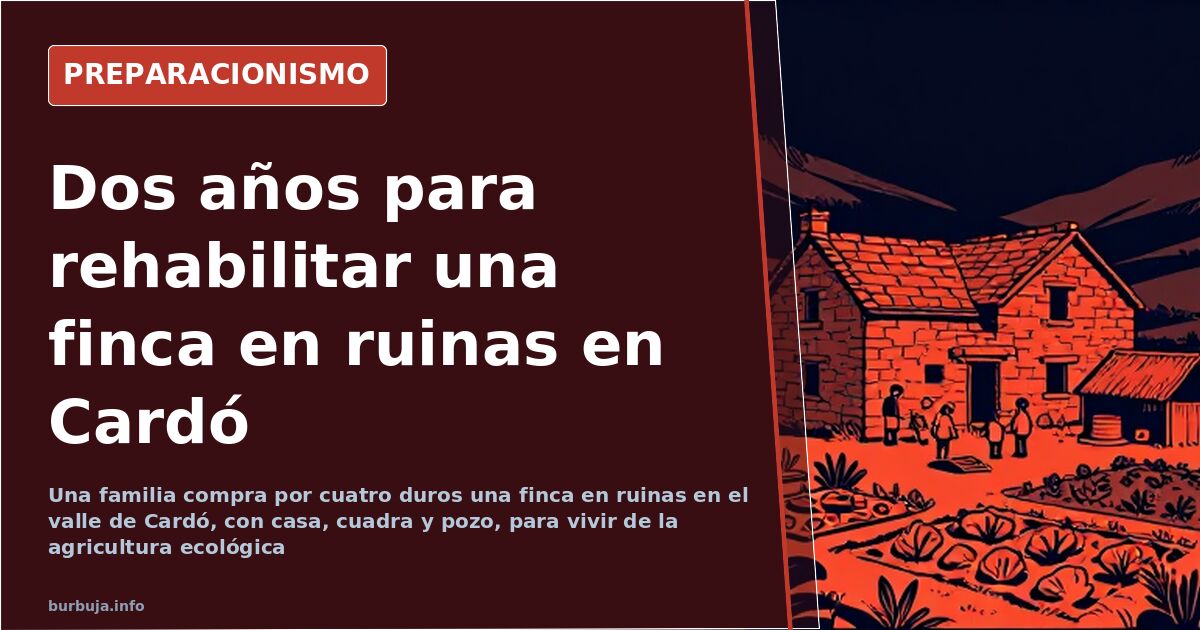
The dream of restoring a ruined estate in the Cardó Valley
How long does it take a family with no rural experience to renovate an abandoned house from the late 19th century, accessible only by a forest track? Ricardo dos Santos, a Brazilian mentioned in the thread as "the bearded one," has given himself two or three years to find out. With his vvife, identified as Dutch, and their children, he bought a ruined property in the Cardó Valley (Tarragona): a house, a stable, two cisterns, and a well. The plan is to restore the dwelling and dedicate themselves to organic farming.
The price is summed up in the story itself: "a few euros." It is roughly what costs a plot without electricity, running water, or neighbors to ask for help.
Where this family is getting involved: the Cardó Mountains
The estate is located in the Sierra de Cardó, a mid-low mountain range whose peak does not reach 1,000 meters. The main valley has paved access, but the plot is reached via a forest track. The Ebro River passes nearby, and the area borders a protected natural park, a factor that complicates any construction on existing structures, according to those familiar with these procedures. It is white land (non-urbanizable), not buildable.
Those who know the valley describe it as relatively cool and humid compared to the rest of the municipality, with groundwater at an indeterminate depth and remaining olive and almond trees in the lower part. Higher up are the ruins of an ancient monastery that functioned as a spa, with an abundant spring that was bottled and sold for years until Grupo Pascual bought the estate, according to local data.
Water decides if the project is viable
The diagnosis repeated in the thread is blunt: without a well providing potable water, the estate is worth little. The 5,000-liter rainwater cistern runs out quickly; electricity, septic tanks, or heating allow for some ingenuity. Water does not. There is a well on the property that needs recovery and, according to available data, still provides water. This changes the scenario: "the key is having a well with potable water," summarizes someone who looked closely at the case.
The route of permits to touch a brick
Here the project stops being romantic. The list of procedures includes building licenses, architect projects, environmental impact studies, habitability certificates, and wastewater treatment plans. If the Hydrographic Confederation views the settlement unfavorably and there is a natural park in the equation, the labyrinth multiplies.
The cited warning case: the mother of an acquaintance expanding her country hut was fined 9,000 euros, more than the work itself was worth. Added to this are the Cadastre and municipal inspections looking for chicken coops and sheds to raise property taxes. Some argue, however, that certain municipalities let you do things if you play by the rules and that buildings appear in deeds even if ruined. Opposing this is the thesis that any town hall lives on reporting, prohibiting, fining, and exploiting anyone who touches a brick, especially outsiders.
The business not told: videos first
The restoration is published as a series under its own brand, Eridu Life Project, and here appears the most repeated suspicion: that the real business is not living isolated eating organic kale, but the videos and subscriptions from those cheering from home. The anticipated script is known: emotional shots of local fauna, introduction of the vvife and children, and, of course, the visit from the urban planning official. The pattern recalls other imported trends, from Britons restoring stone houses in Italy to Europeans buying tool sheds in the Levante, always with cameras and sponsorship accounting on the horizon.
A deep refuge, not just a garden
Behind this specific case lies a broader phenomenon: the trickle of people seeking something more than cheap land in these valleys. They look for a reserve, a Plan B against a scenario they consider bad. And they clash with an uncomfortable reality: finding partners for such a project, in the middle of the woods, is almost impossible, and those who try alone end up depending on outside help to chop wood or raise a wall.
Who really survives the first winter
History is the weightiest data point. In the same area, a couple who tried is remembered disappearing after storm Gloria: half a meter of snow first and 200 liters of water later, several days unable to leave the estate, and goodbye. They have not been seen again. The rule repeated among those who know these valleys: you survive a couple of winters or summers, both harsh, but not both at once.
In the end, the bottleneck is not the house or the price. It is the trade. Without guasonry, plumbing, or knowing how to chop wood, the project depends on hiring everyone or learning through hard knocks. The glass half full requested by the family is today a well giving water, two cisterns, and enthusiasm. The half empty, a beautiful valley where the one who truly stays to live is usually the one who never left.
How long does it take a family with no rural experience to renovate an abandoned house from the late 19th century, accessible only by a forest track? Ricardo dos Santos, a Brazilian mentioned in the thread as "the bearded one," has given himself two or three years to find out. With his vvife, identified as Dutch, and their children, he bought a ruined property in the Cardó Valley (Tarragona): a house, a stable, two cisterns, and a well. The plan is to restore the dwelling and dedicate themselves to organic farming.
The price is summed up in the story itself: "a few euros." It is roughly what costs a plot without electricity, running water, or neighbors to ask for help.
Where this family is getting involved: the Cardó Mountains
The estate is located in the Sierra de Cardó, a mid-low mountain range whose peak does not reach 1,000 meters. The main valley has paved access, but the plot is reached via a forest track. The Ebro River passes nearby, and the area borders a protected natural park, a factor that complicates any construction on existing structures, according to those familiar with these procedures. It is white land (non-urbanizable), not buildable.
Those who know the valley describe it as relatively cool and humid compared to the rest of the municipality, with groundwater at an indeterminate depth and remaining olive and almond trees in the lower part. Higher up are the ruins of an ancient monastery that functioned as a spa, with an abundant spring that was bottled and sold for years until Grupo Pascual bought the estate, according to local data.
Water decides if the project is viable
The diagnosis repeated in the thread is blunt: without a well providing potable water, the estate is worth little. The 5,000-liter rainwater cistern runs out quickly; electricity, septic tanks, or heating allow for some ingenuity. Water does not. There is a well on the property that needs recovery and, according to available data, still provides water. This changes the scenario: "the key is having a well with potable water," summarizes someone who looked closely at the case.
The route of permits to touch a brick
Here the project stops being romantic. The list of procedures includes building licenses, architect projects, environmental impact studies, habitability certificates, and wastewater treatment plans. If the Hydrographic Confederation views the settlement unfavorably and there is a natural park in the equation, the labyrinth multiplies.
The cited warning case: the mother of an acquaintance expanding her country hut was fined 9,000 euros, more than the work itself was worth. Added to this are the Cadastre and municipal inspections looking for chicken coops and sheds to raise property taxes. Some argue, however, that certain municipalities let you do things if you play by the rules and that buildings appear in deeds even if ruined. Opposing this is the thesis that any town hall lives on reporting, prohibiting, fining, and exploiting anyone who touches a brick, especially outsiders.
The business not told: videos first
The restoration is published as a series under its own brand, Eridu Life Project, and here appears the most repeated suspicion: that the real business is not living isolated eating organic kale, but the videos and subscriptions from those cheering from home. The anticipated script is known: emotional shots of local fauna, introduction of the vvife and children, and, of course, the visit from the urban planning official. The pattern recalls other imported trends, from Britons restoring stone houses in Italy to Europeans buying tool sheds in the Levante, always with cameras and sponsorship accounting on the horizon.
A deep refuge, not just a garden
Behind this specific case lies a broader phenomenon: the trickle of people seeking something more than cheap land in these valleys. They look for a reserve, a Plan B against a scenario they consider bad. And they clash with an uncomfortable reality: finding partners for such a project, in the middle of the woods, is almost impossible, and those who try alone end up depending on outside help to chop wood or raise a wall.
Who really survives the first winter
History is the weightiest data point. In the same area, a couple who tried is remembered disappearing after storm Gloria: half a meter of snow first and 200 liters of water later, several days unable to leave the estate, and goodbye. They have not been seen again. The rule repeated among those who know these valleys: you survive a couple of winters or summers, both harsh, but not both at once.
In the end, the bottleneck is not the house or the price. It is the trade. Without guasonry, plumbing, or knowing how to chop wood, the project depends on hiring everyone or learning through hard knocks. The glass half full requested by the family is today a well giving water, two cisterns, and enthusiasm. The half empty, a beautiful valley where the one who truly stays to live is usually the one who never left.
Also available in: Deutsch
Summary of a discussion on Burbuja.info - Foro de economía, actualidad y política., translated from Spanish and reviewed before publication. Read the full discussion (120 replies).
More summaries
-
Utopia 2013: Where to Download the British Series on P2P
The British series Utopia (2013), with two subtitled seasons, is still available on eMule, torrent and direct download
-
Painless suicide: Pentobarbital inaccessible to humans
Pentobarbital, used in animal euthanasia, remains unavailable for human use. The debate on painless suicide clashes with current laws.
-
Choosing a vehicle for the apocalypse: from C15 to Patrol
From the vegetable-oil Citroën C15 to the '87 Patrol, survival in a Mad Max scenario depends on fuel availability and spare parts, not horsepower.
-
300,000 euros for isolated year: forum doubts viral challenge
A viral challenge offers 300,000 euros for a year of isolation in New Zealand. Forum users question the contract and note the property rents for 4,500 euros per night.
-
Spain's LoRa network: 1,700 nodes, 90% inactive
LoRa promises off-grid communication. Spain's Meshtastic map shows over 1,700 nodes, but more than 90% are offline and real range drops to 4 km.
-
Preparing for Death: The Debate on What to Leave Behind
Some build mausoleos, others want to die with zero balance. The debate on legacy when oblivion is inevitable and assets end up...