
Choosing a 2x1 air conditioner: Mitsubishi, Fujitsu or Daikin
A flat with 2x1 pre-installation needs air conditioning: Mitsubishi, Fujitsu or Daikin. How to distribute cooling between rooms and the compressor's power are the key questions.
English · Original discussion in Spanish · Published
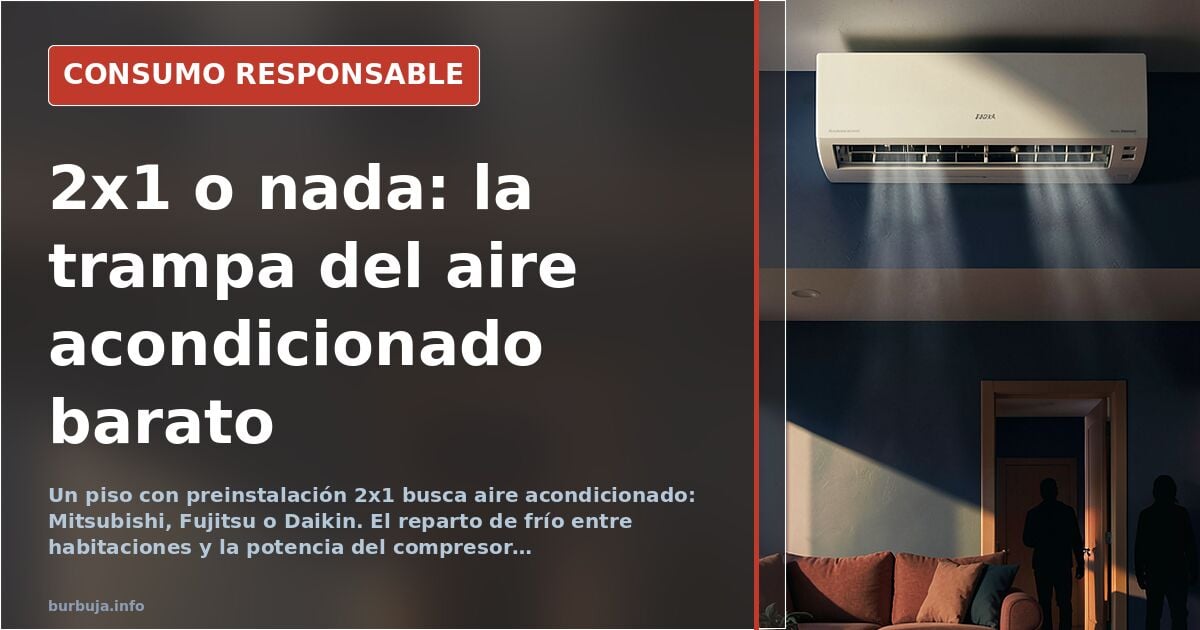
Choosing a 2x1 air conditioner: Mitsubishi, Fujitsu or Daikin
Is a 2x1 multisplit worth it, or is it just money down the drain? The question is far from trivial when the façade doesn't allow two outdoor units: it's either one compressor for two zones, or nothing. A homeowner with a pre-installation already in place for a 2x1 system —20 m² dining room facing the bedroom, plus a second split for three rooms and the kitchen— is asking for help to avoid making a mistake with the brand, the capacity and the energy consumption. The crowd's answer comes with an uncomfortable warning: some argue that a 2x1 system is a mistake from the start.
The first consensus is that a multisplit is a patch, not a solution. When the outdoor unit fails, two zones go down at once. And it isn't cheap: some recall dismantling a Daikin 5x1 running on R22 gas that could no longer be replenished, then reinstalling two 1x1 units reusing the pipework. The general recommendation is clear: if there's room for two compressors, two 1x1 units are better. If there isn't, a 2x1 is accepted, but with eyes wide open.
How much cooling capacity does each split need?
The popular rule of thumb of 100 frigories per square metre falls short as soon as a door is peine. For the master bedroom, at 14 m², a 2,000-frigorie unit is enough and throws in a few decibels less, something you appreciate at night. For the hallway unit that has to cool three rooms and the kitchen —30 or 35 m² in total—, the figure rises to 3,000 frigories, with caveats: it works for dehumidifying and improving the perceived temperature, not for air-conditioning each room separately.
Cold air doesn't respect open doors. Anyone who has tried to cool an adjacent room by leaving the door open knows it: the air arrives, but at floor level, and to feel it in the next room you have to be freezing in the one with the split. Orientation matters: if the morning sun hits the dining room and the bedroom, the system works harder; if the other rooms face an inner courtyard, the improvement shows with fewer frigories.
Mitsubishi, Fujitsu, Daikin or LG: what experience says
The hierarchy that keeps coming up places the Japanese brands —Mitsubishi Electric, Fujitsu, Daikin, Panasonic, Hitachi, Toshiba— at the same technological standard. Within each brand there are better and worse ranges; brand prestige doesn't save a poorly chosen model. Mitsubishi Electric takes the crown for reliability according to repair technicians, although Mitsubishi Heavy Industries is a different company with a different story. Fujitsu holds up as the best value for money in the Japanese camp, with a curious policy: the very same unit is sold as Fujitsu in big-box stores, as General for installers, as Hiyasu in plumbing supply and as Fuji Electric for electricians. Down to the last screw, it's identical.
LG and Samsung play in a different league. Some place them close to the Japanese brands in quality and below them in price; others simply steer clear after a bad experience with after-sales service. Cheap turns expensive when the unit breaks down in August.
The figure that matters: the outdoor unit
Spec sheets from big-box retailers are riddled with typos. One model claims 1,040 W of power consumption and another 4,100 W for similar capacities: impossible. What you really need to look at is the cooling capacity of the compressor, not that of the splits, which are usually all the same. A 5,500-frigorie outdoor unit is overkill for a flat of this size; dropping to 4,400 saves money without sacrificing comfort in a well-insulated home.
The installation matters too. The pipes run in pairs —liquid and gas— and for these capacities 3/8 and 1/4 are the norm. If the pre-installation included 1/2 just in case, the installer will have to reduce at the connections and adjust the gas charge. Nothing serious, but it's best done by someone who already knew the job.
The outcome: 1,700 euros for a Daikin 2x1
The person asking closed the purchase with a Daikin 2MX50KV3: a 4,400-frigorie compressor, two 3,000-frigorie splits, A++/A+ class, for 1,700 euros on offer. The equivalent Japanese alternatives were around 2,000 or 2,100. The installation will be carried out by the same professional who did the pre-installation, at a good price and with no middlemen.
A happy ending, on paper. The question remains whether the distribution of cooling between rooms will deliver as promised, or whether, as the veterans warn, the 2x1 will end up being a permanent compromise with the door left ajar.
Also available in: Deutsch
Summary of a discussion on Burbuja.info - Foro de economía, actualidad y política., translated from Spanish and reviewed before publication. Read the full discussion (57 replies).
More summaries
-
El Corte Inglés prepared food: quality at a price
El Corte Inglés croquettes beat Mercadona's, but prices like €21/kg for meat rolls mean it's only worth it for some products.
-
Cheap clothes in physical stores: Primark, Kiabi and El Corte Inglés outlets
Primark, Kiabi, Lefties and El Corte Inglés outlets: a guide to buying cheap clothes in physical stores, and why cost per wear changes the calculation
-
Elon Musk’s appearance sparks debate: does the founder’s body matter?
Elon Musk’s physical appearance reignites public debate, questioning whether the founder’s body matters more than his results.
-
Men's bags win the battle of the shoulder strap
The men's bag is gaining ground on the backpack: class, practicality and the old prejudice about manhood in the war of accessories.
-
Switching legal aid lawyers in Spain while keeping free justice
Spain's Law 1/1996 lets you give up your court-appointed lawyer while keeping fee waivers, expert witnesses and court agents. The process goes through the SOJ, but the outgoing lawyer may…
-
Cheap own-brand milk: where the quality line falls
Own-brand milk is winning in Spain: Lidl's Finessa at 50 cents a litre and Hacendado made by Covap. A price and quality map of the tetrabrik carton.