
Chinese Battery Plant in Spain Sparks Control and Jobs Debate
Forum debate on Chinese battery factory in Spain: foreign staff, no tech transfer, Northvolt precedent.
English · Original discussion in Spanish · Published
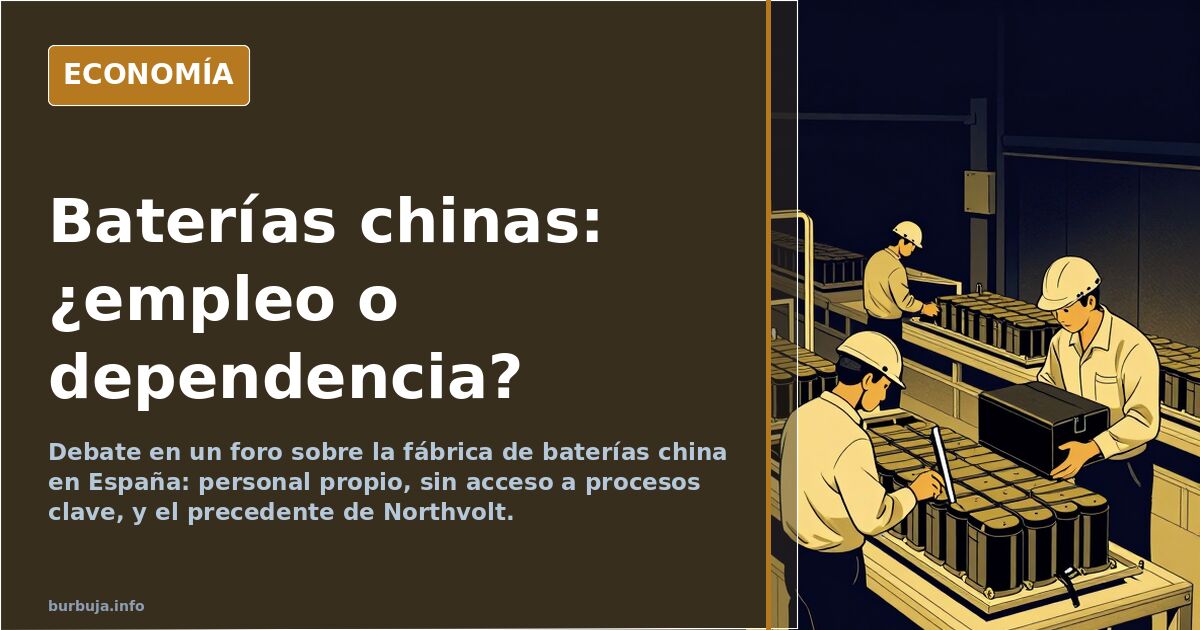
The Battle for the Battery Plant: Chinese Tech and Local Jobs
The arrival of a Chinese-owned battery factory in Spain has ignited a debate over who truly controls the technology and what remains for the host country. The issue, which has generated over a hundred responses, focuses on a condition many consider unacceptable: the plant is set up with staff from the investing country and without access to key processes. The underlying question is not minor: can a country industrialize without technology transfer?
The Chinese Model: Investment with Absolute Control
The first conclusion drawn from the discussion is that the Asian giant has learned from the mistakes the West made with it. For decades, European and US companies moved their plants to China, trained its workers, and shared processes. The result was competition that today dominates the value chain. Now, the situation is reversed. The battery factory is established on Spanish soil, but skilled positions will be filled by Chinese workers and production processes will remain out of reach for locals. It is the same move, but with roles swapped.
Some argue this strategy is a logical response to previous experience. "The Chinese do not want to make the mistake the West made by putting their factories on Chinese territory," summarizes one participant. The logic is relentless: if you copied me, I won't let you copy me. The problem is that this reasoning leaves Spain in a subordinate position, with the promise of jobs as the only consolation.
How Much Real Employment Does a Factory Without Technology Transfer Leave?
The promise of jobs is the argument justifying the operation. But an analysis of what actually happens in similar plants invites skepticism. In the case of Northvolt, the Swedish battery factory that hired Chinese workers to set up its production, the result was bankruptcy with millions in losses. "Not even the machines worked well and nobody but them could use them," reads one message. The experience serves as a warning: without control over the technology, investment can become a black hole.
The issue of local employment is another hot point. Pessimistic estimates speak of a handful of jobs for cleaning and maintenance, while skilled operators would come from abroad. The lack of labor inspectors who can access the plant adds a component of opacity that causes concern. If what happens inside cannot be verified, neither can the real impact on the labor market be measured.
The Geopolitics of Batteries: Strategic Dependence
Beyond employment, the debate touches a geopolitical nerve. Batteries are the heart of the energy transition and the electric car industry. Europe has bet on electrifying its vehicle fleet but has neglected the manufacture of critical components. China controls most of the world's production of cells and refined raw materials. Installing a Chinese factory in Spain does not solve this dependence; it consolidates it.
The paradox is that the European Union continues sending development aid funds to countries that then compete with cutting-edge technology. "It is curious that a developing country to which the EU sends development aid funds installs a cutting-edge technology factory that the EU itself barely possesses," notes one comment. The criticism points to an industrial policy that arrives late and poorly.
The Northvolt Precedent and the Swedish Mirror
The Northvolt case looms over the entire discussion. The Swedish factory, which was to be the flagship of European autonomy in batteries, ended up in bankruptcy after burning billions in public money. The problem was not only the lack of experience, but the dependence on Chinese workers who controlled the machines and processes. The lesson is clear: without real technology transfer, foreign investment can be a mirage.
Some messages go further and speak of a deliberate strategy of Western deindustrialization. "Those in charge have decided to elevate China and its slave society and sink the West," one reads. It is an extreme interpretation, but it reflects deep distrust towards political and business elites negotiating these agreements.
What Does Spain Gain From This Factory?
The official answer is usually jobs, investment, and modernization. But an analysis of the agreement terms suggests benefits are limited. Spain provides the land and tax advantages; China provides the technology and skilled jobs. Those who really win, according to several messages, are intermediaries: builders, land sellers, and managers who collect commissions. "They feed on low prices and tax advantages, but zero technology transfer," summarizes one participant.
The lingering question is whether this model is sustainable long-term. Without access to knowledge, local industry does not learn. Without learning, there is no future competition. And without competition, dependence is perpetuated. The debate is not closed, but skepticism is majority.
Voices from the Forum
- "The Chinese do not want to make the mistake the West made by putting their factories on Chinese territory. The West gave them the technology and power to copy it, and China wants to avoid this error but at the same time wants to sell, so it sets up the factory in the West but doesn't let you touch even the screws."
- "In that factory they will hire 10 Spanish workers to clean the toilets, excellent work by Viruelo."
- "The Swedes already did this, they hired the Chinese to set up Northvolt and not even the machines worked well and nobody but them could use them. Recently its bankruptcy and the loss of billions in public money has been announced."
Also available in: Deutsch
Summary of a discussion on Burbuja.info - Foro de economía, actualidad y política., translated from Spanish and reviewed before publication. Read the full discussion (106 replies).
More summaries
-
German carmakers sell their EVs in China up to 46% cheaper than in Europe
German carmakers are selling their electric cars in China up to 46% cheaper than in Europe. Find out why and which models are affected.
-
Electric car limits: 8 million vs 80 million combustion vehicles
Available lithium could produce 8 million electric cars annually, compared to 80 million combustion engines. Replacing the global fleet would take 175 years.
-
Volkswagen Halts Electric Car Production Amid Falling Demand
Volkswagen to pause electric car production lines for two weeks in October due to declining orders. Electric vehicle share in Germany remains below 16%.
-
Putin's plane forced to circle Moscow amid drone attack
Reports indicate Putin's aircraft could not land in Moscow during a Ukrainian drone strike, with three official Russian planes circling the airport.
-
Spain's clock change debate: GMT+2, seasonal blues and bills
The clock change once again divides Spain: Galicia sees sunrise at 09:04 in December, the Balearic Islands 40 minutes earlier. The debate over GMT+2 and energy savings continues.
-
Allegations of election meddling in Brazil as Pedro Sánchez takes notes
The runoff between Bolsonaro and Lula da Silva is marked by a two-hour extension of polling station hours and 60% support for Lula among overseas voters. Click through for the data.