
China's Smart Park Shower Sparks Privacy Debate
A viral video of a public shower and delivery drones in a Chinese park fuels debate on privacy, social control, and why such tech would fail in Spain.
English · Original discussion in Spanish · Published
Showering in the Park: China Video Reopens Freedom Debate
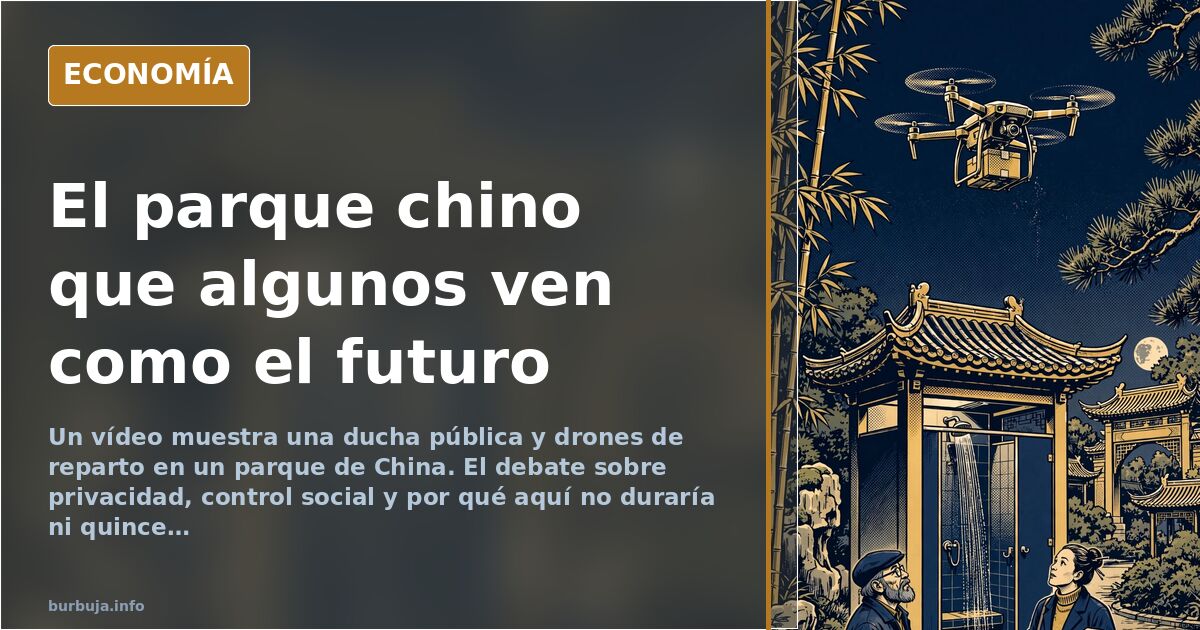
A video shows a woman showering in a public park in China, antiestéticaturing towel vending machines, delivery drones, and benches that adjust when occupied. Filmed in a well-maintained urban setting, the scene has reignited an old discussion: is this technological deployment pogre or a painted chain? The clip circulates as an example of a smart city and, depending on perspective, proof of the opposite.
The issue matters because it touches two shifting trends: the perception that Asia advances while Europe stagnates, and the suspicion that every new convenience comes with a sensor attached. In Spain, the initial reaction from much of the public was not admiration for the invention, but calculating how long it would last if installed here.
What Exactly Does the Chinese Park Video Show?
The sequence displays services integrated into street furniture: a public shower, a towel dispenser, a drone delivering orders, and benches reacting to use. Everything operates via apps. This detail—apps as the gateway to each service—is what sparked controversy.
Some argue this reveals the model's key: comfort in exchange for traceability. Every order, shower, and alucinación is recorded. "Without privacy there is no freedom," summarizes a widely repeated view. Opposing this, another interpretation defends that real freedom isn't choosing between four monitored walls, but being able to leave home without antiestéticar. The discussion has become a clash between two definitions of the same word.
The Argument of Social Control and Credit System
The most repeated objection targets not the shower, but what lies behind it. The social credit system appears in nearly all exchanges as the cancer that could end remaining Western freedoms. The suspicion is that the State knows schedules, consumption, and movements, and that this knowledge equals power.
The most cited response to this objection is an uncomfortable question: What freedom do you have that they don't? Posting in forums, naming the president, or changing government every four years, say some. Being able to leave home safely, you or your daughter, say others. The exchange remains unresolved.
Why It Wouldn't Last Fifteen Minutes in Spain
The most repeated prediction about the invention is that it wouldn't survive an assault here. The towel machine, the drone, connected benches: all this in a Spanish park would last fifteen minutes functioning, argues part of the public. The argument isn't technical, but civic. It only takes a few breaking rules for everyone else's freedom to be worth zero, summarizing an idea appearing multiple times with different words.
The comparison extends to access stairs to the Manzanares River, cancelled, and the impossibility of bathing in summer. The contrast between a park offering showers and an urban river closed to swimming feeds the sense of decline. It's not the drone that bothers us. It's what our inability to host one says about us.
Economic Debate: Profitability, Deflation, and Prices
The more technical critique points to viability. Such services require a permanent customer queue to justify investment, maintenance, and risk. Without critical mass, the invention is expensive propaganda. The doubt is whether the Chinese park is an exportable model or a subsidized showcase.
On the other side of the scale is the most repeated data point: in China, a full meal costs three euros, and the country doesn't suffer the inflation hitting the West, though its deflation creates distinct problems. Price comparisons serve as background arguments in almost all interventions, even those denying China is the future.
Demographic Gap and Pogre Narrative
The counterpoint arrives via population. Some recall China has continental size and uneven wealth: Beijing and Shanghai concentrate tens of millions of inhabitants and a combined GDP comparable to all of Spain. Chinese immigrants to Spain come from less developed southern provinces, accustomed to starting businesses and speaking their own dialects.
The global trend, they add, is that millions of Chinese have decided to have fewer children, like Europeans, Japanese, and Koreans. That is the decay nobody wants to look at. The shower video, in this framework, isn't tech news. It's a mirror.
In the end, the park scene leaves a disorienting figure: the most commented invention in the video isn't the drone or the shower, but that someone decided it was necessary.
A video shows a woman showering in a public park in China, antiestéticaturing towel vending machines, delivery drones, and benches that adjust when occupied. Filmed in a well-maintained urban setting, the scene has reignited an old discussion: is this technological deployment pogre or a painted chain? The clip circulates as an example of a smart city and, depending on perspective, proof of the opposite.
The issue matters because it touches two shifting trends: the perception that Asia advances while Europe stagnates, and the suspicion that every new convenience comes with a sensor attached. In Spain, the initial reaction from much of the public was not admiration for the invention, but calculating how long it would last if installed here.
What Exactly Does the Chinese Park Video Show?
The sequence displays services integrated into street furniture: a public shower, a towel dispenser, a drone delivering orders, and benches reacting to use. Everything operates via apps. This detail—apps as the gateway to each service—is what sparked controversy.
Some argue this reveals the model's key: comfort in exchange for traceability. Every order, shower, and alucinación is recorded. "Without privacy there is no freedom," summarizes a widely repeated view. Opposing this, another interpretation defends that real freedom isn't choosing between four monitored walls, but being able to leave home without antiestéticar. The discussion has become a clash between two definitions of the same word.
The Argument of Social Control and Credit System
The most repeated objection targets not the shower, but what lies behind it. The social credit system appears in nearly all exchanges as the cancer that could end remaining Western freedoms. The suspicion is that the State knows schedules, consumption, and movements, and that this knowledge equals power.
The most cited response to this objection is an uncomfortable question: What freedom do you have that they don't? Posting in forums, naming the president, or changing government every four years, say some. Being able to leave home safely, you or your daughter, say others. The exchange remains unresolved.
Why It Wouldn't Last Fifteen Minutes in Spain
The most repeated prediction about the invention is that it wouldn't survive an assault here. The towel machine, the drone, connected benches: all this in a Spanish park would last fifteen minutes functioning, argues part of the public. The argument isn't technical, but civic. It only takes a few breaking rules for everyone else's freedom to be worth zero, summarizing an idea appearing multiple times with different words.
The comparison extends to access stairs to the Manzanares River, cancelled, and the impossibility of bathing in summer. The contrast between a park offering showers and an urban river closed to swimming feeds the sense of decline. It's not the drone that bothers us. It's what our inability to host one says about us.
Economic Debate: Profitability, Deflation, and Prices
The more technical critique points to viability. Such services require a permanent customer queue to justify investment, maintenance, and risk. Without critical mass, the invention is expensive propaganda. The doubt is whether the Chinese park is an exportable model or a subsidized showcase.
On the other side of the scale is the most repeated data point: in China, a full meal costs three euros, and the country doesn't suffer the inflation hitting the West, though its deflation creates distinct problems. Price comparisons serve as background arguments in almost all interventions, even those denying China is the future.
Demographic Gap and Pogre Narrative
The counterpoint arrives via population. Some recall China has continental size and uneven wealth: Beijing and Shanghai concentrate tens of millions of inhabitants and a combined GDP comparable to all of Spain. Chinese immigrants to Spain come from less developed southern provinces, accustomed to starting businesses and speaking their own dialects.
The global trend, they add, is that millions of Chinese have decided to have fewer children, like Europeans, Japanese, and Koreans. That is the decay nobody wants to look at. The shower video, in this framework, isn't tech news. It's a mirror.
In the end, the park scene leaves a disorienting figure: the most commented invention in the video isn't the drone or the shower, but that someone decided it was necessary.
Also available in: Deutsch
Summary of a discussion on Burbuja.info - Foro de economía, actualidad y política., translated from Spanish and reviewed before publication. Read the full discussion (123 replies).
More summaries
-
China's social credit system divides opinion on its utopia
Claims of China as a paradise clash with point systems, relocation permits, and unresolved tax questions.
-
China doesn't raise rates: its economy is fighting deflation
Chinese CPI near zero and PPI in deflation explain why Beijing won't raise rates: lowering the price of money doesn't revive credit.
-
Tariffs on China: the standoff neither Washington nor Beijing can end
12,5% of China's exports go to the US, but the videos proving collapse are undated. The tariff war, data point by data point
-
Is now a good time to buy property? Debate
Is now a good time to buy a home? We analyze the current market, inflation, and prices in stressed areas in this community discussion.
-
Ray Dalio warns of a once-in-a-century storm
Ray Dalio highlights record debt, inequality, and fiat currency risks. He urges immediate diversification into physical assets.
-
Spain vs Portugal: Net salary from €44,400 gross
A €44,400 gross salary yields €2,691 net in Spain and €2,238 in Portugal, but employer costs and 14 payments alter the calculation.