
Tariffs on China: the standoff neither Washington nor Beijing can end
12,5% of China's exports go to the US, but the videos proving collapse are undated. The tariff war, data point by data point
English · Original discussion in Spanish · Published
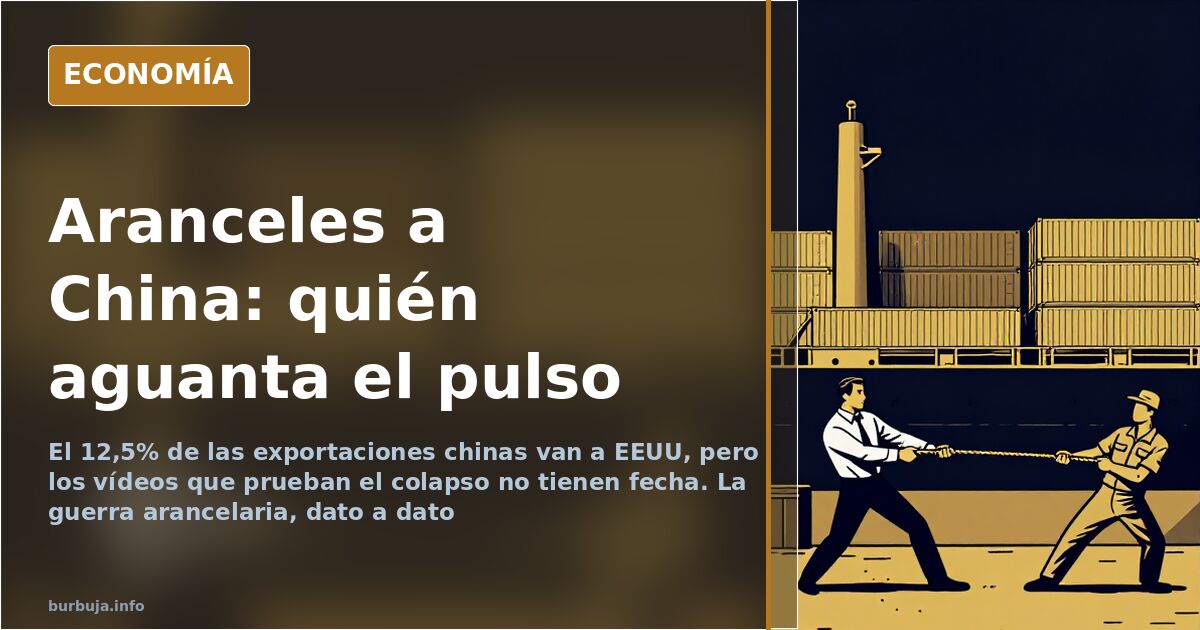
Tariffs on China: plenty of propaganda, few facts that add up
Can China withstand Trump's tariff standoff, or is its model coming apart? Since Washington launched its trade offensive, videos have circulated of Chinese ports packed with containers and businesses on the brink of closure to show that Beijing is buckling. The problem is that neither the videos hold up to even minimally rigorous scrutiny nor do the data confirm an outcome.
There is one number repeated in the debate: the US absorbs 12,5% of Chinese exports, according to 2024 figures cited by one participant. It is the richest market on the planet and, by that same argument, cannot be replaced with three phone calls. Anyone who claims Beijing can relocate that volume in two weeks should explain where.
The video that proves everything and proves nothing
The starting point for the doom-mongering thesis is two recordings: one of Chinese ports jammed with goods and another of Western markets closing the door on Chinese surpluses. It sounds convincing. Until you ask when it was recorded.
The most repeated criticism is that the material comes from a channel with a clear editorial line and that the images are, in fact, from the pandemic era. To measure actual traffic volumes, there are better tools than an undated video: websites that track merchant ships and cargo planes in real time. If you want the precise figure, it's there.
How much China depends on the US market
The opposing thesis is that China doesn't need the US. That's half true. The other half is that alternative markets aren't waiting with open arms either.
The EU has already made clear it does not intend to swallow China's surplus: two months before Trump's election victory, Brussels had approved severe tariffs on Chinese electric vehicles to protect its industry. Australia is playing the same game. There is no spare customer for the volume the US frees up.
And what is growing has a catch. Chinese exports rose 8% in April while those to the US fell 20%, according to the calculation one participant maintains. The gap is plugged by re-routing goods via Malaysia, Indonesia or India, which in turn place the product on the American market. An accounting detour, not a new market.
China's trump card: domestic consumption and a devalued yuan
Where some see fragility, others see room to maneuver. Some argue China is a long-term planned economy, able to stockpile surpluses, devalue the yuan to gain competitiveness and force domestic consumption. During the pandemic it already showed it can sustain a degree of social peace through public subsidies.
There is damage that is mentioned less and is harder to repair: America's credibility as a trading partner. After decades driving offshoring and now closing the door with tariffs, Washington has gone from reliable customer to problem. Beijing has taken note and, as the thread notes, is speeding up its own payments network so it does not depend on international channels.
Weighing against it is the broader picture: a property crisis that has dragged on for years, deflationary pressures, a cooling manufacturing sector and a banking system always on edge. And the figure that dismantles the easy comparison, according to another participant: 68% of US GDP is domestic consumption. The country least dependent on selling abroad, by definition, is Washington.
Switzerland and the treaty technique
The part many skip is that, according to defenders of that reading, tariffs were never intended as an end in themselves. The economic team designing the strategy —with Bessent, Navarro and Miran at the helm— has repeated from day one that they are a negotiating instrument. The goal admitted by advisers close to the president would be zero tariffs with China.
It is the old The Art of the Deal technique: ask for the solar system, then scale back and settle for Earth and the Moon. And whether it works or not, there are signs pieces are moving: Chinese delegations visiting the Treasury Department and a bilateral meeting in Switzerland that at first no one confirmed and later was confirmed.
American inventories are also running
Here the reading is more sober: big American retail —Walmart and company— had built up two or three months of inventory as a buffer for antiestéticar of tariffs, according to what was argued in the debate. In May, much of that product would start running out, and there are no substitutes in sight because there are no alternative suppliers for that volume.
That is the clock that is really ticking. Not the one in the undated videos, but the one on American shelves.
The conclusion nobody wants to state: tariffs hurt both sides, and anyone waiting for a clean winner will be waiting a long time. Still, if anyone finds the date on those videos, speak up. It would be the most valuable data point of the year.
Can China withstand Trump's tariff standoff, or is its model coming apart? Since Washington launched its trade offensive, videos have circulated of Chinese ports packed with containers and businesses on the brink of closure to show that Beijing is buckling. The problem is that neither the videos hold up to even minimally rigorous scrutiny nor do the data confirm an outcome.
There is one number repeated in the debate: the US absorbs 12,5% of Chinese exports, according to 2024 figures cited by one participant. It is the richest market on the planet and, by that same argument, cannot be replaced with three phone calls. Anyone who claims Beijing can relocate that volume in two weeks should explain where.
The video that proves everything and proves nothing
The starting point for the doom-mongering thesis is two recordings: one of Chinese ports jammed with goods and another of Western markets closing the door on Chinese surpluses. It sounds convincing. Until you ask when it was recorded.
The most repeated criticism is that the material comes from a channel with a clear editorial line and that the images are, in fact, from the pandemic era. To measure actual traffic volumes, there are better tools than an undated video: websites that track merchant ships and cargo planes in real time. If you want the precise figure, it's there.
How much China depends on the US market
The opposing thesis is that China doesn't need the US. That's half true. The other half is that alternative markets aren't waiting with open arms either.
The EU has already made clear it does not intend to swallow China's surplus: two months before Trump's election victory, Brussels had approved severe tariffs on Chinese electric vehicles to protect its industry. Australia is playing the same game. There is no spare customer for the volume the US frees up.
And what is growing has a catch. Chinese exports rose 8% in April while those to the US fell 20%, according to the calculation one participant maintains. The gap is plugged by re-routing goods via Malaysia, Indonesia or India, which in turn place the product on the American market. An accounting detour, not a new market.
China's trump card: domestic consumption and a devalued yuan
Where some see fragility, others see room to maneuver. Some argue China is a long-term planned economy, able to stockpile surpluses, devalue the yuan to gain competitiveness and force domestic consumption. During the pandemic it already showed it can sustain a degree of social peace through public subsidies.
There is damage that is mentioned less and is harder to repair: America's credibility as a trading partner. After decades driving offshoring and now closing the door with tariffs, Washington has gone from reliable customer to problem. Beijing has taken note and, as the thread notes, is speeding up its own payments network so it does not depend on international channels.
Weighing against it is the broader picture: a property crisis that has dragged on for years, deflationary pressures, a cooling manufacturing sector and a banking system always on edge. And the figure that dismantles the easy comparison, according to another participant: 68% of US GDP is domestic consumption. The country least dependent on selling abroad, by definition, is Washington.
Switzerland and the treaty technique
The part many skip is that, according to defenders of that reading, tariffs were never intended as an end in themselves. The economic team designing the strategy —with Bessent, Navarro and Miran at the helm— has repeated from day one that they are a negotiating instrument. The goal admitted by advisers close to the president would be zero tariffs with China.
It is the old The Art of the Deal technique: ask for the solar system, then scale back and settle for Earth and the Moon. And whether it works or not, there are signs pieces are moving: Chinese delegations visiting the Treasury Department and a bilateral meeting in Switzerland that at first no one confirmed and later was confirmed.
American inventories are also running
Here the reading is more sober: big American retail —Walmart and company— had built up two or three months of inventory as a buffer for antiestéticar of tariffs, according to what was argued in the debate. In May, much of that product would start running out, and there are no substitutes in sight because there are no alternative suppliers for that volume.
That is the clock that is really ticking. Not the one in the undated videos, but the one on American shelves.
The conclusion nobody wants to state: tariffs hurt both sides, and anyone waiting for a clean winner will be waiting a long time. Still, if anyone finds the date on those videos, speak up. It would be the most valuable data point of the year.
Summary of a discussion on Burbuja.info - Foro de economía, actualidad y política., translated from Spanish and reviewed before publication. Read the full discussion (218 replies).
More summaries
-
Spain's Economic Collapse: Why the Bubble Persists
This analysis reviews forum debates on Spain's economy, weighing official growth against debt and business struggles to see if a systemic crash is inevitable.
-
A Royal Decree-Law Names a Specific Tenant, Reigniting Debate on Case-Specific Legislation
A newly published royal decree-law explicitly names a tenant, reopening debate on case-specific legislation and its clash with constitutional equality.
-
Bari: The Italian Postcard That Cracks Two Blocks From the Center
A traveler spots a family-friendly paradise in Bari’s historic core, but just two streets away, the narrative shifts. Italy vs. Spain compared.
-
Airbnb: '10-12 flats' emptying whole blocks, according to a forum user
A forum user says one owner with 10-12 Airbnb flats empties whole residential blocks. In Lugo or Teruel, prices also rise without mass tourism.
-
Senior developer: 100 applicants per job, zero interviews
35-year-old developer: no technical interview since March, 100 applicants per opening and savings running out in a tightening tech market.
-
Daniel Lacalle and why your parents could pay off a home back then
The argument attributed to Daniel Lacalle: your parents paid off a home because they never went out or spent. Wages, VAT and mortgage rates, in figures