
China's social credit system divides opinion on its utopia
Claims of China as a paradise clash with point systems, relocation permits, and unresolved tax questions.
English · Original discussion in Spanish · Published
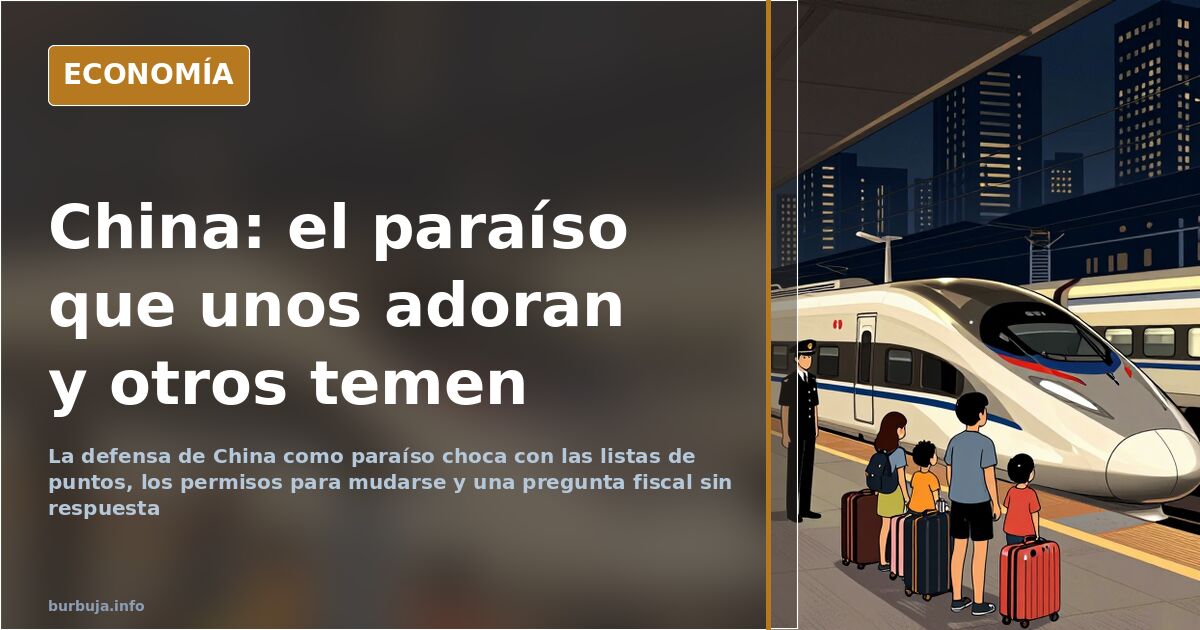
China markets itself as the world’s best place to live
For some proponents, China’s social credit system is not the total surveillance machine depicted in Europe; at best, it is an exaggerated delinquent list. This thesis has circulated for years and resurfaces whenever the model of new Chinese cities—aimed at leading the future—is discussed. The debate begins with unqualified praise—absolute welfare, quality, freedom, superiority—and ends, inevitably, with taxes, points, and permits. Those defending the Chinese model as a leader to trinc must address an uncomfortable question: if it is so good, why do those who know it firsthand choose to leave?
What the Chinese social credit system really is
The crux lies here. Contrary to the image of a score determining metro access, the mechanism is argued to concern payments and credit access, exactly like a delinquent list. The repeated example: with over 550 points, citizens can charge on credit and defer payment; below that, immediate payment is required. The pavor, they ironize, is the same suffered by anyone with a bounced check.
The objection comes from the opposite flank. Anyone needing a permit to move city or neighborhood had better not anger their boss, lest they end up on a blacklist. Access to public transport, certain venues, or even refueling depends on accumulating "good citizen" points. Two incompatible narratives about the same reality, neither willing to yield: for some, it is the Eurasia tale; for others, propaganda discounted by Chinese citizens themselves. No one disputes the system’s existence. What is debated—and never settled—is its scope.
"China is pure anarcho-capitalism": the disorienting thesis
The shock comes when describing the Chinese model as pure anarcho-capitalism. Low taxes, minimal bureaucracy, individual responsibility, legal certainty, meritocracy, no subsidies or benefits. This clashes head-on with Western perceptions, and the rebuttal is swift: packaging such contradictions into one argument takes skill.
The reasoning’s core differs and deserves separation. Some argue full employment reduces worker control: when labor is scarce, a boss’s slight misstep prompts resignation and job-switching. Coercion, in this view, stems not from the state but antiestéticar of income loss. Here, comparisons with Europe begin to sting.
Taxes: the unanswered question
Fiscal debate is dismissed in one line: how many taxes Europeans pay versus Chinese. The no further questions, your honor is the entire argument. The problem is comparisons often stem from tourism, not residency.
On the other side lie bureaucracy, point lists, and feeling constantly tracked. A system that, per one version, merely rewards good taxpayers, and per another, governs daily decisions. Meanwhile, the EU is portrayed as where citizens are guilty by default: for eating meat, owning cars, lacking eco-resilience.
Suburbs and flying cars
New Chinese cities’ showcase coexists with less segarro realities. Poverty appears in big-city outskirts; new hubs rise in nowhere instead of rehabilitating existing neighborhoods; mass-produced goods’ quality—from shoes to infrastructure—is criticized. It is painting main avenues while hiding what’s behind. Against this, the narrative’s magnetism: streets without US-style marginality scenes and sci-fi projects like supposedly tested flying cars.
Real migration flows also debunk static images. Some recall Chinese citizens wait ten years for US green cards, millions applying; others cite reverse experiences: at industry fairs, two visitors separately proposed marriage to exhibitors to escape the country. Told as proof of paradise, the anecdote reads oppositely.
Long-term residents nuance both versions. Ten years living there, mixed couples known afterward: none asked partners to flee; they stayed, raising children as Chinese. Conversely, families displaced two years by shoe industry seek companies avoiding trade with the country upon return.
With these materials, debate stagnates. Verifiable evidence coexists with unverifiable anecdotes and untouchable mental frameworks. If the showcase mirrors European shortcomings, comparison intensity won’t drop soon; likely unresolved is whether the model is admired for what it offers or denies.
For some proponents, China’s social credit system is not the total surveillance machine depicted in Europe; at best, it is an exaggerated delinquent list. This thesis has circulated for years and resurfaces whenever the model of new Chinese cities—aimed at leading the future—is discussed. The debate begins with unqualified praise—absolute welfare, quality, freedom, superiority—and ends, inevitably, with taxes, points, and permits. Those defending the Chinese model as a leader to trinc must address an uncomfortable question: if it is so good, why do those who know it firsthand choose to leave?
What the Chinese social credit system really is
The crux lies here. Contrary to the image of a score determining metro access, the mechanism is argued to concern payments and credit access, exactly like a delinquent list. The repeated example: with over 550 points, citizens can charge on credit and defer payment; below that, immediate payment is required. The pavor, they ironize, is the same suffered by anyone with a bounced check.
The objection comes from the opposite flank. Anyone needing a permit to move city or neighborhood had better not anger their boss, lest they end up on a blacklist. Access to public transport, certain venues, or even refueling depends on accumulating "good citizen" points. Two incompatible narratives about the same reality, neither willing to yield: for some, it is the Eurasia tale; for others, propaganda discounted by Chinese citizens themselves. No one disputes the system’s existence. What is debated—and never settled—is its scope.
"China is pure anarcho-capitalism": the disorienting thesis
The shock comes when describing the Chinese model as pure anarcho-capitalism. Low taxes, minimal bureaucracy, individual responsibility, legal certainty, meritocracy, no subsidies or benefits. This clashes head-on with Western perceptions, and the rebuttal is swift: packaging such contradictions into one argument takes skill.
The reasoning’s core differs and deserves separation. Some argue full employment reduces worker control: when labor is scarce, a boss’s slight misstep prompts resignation and job-switching. Coercion, in this view, stems not from the state but antiestéticar of income loss. Here, comparisons with Europe begin to sting.
Taxes: the unanswered question
Fiscal debate is dismissed in one line: how many taxes Europeans pay versus Chinese. The no further questions, your honor is the entire argument. The problem is comparisons often stem from tourism, not residency.
On the other side lie bureaucracy, point lists, and feeling constantly tracked. A system that, per one version, merely rewards good taxpayers, and per another, governs daily decisions. Meanwhile, the EU is portrayed as where citizens are guilty by default: for eating meat, owning cars, lacking eco-resilience.
Suburbs and flying cars
New Chinese cities’ showcase coexists with less segarro realities. Poverty appears in big-city outskirts; new hubs rise in nowhere instead of rehabilitating existing neighborhoods; mass-produced goods’ quality—from shoes to infrastructure—is criticized. It is painting main avenues while hiding what’s behind. Against this, the narrative’s magnetism: streets without US-style marginality scenes and sci-fi projects like supposedly tested flying cars.
Real migration flows also debunk static images. Some recall Chinese citizens wait ten years for US green cards, millions applying; others cite reverse experiences: at industry fairs, two visitors separately proposed marriage to exhibitors to escape the country. Told as proof of paradise, the anecdote reads oppositely.
Long-term residents nuance both versions. Ten years living there, mixed couples known afterward: none asked partners to flee; they stayed, raising children as Chinese. Conversely, families displaced two years by shoe industry seek companies avoiding trade with the country upon return.
With these materials, debate stagnates. Verifiable evidence coexists with unverifiable anecdotes and untouchable mental frameworks. If the showcase mirrors European shortcomings, comparison intensity won’t drop soon; likely unresolved is whether the model is admired for what it offers or denies.
Also available in: Deutsch
Summary of a discussion on Burbuja.info - Foro de economía, actualidad y política., translated from Spanish and reviewed before publication. Read the full discussion (175 replies).
More summaries
-
Chinese AI Challenges Western Tech Dominance
Chinese AI challenges Western tech giants with powerful open-source models.
-
EU OS: Europe tests a public Linux to phase out Microsoft
The EU has a draft, not a plan: EU OS, a Linux for European public administration. The cost, the Fedora origin, and the regional precedent are under review.
-
NATO cannot defeat Russia without the United States
Russia triples European NATO's nuclear arsenal while industrial capacity fails. Without the US, the Alliance is hollow.
-
Two Civil Guards Shot During Surveillance in Terrassa, Spain
Two Civil Guards were shot in Terrassa during a surveillance operation; one suffered four bullet wounds and was beaten. The incident highlights security concerns in Spain.
-
Spain Reservoirs Hit Record High as Contrail Debate Fades
Spanish reservoirs reach ~72% capacity amid claims that persistent contrails have vanished, reigniting debates on cloud seeding and USAID funding cuts.
-
Canary Islanders: White Europeans or Light-Skinned Africans?
Debate suggests most Canary Islanders descend from Castilian settlers, with North African and Sub-Saharan contributions.