
China’s Hegemony Without War: Forum Thesis
CIC managed $813bn in reserves and Chinese cars lead Spain sales, supporting the view that Beijing wins without firing a shot.
English · Original discussion in Spanish · Published
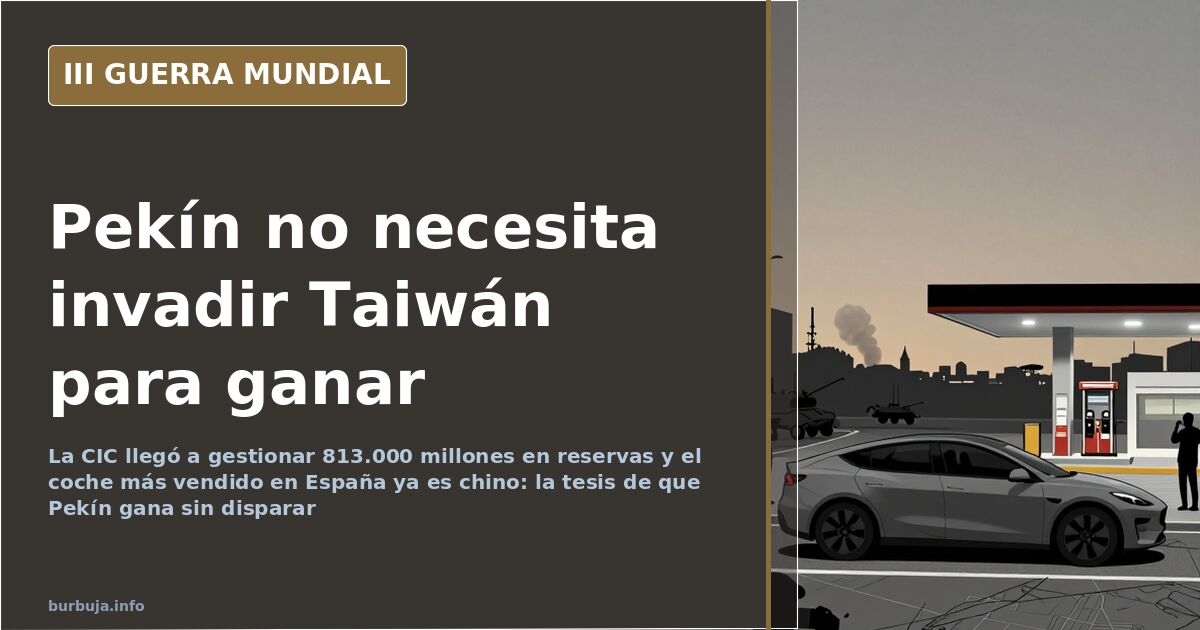
China doesn't need to invade Taiwan to win this war
Two open fronts, a military machine consuming nearly half of the US federal budget, and a power that, for now, fires no shots. This is the scenario underpinning the most repeated thesis when discussing China's hegemony: Beijing does not need to invade Taiwan to impose itself. It is enough that others wear themselves out. The idea, formulated with more vehemence than rigor in many sections, rests on a simple reading: every foreign crisis is a piece falling on the Chinese side, and the only necessary move is silence.
Ukraine and Gaza: The Math Doesn't Add Up
The argument starts with the double front. With Ukraine sustained by Western deliveries and the Middle East in flames, some calculate that US coffers are entering deficit and Washington will have to choose: let Kiev or Israel fall. That dilemma, which no one has formally established in practice, is the heart of the narrative. It is also argued that China plans in the shadows with a parsimony its rivals cannot afford.
There is no consensus on the origin of the conflict in Gaza. One current suggests the offensive was a play by Beijing, due to its alleged planning excellence; another replies that the Israeli foreign service sought to conquer Palestinian territory afterward. These are hypotheses without public proof and should be treated as such. What is verifiable is that the distribution of the bill is already openly debated: some point out that Canada will continue paying, while others say Europe will via inflation.
Why Is It Said That Taiwan Will Fall Without A Shot?
Here the thesis becomes more concrete. It is argued that China does not need to prepare a naval invasion—a task for which, according to some analyses, it lacks experience—because intelligence services do the work: generating just enough propaganda so that the pro-Chinese party wins and a democratic transition toward Beijing's orbit occurs. The precedent cited is Hong Kong, absorbed without a single shot fired.
The thesis has serious counterarguments. The most repeated is South Korea: 50 million inhabitants well armed against a neighbor of 25 million equipped poorly, with deployed US ground troops. And Japan, which operates as a separate case. On this flank, the most cited conclusion is that Beijing only needs to play the defensive card and let the economy do the rest: offshoring of companies, commercial expansion, and control of energy resources.
The Dollar, CIC, And Partners Who Are Not Allies
The financial support is where the numbers appear. The China Investment Corporation reached managing $813 billion in foreign exchange reserves, according to data used for 2015. Its advisory board includes executives linked to major US banks, fueling the idea of an entanglement difficult to break. Some go further and argue that a known European banking firm entered the redistribution of those reserves starting in 2013; this is an unverified claim.
From there comes the second axis: BRICS and dedollarization. "As more global transactions stop being made in dollars—one of the most read interventions summarizes—that American debt can no longer be created from nothing." The corollary is that China has partners, not allies: convenience pacts against a common objective that dissolve once fulfilled. The intuition is not new either: for decades there has been speculation about an understanding between Beijing and the Sarracinic world, the one Samuel Huntington placed at the center of his clash of civilizations.
Europe, The One Paying For The Party
For the continent, the dominant forecast is grim. Europe appears described as a colony rather than an ally, and it is taken for granted that it will continue positioning itself in favor of third parties while inflation devours it. There even appears suspicion that the Old Continent may become a scene for recurrent attacks to justify growing military control. It should be said bluntly: there is no evidence backing that antiestéticar.
The alternative considered is true geopolitics: a Mediterranean alliance, perhaps alongside Poland and Hungary, to exert joint pressure and escape the ship before it sinks. No one dares to say what will come first.
When Geopolitics Crosses With Culture War
Part of the analysis mixes planes. It is argued that Chinese victory would bring the end of what is described as imported social engineering, and cites as an indicator a European population with testosterone levels of 265 points. It is a terrain where data is scarce and where geopolitics functions as an alibi for another malaise. That Beijing gains global weight says nothing, by itself, about what happens within European borders.
The broadest consensus, in any case, is that Beijing does not deploy military bases nor goes out to defend its way of life with guns: it prefers buying companies, supplies, and wills.
The Data That Disorients
While all this is discussed, there is a domestic indicator that requires no interpretation: the best-selling car in Spain is already Chinese, and there is not a single Spanish brand in the country that assembles 5% of the world's automobiles. Without armies, without bases, and without a single shot. Perhaps victory does not need to be announced: it registers itself.
Also available in: Deutsch
Summary of a discussion on Burbuja.info - Foro de economía, actualidad y política., translated from Spanish and reviewed before publication. Read the full discussion (166 replies).
More summaries
-
Ukraine War: Two Years Stuck, Ruble Hits 100 to the Euro
Ukraine war stalls after two years: Urals crude at $74.50 vs. Brent at $81.62, ruble at 100/euro. Focus shifts to endurance.
-
Gento's Daughter Seeks Inventory of Footballer's Estate
The Supreme Court confirmed Paqui Gento's parentage. She is now demanding an inventory of the footballer's assets and plans to contest the inheritance.
-
Ukraine War Drags to 2027, Trump Faces Political Erosion
Forum users debate the stalled siege of Sloviansk and Kramatorsk, Trump’s electoral costs, and Iran war impacts on oil prices.
-
Putin predicts European elites will 'wag tails' for Trump
Putin claims European politicians will submit to Trump, stating they will soon side with their master and wag their tails affectionately.
-
US Republicans Propose Military Force Against Mexican Cartels
Two US Republican lawmakers propose authorizing military force against Mexican drug cartels. Mexico rejects the initiative.
-
NATO M777 artillery debuts in Ukraine, shifting front lines
Videos confirm M777 and Excalibur use in Ukraine; experts debate precision impact versus Russian attrition.