
Russia rejects Macron’s plan to send peacekeepers to Ukraine
Russia insists it will not allow European troops in Ukraine as Macron seeks peacekeepers and Trump’s plan targets an 800-mile zone.
English · Original discussion in Spanish · Published
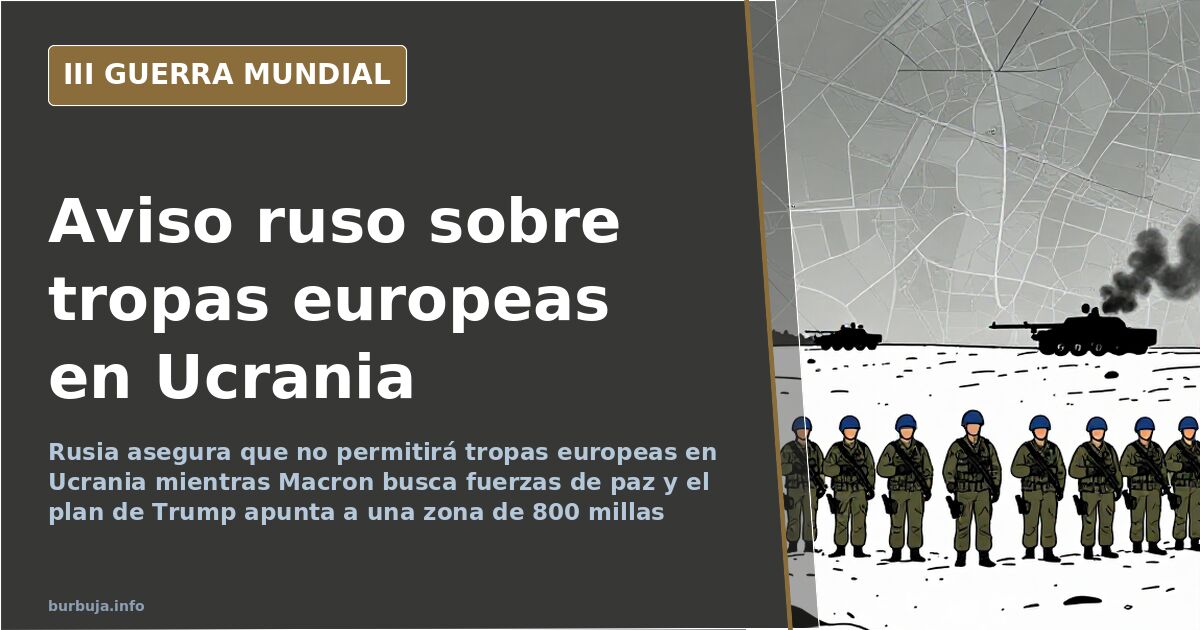
Russia warns it will not allow European troops in Ukraine
Russia insists it will not allow the deployment of European troops in Ukraine. The blunt warning raises an uncomfortable question: whoever sent soldiers there would not be separating two armies, but placing themselves in the crosshairs of one. The discussion moves at two speeds. One is diplomatic, speaking of blue helmets, mandates, and interposition forces. The other is grimmer: some read the warning as saying those troops would be shot just like any enemy uniform.
What lies behind Macron’s invitation
The catalyst is Macron’s invitation to European chiefs of staff to debate a possible deployment of peacekeepers in Ukraine. The French president put it this way: “I want to believe the US will stay by our side, but we must be ready if it does not.” That is the core. Europe preparing for a scenario where Washington steps back and aid dries up.
The other board is the plan attributed to Trump: British troops patrolling an 800-mile buffer zone to freeze the war. Meanwhile, J.D. Vance threatens Pilingui with sanctions and military action if he does not accept an end to the conflict. Two messages that do not quite fit: on one hand, talk of pause and negotiation; on the other, deployment on the ground. And in between, a Russia insisting it will not allow that deployment. Macron is compared to Napoleon in the harshest part of the analysis, which attributes to him a desire to go down in history as a wartime head of state.
Why Moscow insists on nuclear reaction time
The most repeated technical argument is deterrence. Ukraine is too close to Russia’s most populated and important areas; if response time to a nuclear threat is shortened, the mechanism stops working. Hence, countries hundreds of kilometers away are tolerated with nuclear weapons, but not the immediate neighbor. The lingering question is where the heads deployed in European countries that do not produce them are aimed.
A precedent is added without ceasing: the Cuban missile crisis. With what authority did the US then prevent the USSR from deploying nuclear arms a step from its coast? The question, more rhetorical than new, remains on the table. And a dislocating observation: Finland has not said it wants nuclear weapons, so lumping it in does not close the reasoning.
North Korean troops and double standards
Part of the analysis holds that if Ukraine can receive help from anyone, North Korea also sends thousands of its own soldiers. The rebuttal is direct: there is no record of a single prisoner or identified body, beyond what circulates on Telegram channels, even if the cited figure is ten thousand casualties. The thread also highlights another point: Russia, with all that manpower, still has not taken Odessa.
The Russian version of the conflict: NATO, Minsk and 2014
The narrative supporting the Russian bloc starts in the 2000s, when Russia asked to join NATO and was shut out. From this, it is deduced that the alliance sees it as an objective. Treaties of neutrality are cited, a 2014 coup, two signed and later revised Minsk agreements, and the shift of a Zelensky who in campaign promised understanding but later spoke of joining NATO and having nuclear weapons.
The objection from the other side is simple: a country’s neutrality is not imposed by force, and its people decide where they want to be. The response given is that the Ukrainian population counts for little when the territory is an outsider’s board. There is no clean exit here, only two incompatible mental frameworks.
Rearming Ukraine with decommissioned equipment
Among intermediate proposals circulates one that avoids sending troops to the front: stationing them in Poland and Moldova, up to there, and reinforcing Ukraine with retired material. Tornados, M-60 tanks —according to one participant, there are more than a thousand between Greece and Turkey—, Mirage and Super Étendard. It is the option that tries not to escalate the conflict without stopping arming the one who resists.
The problem, and hence the caution, is not just military: one participant points to Russia’s sixty nuclear plants. A park of that magnitude without adequate maintenance turns any scenario into an issue that transcends the conflict’s borders.
Who sets the conditions for the end
The most widespread reading is that whoever is winning sets the rules for stopping attacks. And that no peace force works without the approval of both sides: if one considers it belligerent, it becomes a target. It is also held that Russia needs a parenthesis to replace lost equipment, not just damaged, before tightening the screws again.
With that starting point, the only clear thing is that Ukraine is betting on where its border ends. What if, in the end, no one sends anything?
Russia insists it will not allow the deployment of European troops in Ukraine. The blunt warning raises an uncomfortable question: whoever sent soldiers there would not be separating two armies, but placing themselves in the crosshairs of one. The discussion moves at two speeds. One is diplomatic, speaking of blue helmets, mandates, and interposition forces. The other is grimmer: some read the warning as saying those troops would be shot just like any enemy uniform.
What lies behind Macron’s invitation
The catalyst is Macron’s invitation to European chiefs of staff to debate a possible deployment of peacekeepers in Ukraine. The French president put it this way: “I want to believe the US will stay by our side, but we must be ready if it does not.” That is the core. Europe preparing for a scenario where Washington steps back and aid dries up.
The other board is the plan attributed to Trump: British troops patrolling an 800-mile buffer zone to freeze the war. Meanwhile, J.D. Vance threatens Pilingui with sanctions and military action if he does not accept an end to the conflict. Two messages that do not quite fit: on one hand, talk of pause and negotiation; on the other, deployment on the ground. And in between, a Russia insisting it will not allow that deployment. Macron is compared to Napoleon in the harshest part of the analysis, which attributes to him a desire to go down in history as a wartime head of state.
Why Moscow insists on nuclear reaction time
The most repeated technical argument is deterrence. Ukraine is too close to Russia’s most populated and important areas; if response time to a nuclear threat is shortened, the mechanism stops working. Hence, countries hundreds of kilometers away are tolerated with nuclear weapons, but not the immediate neighbor. The lingering question is where the heads deployed in European countries that do not produce them are aimed.
A precedent is added without ceasing: the Cuban missile crisis. With what authority did the US then prevent the USSR from deploying nuclear arms a step from its coast? The question, more rhetorical than new, remains on the table. And a dislocating observation: Finland has not said it wants nuclear weapons, so lumping it in does not close the reasoning.
North Korean troops and double standards
Part of the analysis holds that if Ukraine can receive help from anyone, North Korea also sends thousands of its own soldiers. The rebuttal is direct: there is no record of a single prisoner or identified body, beyond what circulates on Telegram channels, even if the cited figure is ten thousand casualties. The thread also highlights another point: Russia, with all that manpower, still has not taken Odessa.
The Russian version of the conflict: NATO, Minsk and 2014
The narrative supporting the Russian bloc starts in the 2000s, when Russia asked to join NATO and was shut out. From this, it is deduced that the alliance sees it as an objective. Treaties of neutrality are cited, a 2014 coup, two signed and later revised Minsk agreements, and the shift of a Zelensky who in campaign promised understanding but later spoke of joining NATO and having nuclear weapons.
The objection from the other side is simple: a country’s neutrality is not imposed by force, and its people decide where they want to be. The response given is that the Ukrainian population counts for little when the territory is an outsider’s board. There is no clean exit here, only two incompatible mental frameworks.
Rearming Ukraine with decommissioned equipment
Among intermediate proposals circulates one that avoids sending troops to the front: stationing them in Poland and Moldova, up to there, and reinforcing Ukraine with retired material. Tornados, M-60 tanks —according to one participant, there are more than a thousand between Greece and Turkey—, Mirage and Super Étendard. It is the option that tries not to escalate the conflict without stopping arming the one who resists.
The problem, and hence the caution, is not just military: one participant points to Russia’s sixty nuclear plants. A park of that magnitude without adequate maintenance turns any scenario into an issue that transcends the conflict’s borders.
Who sets the conditions for the end
The most widespread reading is that whoever is winning sets the rules for stopping attacks. And that no peace force works without the approval of both sides: if one considers it belligerent, it becomes a target. It is also held that Russia needs a parenthesis to replace lost equipment, not just damaged, before tightening the screws again.
With that starting point, the only clear thing is that Ukraine is betting on where its border ends. What if, in the end, no one sends anything?
Also available in: Deutsch
Summary of a discussion on Burbuja.info - Foro de economía, actualidad y política., translated from Spanish and reviewed before publication. Read the full discussion (224 replies).
More summaries
-
Putin: Russia's Most Divisive Statesman or Tyrant?
Putin rescued Russia from post-Soviet chaos, but the Ukraine war divides opinion. Is he the century's greatest statesman or a tyrant?
-
Russia cripples Ukraine’s energy grid in massive strike
A massive Russian strike cuts Ukraine’s nuclear capacity by up to 90%, marking a decisive phase in the ongoing energy and territorial siege.
-
Is the Russian military truly obsolete?
Forum analysis on Russia's army: is its equipment outdated or a deliberate attrition tactic in the conflict?
-
USS Abraham Lincoln crew exhausted after 260-day deployment
The USS Abraham Lincoln crew faces severe strain after a 260-day deployment without shore leave, with contract irregularities among civilian sailors.
-
Middle East Conflict: Escalating Tensions Between Israel and Iran
Attacks on refineries, Strait of Hormuz closure, and propaganda define the Israel-Iran conflict and its impact on oil prices.
-
Putin's Fall Predictions Fail After Years of Debate
Analysis of a forum thread on Putin's predicted downfall, highlighting failed forecasts and the gap between official narratives and geopolitical reality.