
China breaks nuclear fusion record with 1,066 seconds
China sustains a fusion plasma for 1,066 seconds, shattering its own record. With ITER delayed, who will lead future energy?
English · Original discussion in Spanish · Published
China breaks nuclear fusion record with 1,066 seconds
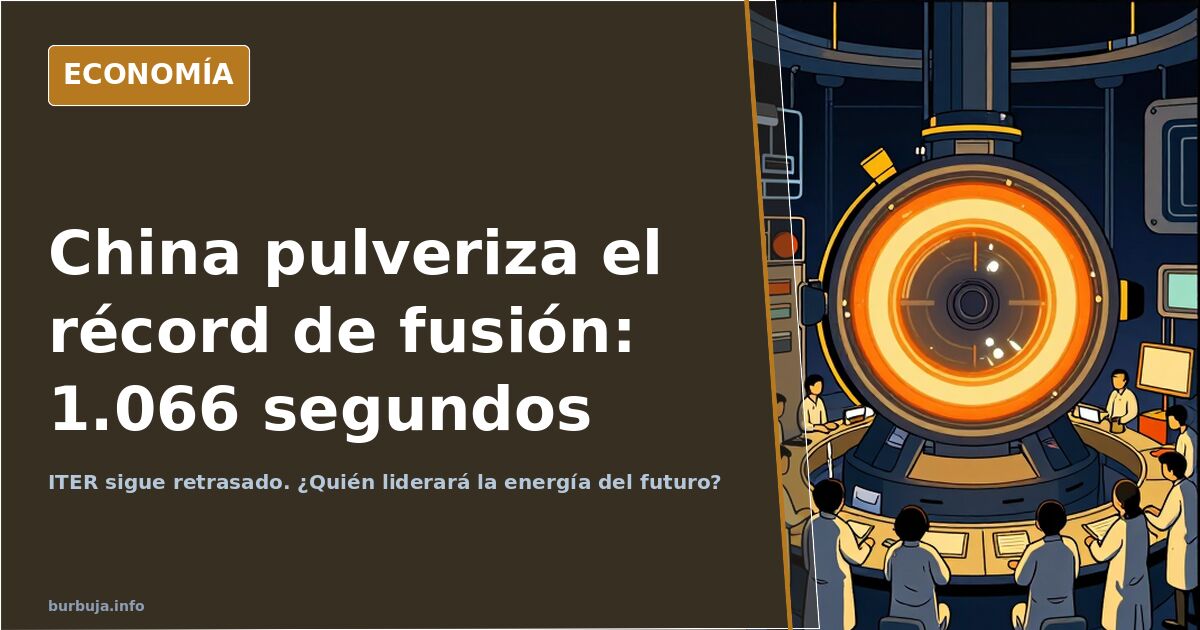
The experimental EAST reactor, an advanced superconducting tokamak, maintained a high-confinement steady-state plasma for 1,066 seconds. This figure does not come from a Western laboratory: it crushes the previous record of 403 seconds, which was also held by China. While the international ITER project accumulates delays, China's artificial sun advances in the only short-term metric that matters: confinement duration. The question is not whether fusion will arrive, but who will lay the first commercial cornerstone and at what price.
What sustaining a plasma for 1,066 seconds really means
A tokamak is not a power plant. It is a machine attempting to reproduce what occurs in the Sun's core: confining gas at impossible temperatures using magnetic fields. The EAST record does not imply net electricity generation, far from it. What it demonstrates is the ability to sustain stable plasma for more than seventeen minutes, an essential prerequisite for a viable commercial reactor.
The problem is that this plasma does not yet self-heat. In a real reactor, the fusion process itself must generate the heat needed to maintain the reaction. EAST studies confinement physics, not energy production. Some argue this is an engineering milestone; others point out that without net energy gain, the headline is propaganda. Both have a point.
ITER, the white elephant that won't start
While China celebrates, the ITER project in Cadarache (France) continues to accumulate delays. The international consortium, involving the EU, US, Russia, China, India, Japan, and South Korea, should have been operational years ago. Critics cite design flaws, administrative standstills, and magnet technology some consider obsolete compared to the superconductors used in the Chinese reactor.
ITER's cost is measured in billions of euros. The return, so far, is zero. Some defend that basic research isn't measured in accounting balances; others respond that when a project drags on without results, it ceases to be science and becomes a subsidy. The comparison with EAST is inevitable: while one breaks records, the other breaks delay benchmarks.
The dream of infinite energy and its physical limits
Nuclear fusion promises something no other technology has achieved: practically inexhaustible fuel and no long-lived waste. But there is a gap between that and "unlimited electricity." Matter is a form of energy, yes, but extracting and transforming it requires infrastructure, minerals, and water. Cheap energy does not eliminate geological limitations or those of fertile soil.
The debate over Jevons' paradox looms: if energy becomes cheaper, consumption does not drop, it rises. More desalination plants, more mining, more industrial production. The result could be runaway growth with severe environmental impact. This is not an argument against fusion, but against the naivety of believing it will solve all problems on its own.
The geopolitics of energy that hasn't arrived
Technological dominance in fusion would have enormous geopolitical consequences. Whoever controls unlimited energy controls the global economy. The US has based part of its power on oil; Russia, on gas. A commercial fusion reactor in China would change the board. That is why some analysts argue that the West has neglected research due to short-term economic interests.
The reality is more prosaic: fusion is difficult and expensive. China invests because it can afford long timelines without immediate returns. Market economies demand quarterly results. This asymmetry explains why technological leadership is shifting eastward in long-cycle sectors.
When will there be a grid-connected fusion reactor?
No one knows for certain. The most optimistic forecasts speak of 2035 for an experimental reactor connected to the grid. The most realistic ones suggest several decades. ITER itself acknowledges that its goal is not to generate commercial electricity, but to demonstrate scientific viability. Commercial fusion is another leap, still without a date.
Meanwhile, renewables are advancing at a pace that seemed impossible a decade ago. Solar and wind installed capacity in China already exceeds 1,400 GW, a figure equivalent to the output of dozens of nuclear plants. Fusion does not compete with them today; it competes with the future. And that future, for now, remains decades away.
Is it worth continuing to invest billions in a dream that is always twenty years away?
Also available in: Deutsch
Summary of a discussion on Burbuja.info - Foro de economía, actualidad y política., translated from Spanish and reviewed before publication. Read the full discussion (178 replies).
More summaries
-
Spain's shrinking industry halts as renewables falter
Lower summer wind output and a 35% cut in curtailment payments are bringing Spanish industry to a standstill. Meanwhile, nuclear's future is being decided behind closed doors.
-
Lockheed's 10-Year Nuclear Fusion Promise: A Decade Later, Nothing
Lockheed Martin promised a 100 MW fusion reactor by 2024. Eleven years later, it still does not exist, and the tritium bottleneck remains unresolved.
-
Spain Blackout: Nuclear Shutdown Amid Renewable Surge
Forum debate on the Iberian Peninsula blackout: renewables, nuclear backup, prices, and grid stability. No official cause confirmed.
-
Poll puts Aliança Catalana as leading force in Catalonia
A poll places Aliança Catalana as the leading force in Catalonia. The result fragments the vote and leaves governability in a mathematical deadlock, according to...
-
Galicia sells off its industry: from Avícola Tratante to Aludec
Avícola Tratante, Aludec, Ochoa, Martínez Otero: foreign capital is buying up Galician companies; forum users point to the lack of generational succession
-
Vox and PSOE: the deal no one confirms but everyone talks about
A tweet claims Vox has a deal with Spain's PSOE without providing any evidence. The claim is stirring up a campaign in which, some say, Vox is rising and the PP fears being overtaken.